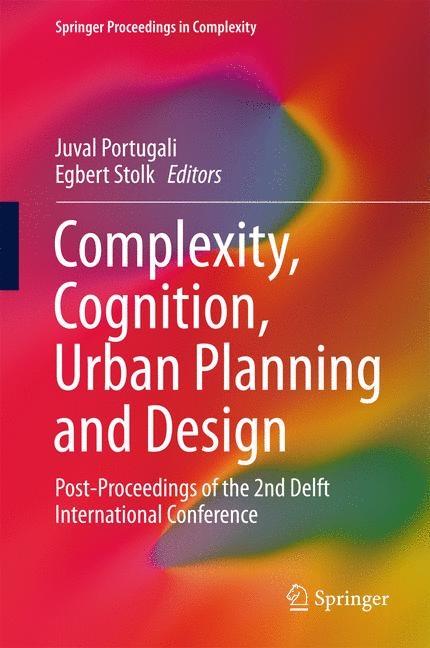
Complexity, Cognition, Urban Planning and Design (eBook)
XXVI, 316 Seiten
Springer International Publishing (Verlag)
978-3-319-32653-5 (ISBN)
Introduction.- Part I: Complexity, Cognition and Cities.- 1. What makes cities complex?.- 2. Evolving a Plan: Design and Planning with Complexity.- 3. Self-organization and design as complementary pair.- 4. Cultivating complexity: The need for a shift in cognition.- 5. The fourth sustainability, creativity: Statistical associations and credible mechanism.- 6. Design thinking as principles for the structure of creative cities.- Part II: On Termites, Rats and Cities.- 7. Swarm cognition and swarm construction. Lessons from a social insect master builder.- 8. Physical, Behavioral, and Spatiotemporal Perspectives of Home in Humans and other Animals.- Part III: Complexity, Cognition and Planning.- 9. Framing the Planning Game: A cognitive understanding of the planner’s rationale in a differentiated world.- 10. Global scale predictions of cities in urban and in cognitive planning.- 11. Emotional cognition and urban planning.- Part IV: Complexity, Cognition and Design.- 12. A Complexity-Cognitive view on Scale in Urban Design.- 13. Lines: Orderly and Messy.
| Erscheint lt. Verlag | 19.5.2016 |
|---|---|
| Reihe/Serie | Springer Proceedings in Complexity | Springer Proceedings in Complexity |
| Zusatzinfo | XXVI, 316 p. 110 illus., 63 illus. in color. |
| Verlagsort | Cham |
| Sprache | englisch |
| Themenwelt | Sozialwissenschaften ► Politik / Verwaltung |
| Technik ► Architektur | |
| Wirtschaft ► Volkswirtschaftslehre | |
| Schlagworte | Artificial-natural Complex Systems • Complexity • Complexity Theories of Cities • Complex Urbanism • Emotional Cognition in Urban Design • Self-organizing Cities • urban geography and urbanism • Urban Planning and Development |
| ISBN-10 | 3-319-32653-8 / 3319326538 |
| ISBN-13 | 978-3-319-32653-5 / 9783319326535 |
| Informationen gemäß Produktsicherheitsverordnung (GPSR) | |
| Haben Sie eine Frage zum Produkt? |
 PDF (Wasserzeichen)
DRM: Digitales Wasserzeichen
Dieses eBook enthält ein digitales Wasserzeichen und ist damit für Sie personalisiert. Bei einer missbräuchlichen Weitergabe des eBooks an Dritte ist eine Rückverfolgung an die Quelle möglich.
Dateiformat: PDF (Portable Document Format)
Mit einem festen Seitenlayout eignet sich die PDF besonders für Fachbücher mit Spalten, Tabellen und Abbildungen. Eine PDF kann auf fast allen Geräten angezeigt werden, ist aber für kleine Displays (Smartphone, eReader) nur eingeschränkt geeignet.
Systemvoraussetzungen:
PC/Mac: Mit einem PC oder Mac können Sie dieses eBook lesen. Sie benötigen dafür einen PDF-Viewer - z.B. den Adobe Reader oder Adobe Digital Editions.
eReader: Dieses eBook kann mit (fast) allen eBook-Readern gelesen werden. Mit dem amazon-Kindle ist es aber nicht kompatibel.
Smartphone/Tablet: Egal ob Apple oder Android, dieses eBook können Sie lesen. Sie benötigen dafür einen PDF-Viewer - z.B. die kostenlose Adobe Digital Editions-App.
Buying eBooks from abroad
For tax law reasons we can sell eBooks just within Germany and Switzerland. Regrettably we cannot fulfill eBook-orders from other countries.
aus dem Bereich