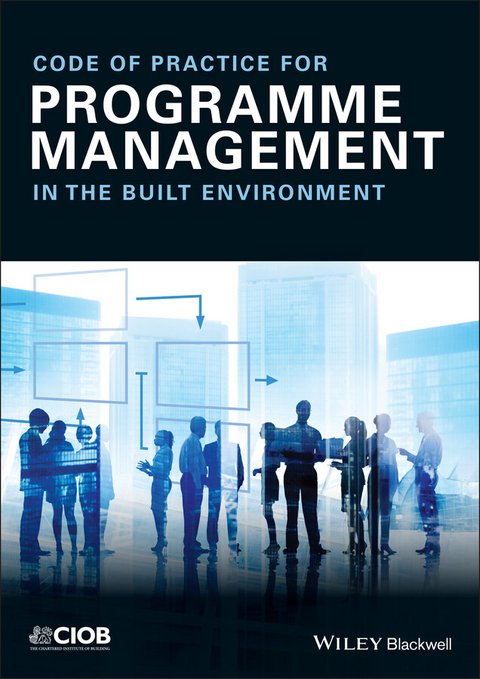
Code of Practice for Programme Management (eBook)
192 Seiten
Wiley-Blackwell (Verlag)
978-1-118-71784-4 (ISBN)
About the CIOB
The Chartered Institute of Building is at the heart of a management career in construction. It is the world's largest and most influential professional body for construction management and leadership, with a Royal Charter to promote the science and practice of building and construction for the benefit of society. With over 48,000 members worldwide, the CIOB is the international voice of the building professional.
About the CIOB The Chartered Institute of Building is at the heart of a management career in construction. It is the world's largest and most influential professional body for construction management and leadership, with a Royal Charter to promote the science and practice of building and construction for the benefit of society. With over 48,000 members worldwide, the CIOB is the international voice of the building professional.
1
The Context of Programme Management
- What are projects, programmes and portfolios?
- Why is there a need for programme management in the built environment?
- What are the contextual issues for programme management in built environment?
- What are the types of programmes?
- What are the stages of programme management?
- How is a programme organisation structured?
- What is the importance of stakeholders in programme management?
1.1 Definitions of projects, programmes and portfolios
Project
Projects are needed in every industrial sector, and several definitions of the term ‘project’ exist today. Some of the most commonly used definitions are listed below:
A unique set of co-ordinated activities, with definite starting and finishing points, undertaken by an individual or organization to meet specific objectives within defined schedule, cost and performance parameters. ISO 21500: 2012/BS 6079 – 1:2010
A project is a time and cost constrained operation to realize a set of defined deliverables (the scope to fulfil the project’s objectives) up to quality standards and requirements. International Project Management Association (IPMA)1
A unique, transient endeavour undertaken to achieve planned objectives. Association for Project Management (APM)2
A temporary endeavour undertaken to create a unique product, service or result. Project Management Institute (PMI)3
These definitions collectively recognise temporary and transient nature as the two fundamental characteristic of a project. Projects are temporary in that they have a definitive start and an end. They are also transient because they are completed as the organisation moves from one project to another at a different location and so on. Projects are created to achieve agreed objectives and produce and deliver a product, service or result. The involved parties need to agree to the objectives, and the partner tasked with achieving the objectives needs to first produce and finally deliver what has been set in the objectives.
The CIOB Code of Practice for Project Management (fifth ed., p. 317) defines project as:
A unique process, consisting of a set of co-ordinated and controlled activities with start and finish dates, undertaken to achieve an objective conforming to specific requirements, including constraints of time, cost and resources.
The task of project management is to bring in at the right time and co-ordinate many different professionals and specialists to enable them to achieve the agreed objectives. To do this effectively, project managers need to manage key business functions for a project.
Programme
Programme is different from a project, but the two terms are often used interchangeably. Some of the notable existing definitions recognise the following:
“A programme is designed as a temporary flexible organisation structure created to coordinate, direct and oversee the implementation of a set of related projects and activities in order to deliver outcomes and benefits related to the organisation’s strategic objectives.” Business Innovation and Skills (BIS)
“A program is a group of related projects managed in a coordinated manner to obtain benefits and control NOT available from managing them individually. Programs may include elements of related work outside of the scope of the discreet projects in the program… Some projects within a program can deliver useful incremental benefits to the organization before the program itself has completed.” PMI
“A group of related projects and change management activities that together achieve beneficial change for an organisation.” APM
Programmes comprise multiple related projects, and that by itself makes a programme distinctly different from a project. Programmes are often ongoing, with a number of milestones, and do not necessarily have the strictly finite nature of a project. Even when a programme has an end date, the time scheduled is normally far longer than any project within this programme. Unlike projects, programmes are created for horizontal co-ordination of projects, which often run in parallel.
From a business and customer perspective, a programme is a temporary organisation designed to operate, learn and adapt in a complex environment of interrelated projects, people and organisations. In this context, the programme manager is the chief executive officer of a temporary organisation with the ability to carry the flame for what users want.
A programme therefore comprises a collective of related projects which are limited in time and designed to individually deliver agreed upon objectives and which produce and deliver a product, service or result. The coordinated manner by which they are managed delivers programme benefits that are greater than the sum of individual project benefits were they not coordinated at the programme level. Success of a programme is thus dependent on a programme team’s ability to deliver those benefits.
In the context of construction, CIOB defines a programme in the following way:
A programme is a collective of related projects coordinated to achieve desired benefits more effectively from managing them as a group of individual projects.
From a summary point of view, a business or a client define strategic objectives that are implemented through a programme of interrelated projects internally delivered or outsourced to specialist supplier and/or contractors.
Projects in a programme may be related in different ways. For example, a number of projects that collectively need to be managed to deliver a set of benefits in order to address client’s objectives are related through client or customer/end user (see Figure 1.1).
Figure 1.1 Establishing relatedness.
On the other hand, a number of projects that collectively need to be managed to deliver a set of benefits in order to address construction organisation’s strategic objectives are organisationally related (see Figure 1.2).
Figure 1.2 Organisationally related projects.
The task of programme management is to create and co-ordinate a collective of related projects in order to deliver programme benefits which would not be as achievable if they are managed as a group of individual projects.
Portfolio
The existing definitions of ‘portfolio’ recognise that organisations are involved in a number of programmes and projects at any given time that may or may not be related.
“The term Portfolio is used to describe the total set of programmes and stand-alone projects undertaken by an organisation.” BIS
“A [portfolio is a] grouping of an organisation’s projects, programmes. Portfolios can be managed at an organisational or functional level.” APM
“A portfolio is a collection of programs, projects and/or operations managed as a group. The components of a portfolio may not necessarily be interdependent or even related – but they are managed together as a group to achieve strategic objectives.” PMI
However, a portfolio is not a random collection. Organisations need to achieve their strategic objectives, so they carefully consider the kind of projects and programmes that constitute their portfolios. CIOB defines portfolio in the following way:
A portfolio is a total collection of programmes and stand-alone projects managed by an organisation to achieve strategic objectives.
The task of portfolio management is to manage and maintain all of an organisation’s projects and programmes to help achieve its strategic objectives. The organisation’s ongoing business may be project-based and/or require projects and programmes to achieve the desired change to sustain its business.
Figure 1.3 summarizes the key characteristics of project management, programme management and portfolio management as set out above.
Figure 1.3 Key characteristics for projects, programmes and portfolios.
1.2 Understanding programme management: is there a programme?
When is it a project?
An undertaking is considered and executed as a project when:
- the delivery criteria, scope, quality, cost and time can be defined and measured
- the delivery structure and methodology is known and available
The output/benefits resulting from the project may or may not deliver the total outcome required by the undertaking’s initiator.
When is it a programme?
An undertaking is considered and executed as a programme when:
- the delivery criteria may or may not be fully known, defined or approved
- the undertaking requires a high level of regulated governance
- achievement of the overall outcome required necessitates a number of related projects, each demanding different specialist skills, expertise or organisational approaches
- the size, complexity and uncertainty of the undertaking are such that delivery is best approached by creating a number of projects
- the delivery skills required are beyond the organisational and contractual arrangements for one team
- the...
| Erscheint lt. Verlag | 1.6.2016 |
|---|---|
| Sprache | englisch |
| Themenwelt | Technik ► Bauwesen |
| Wirtschaft ► Betriebswirtschaft / Management ► Unternehmensführung / Management | |
| Schlagworte | Baubetrieb • Bauingenieur- u. Bauwesen • Business & Management • Civil Engineering & Construction • Construction Management • Project Management • Projektmanagement • Wirtschaft u. Management |
| ISBN-10 | 1-118-71784-8 / 1118717848 |
| ISBN-13 | 978-1-118-71784-4 / 9781118717844 |
| Informationen gemäß Produktsicherheitsverordnung (GPSR) | |
| Haben Sie eine Frage zum Produkt? |
 EPUB (Adobe DRM)
Kopierschutz: Adobe-DRM
Adobe-DRM ist ein Kopierschutz, der das eBook vor Mißbrauch schützen soll. Dabei wird das eBook bereits beim Download auf Ihre persönliche Adobe-ID autorisiert. Lesen können Sie das eBook dann nur auf den Geräten, welche ebenfalls auf Ihre Adobe-ID registriert sind.
Details zum Adobe-DRM
Dateiformat: EPUB (Electronic Publication)
EPUB ist ein offener Standard für eBooks und eignet sich besonders zur Darstellung von Belletristik und Sachbüchern. Der Fließtext wird dynamisch an die Display- und Schriftgröße angepasst. Auch für mobile Lesegeräte ist EPUB daher gut geeignet.
Systemvoraussetzungen:
PC/Mac: Mit einem PC oder Mac können Sie dieses eBook lesen. Sie benötigen eine
eReader: Dieses eBook kann mit (fast) allen eBook-Readern gelesen werden. Mit dem amazon-Kindle ist es aber nicht kompatibel.
Smartphone/Tablet: Egal ob Apple oder Android, dieses eBook können Sie lesen. Sie benötigen eine
Geräteliste und zusätzliche Hinweise
Buying eBooks from abroad
For tax law reasons we can sell eBooks just within Germany and Switzerland. Regrettably we cannot fulfill eBook-orders from other countries.
aus dem Bereich