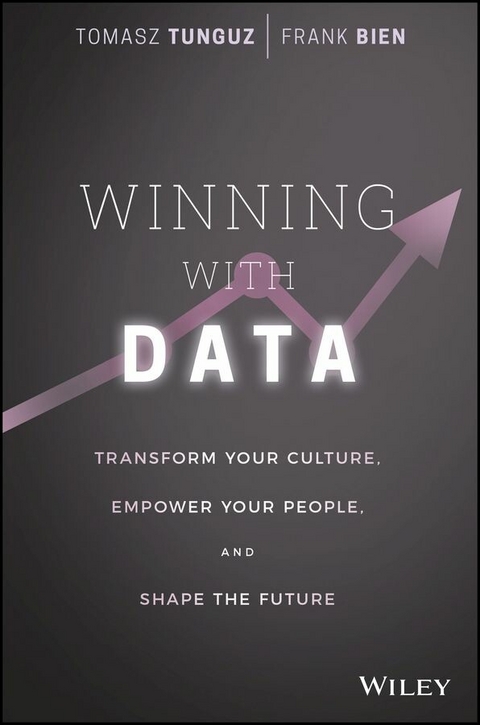
Winning with Data (eBook)
John Wiley & Sons (Verlag)
978-1-119-25739-4 (ISBN)
Winning with Data explores the cultural changes big data brings to business, and shows you how to adapt your organization to leverage data to maximum effect. Authors Tomasz Tunguz and Frank Bien draw on extensive background in big data, business intelligence, and business strategy to provide a blueprint for companies looking to move head-on into the data wave. Instrumentation is discussed in detail, but the core of the change is in the culture-this book provides sound guidance on building the type of organizational culture that creates and leverages data daily, in every aspect of the business. Real-world examples illustrate these important concepts at work: you'll learn how data helped Warby-Parker disrupt a $13 billion monopolized market, how ThredUp uses data to process more than 20 thousand items of clothing every day, how Venmo leverages data to build better products, how HubSpot empowers their salespeople to be more productive, and more. From decision making and strategy to shipping and sales, this book shows you how data makes better business.
Big data has taken on buzzword status, but there is little real guidance for companies seeking everyday business data solutions. This book takes a deeper look at big data in business, and shows you how to shift internal culture ahead of the curve.
- Understand the changes a data culture brings to companies
- Instrument your company for maximum benefit
- Utilize data to optimize every aspect of your business
- Improve decision making and transform business strategy
Big data is becoming the number-one topic in business, yet no one is asking the right questions. Leveraging the full power of data requires more than good IT-organization-wide buy-in is essential for long-term success. Winning with Data is the expert guide to making data work for your business, and your needs.
Crest the data wave with a deep cultural shift Winning with Data explores the cultural changes big data brings to business, and shows you how to adapt your organization to leverage data to maximum effect. Authors Tomasz Tunguz and Frank Bien draw on extensive background in big data, business intelligence, and business strategy to provide a blueprint for companies looking to move head-on into the data wave. Instrumentation is discussed in detail, but the core of the change is in the culture this book provides sound guidance on building the type of organizational culture that creates and leverages data daily, in every aspect of the business. Real-world examples illustrate these important concepts at work: you'll learn how data helped Warby-Parker disrupt a $13 billion monopolized market, how ThredUp uses data to process more than 20 thousand items of clothing every day, how Venmo leverages data to build better products, how HubSpot empowers their salespeople to be more productive, and more. From decision making and strategy to shipping and sales, this book shows you how data makes better business. Big data has taken on buzzword status, but there is little real guidance for companies seeking everyday business data solutions. This book takes a deeper look at big data in business, and shows you how to shift internal culture ahead of the curve. Understand the changes a data culture brings to companies Instrument your company for maximum benefit Utilize data to optimize every aspect of your business Improve decision making and transform business strategy Big data is becoming the number-one topic in business, yet no one is asking the right questions. Leveraging the full power of data requires more than good IT organization-wide buy-in is essential for long-term success. Winning with Data is the expert guide to making data work for your business, and your needs.
TOMASZ TUNGUZ is a venture capitalist at Redpoint and writes daily, data-driven blog posts about key topics for startups including fundraising, startup benchmarks, best practices, and team building. FRANK BIEN is CEO of Looker, exploration and discovery business intelligence platform. He has built his career on nurturing strong corporate culture and highly efficient teams.
Introduction ix
Chapter 1 Mad Men to Math Men: The Power of the Data-Driven Culture 1
Operationalizing Data: Uber's Competitive Weapon 2
The Era of Instant Data: You Better Get Yourself Together 4
Data Supply Chains: Buckling Under the Load 6
Management by Opinion: The Illusion of Knowledge 8
Our Vantage Points 10
Chapter 2 Four Problems with Data Today: Breadlines, Obscurity, Fragmentation, and Brawls 15
Data Breadlines for the Data-Poor 15
Data Obscurity: The Failure of the Card Catalog 17
Rogue Databases and Analysts: The Data Fragmentation Problem 19
Data Brawls: When Miscommunication Devolves into Arguments 21
Chapter 3 Business Intelligence: How We Got Here 23
Business Intelligence Is Born: The First Query 23
Databases for the Masses: Oracle Commercializes Codd's Invention 24
Legacy BI: A Three-Layer Cake 26
Google's Answer to Huge Data: Vanilla Boxes 27
600 Petabytes per Day: HiPal at Facebook 30
Extreme Data Collection: The New Normal 32
Looker: Weaving the Data Fabric 33
Chapter 4 Achieving Data Enlightenment: Gathering Data in the Morning and Changing Your Business's Operations in the Afternoon 37
Not Just Another Person with an Opinion 37
Aligning Sales Teams in Real Time 48
Scaling Sales Teams with Data 50
Determining Customer Satisfaction at Every Point in the Buyer Journey 52
The Rosetta Stone: Developing a Shared Data Language 55
The One Equation That Defines the Business 57
Brutal Intellectual Honesty: Speaking Data to Power 60
Putting Pride in Its Place: How Data Transforms Cultures 66
Chapter 5 Five Steps to Creating a Data-Driven Company--From Recruiting to Regression, It All Starts with Curiosity: Changing the Culture 71
It All Starts with Curiosity 71
Why You Should Stop Listening to Your Boss 72
How to Recruit Curious People 76
Chapter 6 From Hacks to Harmony: The Typical Progression of Data-Driven Companies 83
Step 1: Ask Your Friend, the Engineer 84
Step 2: Bastardize an Existing Solution 84
Step 3: Access Raw Data 85
The Crux of the Problem 85
Bring Your Own BI: The Five Letters That Will Change the Data World 86
The Power of a Unified Data-Modeling Layer 89
The Final Step: A Data Fabric 92
Chapter 7 Data Literacy and Empowerment: The Core Responsibilities of the Data Team 95
The Illusion of Validity: How to Avoid Data Biases 95
Correlation versus Causation 98
How Facebook and Zendesk Engender Data Literacy 100
Walking the Data Gemba: Training by Walking Around 104
Chapter 8 Deeper Analyses: Asking the Right Questions 109
When Data Confounds Our Intuition: How to Handle Ambiguity 112
Data Is Useless Unless You Can Act on It 115
Defining New Opportunities by Creating New Metrics That Matter 120
The Fastest Growing Media Site of All Time 122
How to Run a Data-Backed Experiment: Step by Step 124
Chapter 9 Changing the Way We Operate 129
Change Begins with a Story 129
Deliver Data with Panache: Structuring Presentations to Inspire 133
Chapter 10 Putting It All Together 141
Acknowledgments 145
Appendix: Revenue Metrics 147
Index 155
Chapter 1
Mad Men to Math Men:
The Power of the Data-Driven Culture
If we have data, let's look at data. If all we have are opinions, let's go with mine.
—Jim Barksdale, CEO of Netscape
As the television series Mad Men depicted, the Madison Avenue executives of the 1960s swirled scotch and smoked cigars from their Eames chairs, stoking their creative powers and developing the memorable advertising campaigns of the era. But very little of that reality remains today.
Modern marketing bears more resemblance to high-frequency stock trading than to Mad Men. Marketers sit in front of computers to buy and sell impressions on online advertising exchanges in a matter of milliseconds. Outputs of algorithms determine, in real time, precisely on which web page or mobile app to place an ad, precisely which variation of the ad to serve based on what the software knows about the user, and precisely how much to pay for it based on the probability the viewer will convert to a paid customer.
The paradigm shift from Mad Men to Math Men hasn't happened exclusively on Madison Avenue. This new era of marketing heralds analogous transformations in sales, human resources, and product management. No matter the role, no matter the sector, data is transforming it.
Modern sales teams employ predictive scoring technologies that crawl the web to aggregate data about potential customers and calculate the likelihood a customer will close. Each morning, sales account executives log into their customer relationship management software to a list of leads prioritized by likelihood to close. These are the new leads. The Glengarry leads.
Recruiters use data to identify the best candidates to pursue based on online profiles, blogs, social media accounts, and open-source software contributions. Product managers record the actions of users by the millisecond to understand exactly which customer journeys optimize revenue and where in the product customers exhibit confusion or drop off. Data courses through these teams by the gigabyte and supplies the essential foundation for decision making throughout the organization.
As novelist William Gibson said, “The future is already here—it's just not very evenly distributed.”1 A small number of companies have restructured themselves, their hiring practices, their internal processes, their data systems, and their cultures to seize the opportunity provided by data. And they are winning because of it. They exemplify the future. Inevitably, these techniques will diffuse through industry until everyone remaining employs them.
With this book, we'll illuminate how forward-thinking businesses already operate in the future, and outline how we have seen others evolve their businesses, their technology, and their cultures to win with data.
Operationalizing Data: Uber's Competitive Weapon
Who among us does not say that data is the lifeblood of their company? The largest hoteling company [AirBnB] owns no hotel rooms. The largest taxi company [Uber] owns no taxis.
—Ash Ashutosh, CEO of Actifio
At their core, the best data-driven companies operationalize data. Instead of regarding data as a retrospective report card of a team's performance, data informs the actions of each employee every morning and every evening. From harnessing customer survey responses to evaluating loan applications, these Math Men and Women are transforming every industry and every function.
As Ash Ashutosh said, the biggest transportation and lodging companies own no infrastructure. Instead, they manage data better than anyone else. Just four years after Uber was founded, its San Francisco revenues totaled more than three times all the revenues of all the taxi cab companies in the city. Two years later, the Yellow Cab Cooperative, which has operated the largest fleet of taxis in San Francisco for decades, filed for bankruptcy.
Among many innovations, Uber brought data to the taxi industry. Using historical data, Uber advises drivers to be in certain hotspots during certain times of day to maximize their revenue because customers tell them with the push of a button where to be. Uber matches the closest driver with the customer to minimize wait time and maximize driver utilization and earnings.
In contrast, disconnected Yellow Cab drivers listen to a coffee-fueled, fast-talking dispatcher relaying telephone call requests by radio. Individual drivers claim passenger pickups by responding over the CB, even if they are the furthest cab from the customer. “How long until the taxi arrives?”
Dispatchers can handle only one request at a time, serially. In rush hour, potential passengers redial after hearing a busy tone. Let too much time elapse coming from the other side of town and your passenger has already jumped into an Uber. For the Yellow Cab driver, the gas, time, and effort are all wasted because of an information asymmetry. In comparison to Uber, Yellow Cab drivers are driving blind to the demand of the city, and Yellow Cab customers are blind to the supply of taxi cabs.
Uber changes its pricing as a function of demand, telling drivers when it makes sense to start and stop working. Surge pricing, though controversial, establishes a true market for taxi services. Yellow Cab drivers don't know the best hours to work and prices are fixed regardless of demand.
Data improves more than the marketplace efficiency. Uber employs drivers based on their customer satisfaction data provided by consumers. Drivers who score below a 4.4 on a 5.0 scale risk “deactivation”—inability to access Uber's passenger base. Meanwhile, the Yellow Cab company maintains an average Yelp review of less than 1.5 stars out of 5.
The data teams that optimize Uber driver locations, maximize revenue for drivers, and drive customer satisfaction operate on a different plane from the management of the Yellow Cab company. Blind, Yellow Cab drivers are completely outgunned in the competitive transportation market. They don't have what it takes to compete: data.
But the Uber phenomenon isn't just a revolution in the back office. It's also about a new generation of taxi drivers, who operate their own businesses in a radically different way. What cabbie in the 1990s could have dreamed that upon waking early in the morning, a mobile phone would suggest there's more money to be made in the financial district of San Francisco than at the airport? But the millennial driver knows the data is attainable: It's just a search query or text message away. This is the fundamental, secular discontinuity that data engenders.
The Era of Instant Data: You Better Get Yourself Together
Instant Karma's gonna get you
Gonna knock you right on the head
You better get yourself together
Pretty soon you're gonna be dead
—John Lennon
The demand for instant data will increase inexorably. Like Uber drivers seeking a passenger at this very moment, we expect answers instantly. If you're making Baked Alaska for company tonight, and you've forgotten the ratio of sugar to egg whites in the meringue that houses the ice cream, your phone will answer the question in just a few seconds.
Where is Priceline stock trading? Where do the San Francisco Giants stand in this year's pennant race? When hiring a litigation attorney, what are the key questions to ask? Are there any grammatically sound sentences in English where every word starts with the same letter?
All of these questions are instantly answerable. These are the types of questions we ask at the dinner table or when sharing a drink with a friend at a bar, and answer in a few seconds with a search query on a phone.
Because of this new instant access to just about every kind of information, we expect the same instantaneity of answers at work. Why did our sales team outperform last quarter? Which of my clients are paying the most? Does this marketing campaign acquire customers more efficiently than the others? Should we launch our product in Japan in December?
In most companies, these questions require days or weeks to answer. Consequently, data is a historical tool, a useful rearview mirror to the well-managed business. It's a lens through which we can understand what happened in the past. And, if we're lucky, it can help us understand a little bit about why the past unfolded in a particular way.
But this level of analysis pales in comparison with the practices of best-in-class companies that operationalize their data. These are businesses that use the morning's purchasing data to inform which merchandise sits on the shelves in the afternoon.
What have those companies done to access instant data? First, they've changed the way they manage themselves, their teams, and their companies; they've changed how they run meetings, how they make decisions, and how they collaborate. Employees are data literate: They understand how to access the data they need, how to analyze it, and how to communicate it well.
Second, these companies have developed functional data supply chains that send insight to the people who need it. A data supply chain comprises all the people, software, and processes related to data as it's generated, stored, and accessed. While most of us think of data as the figures in an Excel spreadsheet or a beautiful bar chart, these simple formats often hide the complexity required to produce them.
The simple Excel spreadsheet hides a...
| Erscheint lt. Verlag | 26.5.2016 |
|---|---|
| Sprache | englisch |
| Themenwelt | Wirtschaft ► Betriebswirtschaft / Management ► Unternehmensführung / Management |
| Schlagworte | big data business processes • big data business strategy • big data cultural change • big data culture • big data in business • big data in decision making • big data in management • big data instrumentation • Business & Management • Business Analytics • Business Strategy • Business Technology • Creating a Data-Driven Culture: Empower Your People, Replace Opinion With Facts, and Make Smarter Business Decisions • data-driven business • Frank Bien • implementing big data • leveraging big data • looker • Organizational Culture • Redpoint • Tomasz Tunguz • Unternehmenstechnologie • Wirtschaft u. Management |
| ISBN-10 | 1-119-25739-5 / 1119257395 |
| ISBN-13 | 978-1-119-25739-4 / 9781119257394 |
| Informationen gemäß Produktsicherheitsverordnung (GPSR) | |
| Haben Sie eine Frage zum Produkt? |
 EPUB (Adobe DRM)
Kopierschutz: Adobe-DRM
Adobe-DRM ist ein Kopierschutz, der das eBook vor Mißbrauch schützen soll. Dabei wird das eBook bereits beim Download auf Ihre persönliche Adobe-ID autorisiert. Lesen können Sie das eBook dann nur auf den Geräten, welche ebenfalls auf Ihre Adobe-ID registriert sind.
Details zum Adobe-DRM
Dateiformat: EPUB (Electronic Publication)
EPUB ist ein offener Standard für eBooks und eignet sich besonders zur Darstellung von Belletristik und Sachbüchern. Der Fließtext wird dynamisch an die Display- und Schriftgröße angepasst. Auch für mobile Lesegeräte ist EPUB daher gut geeignet.
Systemvoraussetzungen:
PC/Mac: Mit einem PC oder Mac können Sie dieses eBook lesen. Sie benötigen eine
eReader: Dieses eBook kann mit (fast) allen eBook-Readern gelesen werden. Mit dem amazon-Kindle ist es aber nicht kompatibel.
Smartphone/Tablet: Egal ob Apple oder Android, dieses eBook können Sie lesen. Sie benötigen eine
Geräteliste und zusätzliche Hinweise
Buying eBooks from abroad
For tax law reasons we can sell eBooks just within Germany and Switzerland. Regrettably we cannot fulfill eBook-orders from other countries.
aus dem Bereich