


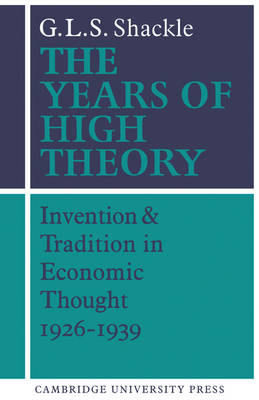
The Years of High Theory
Invention and Tradition in Economic Thought 1926–1939
Seiten
1983
Cambridge University Press (Verlag)
978-0-521-27478-4 (ISBN)
Cambridge University Press (Verlag)
978-0-521-27478-4 (ISBN)
In this classic book, first published in 1967, Professor Shackle provides a study, in exact and professional language, of the precise nature, structure, presuppositions, language and inter-relations of the theories formulated between 1926 and 1939, when the post-war notion of a tranquil world was shattered by economic crisis.
Even a decade after the end of the 1914–1918 war, economic theory assumed that the world was tranquil and orderly. By 1939 an economic slump without parallel, allied to the re-emergence of military ambition in Europe, had brought economic theorists face to face with reality. In this classic book, first published in 1967, Professor Shackle provides a study, in exact and professional language, of the precise nature, structure, presuppositions, language and inter-relations of the theories which were formulated in these fourteen years - unparalleled in the whole history of economics except perhaps by the years of the Physiocrats and Adam Smith. These theories are not prototypes on the way to something better but are of essential and permanent importance.
Even a decade after the end of the 1914–1918 war, economic theory assumed that the world was tranquil and orderly. By 1939 an economic slump without parallel, allied to the re-emergence of military ambition in Europe, had brought economic theorists face to face with reality. In this classic book, first published in 1967, Professor Shackle provides a study, in exact and professional language, of the precise nature, structure, presuppositions, language and inter-relations of the theories which were formulated in these fourteen years - unparalleled in the whole history of economics except perhaps by the years of the Physiocrats and Adam Smith. These theories are not prototypes on the way to something better but are of essential and permanent importance.
1. The origin of theories: a case-study procedure; 2. Economic hard times and the riches of ideas; 3. Straffa and the state of value theory, 1926; 4. Marginal revenue; 5. The new establishment in value theory: (i) Mrs Joan Robinson; 6. The new establishment in value theory: (ii) Edward Chamberllin; 7. The indifference curve; 8. Two theories of demand; 9. Monetary equilibrium; 10. Mydral's analysis; 11. To the QJE from chapter 12 of the General Theory; 12. The anatomy of the General Theory; 13. Spending, saving and demand; 14. The multiplier; 15. Liquidity performance; 16. Formal dynamics: cycles and growth; 17. Leontief's tableau économique; 18. The landslide of invention; Index.
| Erscheint lt. Verlag | 3.3.1983 |
|---|---|
| Zusatzinfo | Worked examples or Exercises |
| Verlagsort | Cambridge |
| Sprache | englisch |
| Maße | 140 x 216 mm |
| Gewicht | 430 g |
| Themenwelt | Wirtschaft ► Allgemeines / Lexika |
| Wirtschaft ► Volkswirtschaftslehre | |
| ISBN-10 | 0-521-27478-8 / 0521274788 |
| ISBN-13 | 978-0-521-27478-4 / 9780521274784 |
| Zustand | Neuware |
| Informationen gemäß Produktsicherheitsverordnung (GPSR) | |
| Haben Sie eine Frage zum Produkt? |
Mehr entdecken
aus dem Bereich



aus dem Bereich
erfolgreich bei Bachelor- und Masterarbeit
Buch | Softcover (2024)
Vahlen (Verlag)
CHF 26,45
erfolgreich organisieren, recherchieren, präsentieren
Buch | Softcover (2025)
Vahlen, Franz (Verlag)
CHF 26,45
Buch | Softcover (2025)
Franz Vahlen (Verlag)
CHF 30,65


