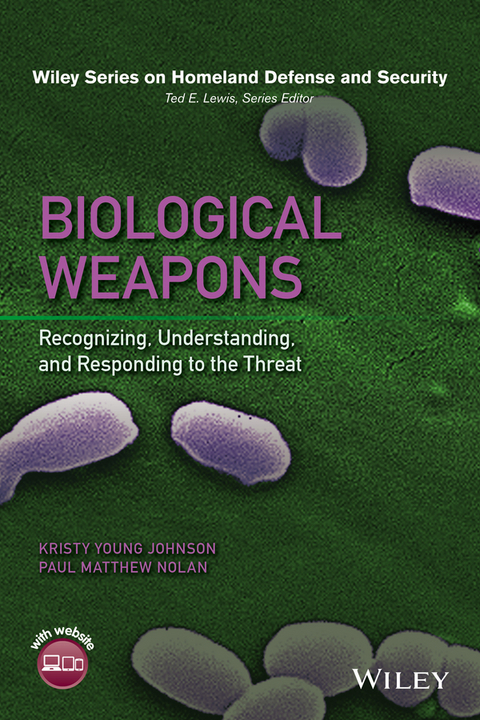
Biological Weapons (eBook)
Gives readers a detailed understanding of how specific biological weapons work and how those affected by the weapons would be treated
- Teaches the reader to recognize the symptoms of each biological weapon and understand the threat these weapons pose
- Concentrates on the weapons considered the greatest threats by the CDC such as Anthrax, Botulism, Smallpox, Ricin toxin, Ebola, Plague, and Viral encephalitis
- Provides a detailed understanding of how specific biological weapons work and how to recognize the symptoms of those affected by the weapons as well as how they would be treated
- Includes case studies, chapter review questions, and the instructor's supplemental materials include PowerPoint presentations, a Test Bank, and suggestions for student projects
- Begins with a primer on microbiology, the human immune system's response to these biological agents, and the defense agencies involved with protecting the public against these agents
Kristy Young Johnson is an Associate Professor in the Department of Biology at The Citadel - The Military College of South Carolina. She has taught a wide variety of undergraduate and graduate biology courses, including General Biology, Genetics, Microbiology, and Descriptive Histology. She developed an entirely new Bioterrorism course that she has taught regularly since 2007. She holds a Bachelor of Science in Chemistry from Gardner-Webb University in North Carolina and a doctorate in Pathology and Laboratory Medicine from the Medical University of South Carolina.
Paul Matthew Nolan is an Associate Professor of Biology, Behavior, and Disease Ecology at The Citadel - The Military College of South Carolina as well as an adjunct professor in the Graduate Program in Marine Biology, and Graduate Program in Environmental Studies at The College of Charleston. In 2012 he was awarded the Faculty Spotlight Award for Excellence in Teaching and Scholarship from The Citadel. He has published extensively on the influence of condition and parasites on individual condition in a wide variety of bird species.
Kristy Young Johnson is an Associate Professor in the Department of Biology at The Citadel - The Military College of South Carolina. She has taught a wide variety of undergraduate and graduate biology courses, including General Biology, Genetics, Microbiology, and Descriptive Histology. She developed an entirely new Bioterrorism course that she has taught regularly since 2007. She holds a Bachelor of Science in Chemistry from Gardner-Webb University in North Carolina and a doctorate in Pathology and Laboratory Medicine from the Medical University of South Carolina. Paul Matthew Nolan is an Associate Professor of Biology, Behavior, and Disease Ecology at The Citadel - The Military College of South Carolina as well as an adjunct professor in the Graduate Program in Marine Biology, and Graduate Program in Environmental Studies at The College of Charleston. In 2012 he was awarded the Faculty Spotlight Award for Excellence in Teaching and Scholarship from The Citadel. He has published extensively on the influence of condition and parasites on individual condition in a wide variety of bird species.
CHAPTER 1
BACTERIA, TOXINS, AND VIRUSES
A staggering variety of microbes and chemicals found in the environment pose serious health threats to humans, but some can be manipulated to be even more dangerous. Certain types of bacteria, toxins, and viruses have been identified as potential weapons of bioterrorism. While each agent has its own unique characteristics, it is worthwhile to consider some traits common to each group.
1.1 BACTERIA
Bacteria are too small to be seen without a microscope, yet they comprise more of the total biomass of Earth than all plants and animals combined. Different species are adapted to different conditions, and bacteria can be found in virtually every environment on the planet. Many species have established mutually beneficial, symbiotic relationships with humans; our bodies provide a home and nutrition for the bacteria, and the bacteria provide some type of benefit to our health. The human digestive system is particularly dependent on the multitude of bacteria occupying the intestines. In fact, the population of bacteria living in and on the human body outnumbers human body cells by 10 to 1. The presence of symbiotic bacteria also confers protection against other bacterial species that are actually pathogenic to humans, causing various symptoms of disease or, in many cases, death. Some of these pathogens, however, are undaunted by symbiotic bacteria and will cause disease in virtually everyone they encounter.
Organisms such as plants and animals consist of many cells and have numerous intracellular structures called organelles that perform specific cellular functions; some of these organelles are enclosed in membranes within the internal environment of the cell. Such organisms are considered eukaryotic. Bacteria, however, exist as individual cells that also have organelles, but none of their organelles are membrane-bound; these organisms are considered prokaryotic (Fig. 1.1).
Figure 1.1 Prokaryotic and eukaryotic cells share many features, but eukaryotic cells are typically larger and have their DNA enclosed in a nucleus
Source: Wikipedia, https://biology12-lum.wikispaces.com/Recombinant+DNA, Used under CC BY-SA 3.0, http://creativecommons.org/licenses/by-sa/3.0/
The genetic material of bacteria is composed of deoxyribonucleic acid (DNA), the same molecule that carries hereditary information in all living cells. While eukaryotic DNA is organized into linear, thread-like chromosomes (imagine miniscule strands of spaghetti) encased in a membrane to form the nucleus (Fig. 1.2), bacterial chromosomes have a circular formation (as microscopic SpaghettiOs™) and are not bound by a membrane. Most bacterial cells have one large, circular chromosome, and many also have smaller, circular strands of DNA called plasmids (Fig. 1.3). Bacteria frequently exchange copies of plasmids, easily generating diversity within a bacterial population descended from the same bacterial cell.
Figure 1.2 Long strands of DNA are folded into chromosomes and located in the nucleus of eukaryotic cells
Figure 1.3 Prokaryotic DNA is not enclosed in a nucleus. Small molecules of DNA called plasmids are often present
Source: Wikipedia, https://commons.wikimedia.org/wiki/File:Plasmid_(english).svg. Used under CC BY-SA 2.5, https://creativecommons.org/licenses/by-sa/2.5/deed.en
Without microscopes, bacterial species can often be differentiated based on the appearance of their colonies, macroscopic clusters of cells growing on a solid surface. However, many species produce colonies with similar appearances and must be distinguished by other means. Often, extensive laboratory tests are required to identify bacterial species conclusively, but the first step in identification is to characterize the shape of the individual cells. Most bacterial cells can be categorized as rod-shaped (bacillus), spherical (coccus), corkscrew-shaped (spirillum), or comma-shaped (vibrio) (Fig. 1.4). Some bacterial species do not fit neatly into one of these cell-shape categories; for example, those that are more round than bacilli but more elongated than cocci are referred to as coccobacilli.
Figure 1.4 (a) Rod-shaped Bacillus anthracis cells among large, round neutrophils. (b) Spherical Staphylococcus aureus cells. (c) Spiral-shaped Spirillum volutans cells. (d) Comma-shaped Vibrio
Another step in the initial identification of bacterial species is based on their appearance after certain staining procedures. While all living cells have a flexible cell membrane that envelops their internal components, bacteria have an additional cell wall composed of peptidoglycan (a complex of protein and sugar molecules) on the outer surface of their cell membrane (Fig. 1.5). A staining procedure known as the Gram stain distinguishes bacteria with thick cell walls (Gram positive) from those with thin cell walls (Gram negative). After staining, Gram positive bacteria appear purple (seen here as dark gray), while Gram negative bacteria appear pink (seen here as light gray) (Fig. 1.6). In many cases, the bacterial cell wall renders the bacteria impervious to medications, making some bacterial infections extremely difficult to treat.
Reality Check:
What are some tests scientists could use to identify biological agents rapidly in the field?
Figure 1.5 Some prokaryotic cells have a thin peptidoglycan layer (a), while others have a thick peptidoglycan layer (b)
Source: http://www.intechopen.com/books/viscoelasticity-from-theory-to-biological-applications/viscoelasticity-in-biological-systems-a-special-focus-on-microbes, Used under CC BY 3.0, http://creativecommons.org/licenses/by/3.0/
Figure 1.6 Gram positive cocci appear dark gray, while Gram negative bacilli appear light gray
Source: Wikipedia, https://commons.wikimedia.org/wiki/File:Gram_stain_01.jpg, Used under CC BY-SA 3.0, https://creativecommons.org/licenses/by-sa/3.0/
Some bacteria that are pathogenic to humans also infect other species. For instance, the bacterium that causes plague in humans also infects rodents and fleas. A species that commonly carries but is not killed by a pathogen is known as a reservoir host. While infection with the bacterium that causes plague produces nonfatal sickness in rodents, the same bacteria do not cause those symptoms in fleas. Thus, fleas ingest the bacteria while feeding on an infected rodent. If the rodent dies, the fleas often turn to humans as a source of food, transmitting plague bacteria with every bite. Any species that is involved in transmitting a pathogen to humans is considered a vector. Vectors can be employed by bioterrorists as a means of spreading a biological weapon across borders, particularly if the vector is a flying insect such as a mosquito that could easily bypass security checkpoints.
Some bacteria can live and multiply only in the presence of oxygen; these are known as aerobes. Others grow best in the absence of oxygen; these bacteria are called anaerobes. Aerobes are most commonly found in open environments, while active anaerobes are found in closed environments such as sealed jars and cans. Because of their different environmental requirements, these categories of bacteria pose different threats. Aerobes can be dispersed in open-air environments, while anaerobes can be covertly distributed in canned food or other sealed containers.
While there are specific environmental conditions that are ideal for each species of bacteria, most are able to tolerate a range of conditions, if only for minutes or hours. This hardiness allows bacteria to be transmitted via fomites, inanimate objects that can become contaminated when touched by an infected individual. Some frequently encountered fomites include monetary currency (especially paper bills), elevator buttons, door handles, and even restaurant menus. Because infection often results from touching the mouth, nose, or eyes after making contact with a fomite, frequent hand-washing is one of the best defenses against everything from bacteria to viruses (Fig. 1.7). Similar to vectors, fomites can also be used to spread biological weapons, and an object as innocent as the contaminated surface of a sticky ketchup bottle in a restaurant can instantly become a deadly weapon. In some cases, live aerobic bacteria can be aerosolized, traveling on air currents for great distances, possibly miles, before being inhaled by unsuspecting victims. Most living bacteria have a low tolerance to ultraviolet radiation and would be most effective if released at night, indoors, or in an underground structure such as a subway. Chapter 6 includes a discussion of the harrowing results of government-sponsored testing of the release of a bacterial agent in a New York City subway.
Figure 1.7 The CDC recommends frequent hand-washing to prevent Ebola
While they are generally considered simple organisms, bacteria possess some bizarre qualities not found in eukaryotic organisms. Some bacterial species possess the astounding ability to survive extended periods of harsh environmental conditions in a state of suspended animation by forming structures known as endospores. Each...
| Erscheint lt. Verlag | 3.5.2016 |
|---|---|
| Reihe/Serie | Wiley Series on Homeland Defense and Security |
| Wiley Series on Homeland Defense and Security) | Wiley Series on Homeland Defense and Security) |
| Sprache | englisch |
| Themenwelt | Natur / Technik ► Fahrzeuge / Flugzeuge / Schiffe ► Militärfahrzeuge / -flugzeuge / -schiffe |
| Studium ► Querschnittsbereiche ► Prävention / Gesundheitsförderung | |
| Sozialwissenschaften ► Politik / Verwaltung | |
| Technik | |
| Wirtschaft ► Betriebswirtschaft / Management | |
| Schlagworte | Anthrax • Arbeitsschutz u. Arbeitssicherheit • Arbeitssicherheit u. Umweltschutz i. d. Chemie • Bacteria • Biologische Waffe • bioterrorism • Botulism • CDC • Chemical and Environmental Health and Safety • Chemie • Chemistry • Cholera • Ebola • encephalitis • Gesundheits- u. Sozialwesen • Health & Social Care • Homeland Security • Innere Sicherheit • Lassa • <p>Biological weapon • Marburg</p> • Massenvernichtungswaffen • nipah • Occupational Health & Safety • Plague • ricin • security management • Sicherheitsmanagement • Smallpox • Staphylococcal Enterotoxin B • terrorism • Terrorismus • Toxin • Tularemia • Virus |
| ISBN-13 | 9781119085317 / 9781119085317 |
| Informationen gemäß Produktsicherheitsverordnung (GPSR) | |
| Haben Sie eine Frage zum Produkt? |
 EPUB (Adobe DRM)
Kopierschutz: Adobe-DRM
Adobe-DRM ist ein Kopierschutz, der das eBook vor Mißbrauch schützen soll. Dabei wird das eBook bereits beim Download auf Ihre persönliche Adobe-ID autorisiert. Lesen können Sie das eBook dann nur auf den Geräten, welche ebenfalls auf Ihre Adobe-ID registriert sind.
Details zum Adobe-DRM
Dateiformat: EPUB (Electronic Publication)
EPUB ist ein offener Standard für eBooks und eignet sich besonders zur Darstellung von Belletristik und Sachbüchern. Der Fließtext wird dynamisch an die Display- und Schriftgröße angepasst. Auch für mobile Lesegeräte ist EPUB daher gut geeignet.
Systemvoraussetzungen:
PC/Mac: Mit einem PC oder Mac können Sie dieses eBook lesen. Sie benötigen eine
eReader: Dieses eBook kann mit (fast) allen eBook-Readern gelesen werden. Mit dem amazon-Kindle ist es aber nicht kompatibel.
Smartphone/Tablet: Egal ob Apple oder Android, dieses eBook können Sie lesen. Sie benötigen eine
Geräteliste und zusätzliche Hinweise
Buying eBooks from abroad
For tax law reasons we can sell eBooks just within Germany and Switzerland. Regrettably we cannot fulfill eBook-orders from other countries.
aus dem Bereich