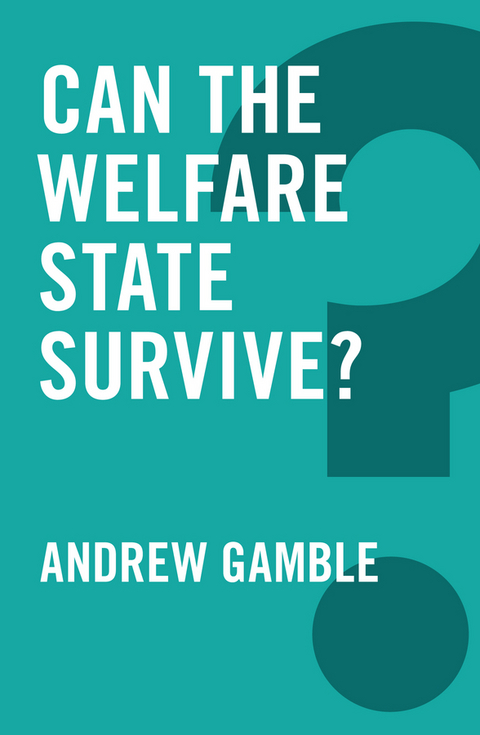
After the most serious economic crash since the 1930s and the slowest recovery on record, austerity rules. Spending on the welfare state did not cause the crisis, but deep cuts in welfare budgets has become the default policy response. The welfare state is seen as a burden on wealth creation which can no longer be afforded in an ever more competitive global economy. There are calls for it to be dismantled altogether.
In this incisive book, leading political economist Andrew Gamble explains why western societies still need generous inclusive welfare states for all their citizens, and are rich enough to provide them. Welfare states can survive, he argues, but only if there is the political will to reform them and to fund them.
Andrew Gamble is Emeritus Professor of Politics at Queens? College, Cambridge
After the most serious economic crash since the 1930s and the slowest recovery on record, austerity rules. Spending on the welfare state did not cause the crisis, but deep cuts in welfare budgets has become the default policy response. The welfare state is seen as a burden on wealth creation which can no longer be afforded in an ever more competitive global economy. There are calls for it to be dismantled altogether. In this incisive book, leading political economist Andrew Gamble explains why western societies still need generous inclusive welfare states for all their citizens, and are rich enough to provide them. Welfare states can survive, he argues, but only if there is the political will to reform them and to fund them.
Andrew Gamble is Emeritus Professor of Politics at Queens? College, Cambridge
* Introduction
* 1. The life and times of the welfare state
* 2. The battle of ideas
* 3. Four challenges
* 4. A future for the welfare state
* Further reading
?This is an incredibly useful book, on a subject that could not be more important.?
Progress
Introduction
Can the welfare state survive? Yes, I think it can. It might seem strange even to pose the question. Western societies have grown steadily richer and safer over the seventy years since the Second World War. The establishment and extension of welfare states over this period has been one of the proudest achievements and most obvious fruits of Western prosperity. It is one of the features which makes rich societies distinctive. Pooling collective risks over the life-cycle, redistributing between the generations to provide a better, more secure existence for everybody, alleviating poverty – who can be seriously opposed to that? Yet all is not well with our welfare states. The richer we become, the less willing and able we seem to be to pay for them. We hear constantly of underfunding, of a looming crisis of entitlements, of costs escalating and service standards slipping. For many decades now, welfare states of all kinds have been under siege, even in times of prosperity and economic growth. Their era of expansion came to an end in the 1970s, and since then they have entered an era of permanent austerity. There have been constant complaints that welfare states are becoming unaffordable, are wasteful and inefficient, and are in need of drastic reform. During the 1990s, far-reaching reforms were launched which seemed for a time to offer them a new political foundation. But since the financial crash in 2008 and its troubled aftermath, they have had to confront a new era of retrenchment and austerity. New struggles have erupted over which welfare programmes should be protected and which should be axed or scaled back, and there are those who dare to think the unthinkable and wonder whether we need a welfare state at all. Is the welfare state out of time, a relic of the industrial capitalist past, which may once have had its place, but increasingly jars with the political economy of the twenty-first century and should be dismantled?
What do we mean by welfare? The Oxford English Dictionary defines it as the state or condition of doing or being well; good fortune, happiness or well-being; prosperity. ‘Well fare you’ in the sixteenth century meant ‘May it go well with you.’ Everyone wants to fare well, to have opportunities, good health and education, to enjoy protection against the risks of being unable to earn a living through ill health, injury, or unemployment, and to have access to the basic resources needed to live a full life. But why do we need the state to be involved? This is where the controversy lies. The role of states in providing welfare has taken different forms, which explains why the American definition of ‘welfare’ is very different from the European one. In the United States, welfare is defined narrowly to mean income transfers or direct services which support the poor and give them a minimum standard of living. For Europeans, welfare is defined broadly to include not just redistribution to the poor, but also spending to pool collective risks and to provide investment in the human capital of all citizens. It therefore includes spending on health, education, and pensions. If the welfare state is understood only to concern the poor, the majority of citizens will have no stake in it, but they will have a very big stake if it includes the mainstream services which all citizens use at different stages of their lives.1
In exploring whether the welfare state can survive, I will use the broad rather than the narrow definition of welfare. Welfare states as they have evolved have come to be concerned with much more than just providing a safety net. Pinning down what is meant by a welfare state is important because it affects the definition of ‘survival’. If measured purely by spending, the welfare state appears to be in rude health, even in the midst of austerity and cuts. But these aggregate figures often do not reflect qualitative changes in the way welfare states operate. Welfare spending may be as high as ever, but what comfort is that if welfare states no longer protect citizens against risks in the way they once did, or if they are becoming much more punitive to the poor? In an era of retrenchment, welfare states are put under extreme pressure. This raises the interesting question: at what point does the welfare state cease to be a welfare state? This question is part normative and part empirical. The normative part is whether the welfare state should survive, meaning whether it deserves to survive, which is separate from the empirical question of whether it will survive. You can argue, as many market libertarians do, that the welfare state should not survive, while concluding gloomily that it very probably will, because the political obstacles to dismantling it are too great. Among supporters of the welfare state, there are those like Paul Pierson, who fears it is unlikely to survive for much longer because the very features which made it so resilient in the past have also made it virtually incapable of reform, and now very vulnerable in the new circumstances that have emerged in the aftermath of the financial crisis.2 A contrasting view is held by those like Anton Hemerijck, who, while acknowledging the peril facing welfare states, argues that the crisis creates the opportunity for reform and a new advance for the welfare state.3 I agree with Hemerijck. The welfare state can survive, but only if some of the key challenges which it faces are addressed through a new politics. Its survival is not guaranteed or certain, but it is possible.
There are four key challenges which the welfare state faces. The first is affordability – the perpetual task of reconciling resources with expectations. How can the welfare state survive if it is starved of the resources it requires because its citizens will the end but not the means? They want high-quality public services but are reluctant to pay the taxes to fund them. As the welfare state has expanded, so the expectations of citizens have risen, fuelled by competition between political parties to secure votes. In the initial phase of the development of the welfare state, the cost was easier to carry. But as the programmes have matured, the long-term funding implications of many of the programmes, like pensions, have loomed larger. Projected forward, these costs rise exponentially, suggesting severe fiscal squeezes to come unless programmes are made much less generous or citizens agree to higher taxes.
The second challenge is international competitiveness. How can the welfare state survive when many of the new rising powers in the world are developing forms of capitalism which are not burdened by welfare costs? The higher costs of labour in the rich economies make them uncompetitive with labour elsewhere. Many fear that the rents in the form of higher incomes and profits which the Western world has extracted for several centuries are gradually being eroded and with them the fiscal base for the welfare state, and the social contract which has sustained it. This is not a new problem. The same fears were raised in the past about globalization and the ‘race to the bottom’. These fears proved unfounded, because many welfare states proved resilient.4 But with the arrival of new hard times since the financial crash, these fears have surfaced once again.
The third challenge is new social risks. Can the welfare state be adapted to cope with the very different economic and social landscape of contemporary advanced capitalist societies? The welfare state developed in an era of big government, big companies, and big unions. It shared the collective ethic and purpose of many of these institutions. It was a natural counterpart to the modern industrial societies which were pioneered in the United States and Germany in the first half of the twentieth century. With the decline of mass manufacturing and the rise of service economies, contemporary market societies have placed ever greater emphasis on individual initiative and responsibility, eroding many of the collective structures and organizations, like trade unions, which supported collective action in the past and created political support for the welfare state. New social risks arise from the changing role of women in the workforce, the weakening of the traditional form of the household, the importance of social care, and new vulnerabilities of individuals in a rapidly changing labour market because of their low or inadequate skills and the insecurity of so many jobs.
The fourth challenge is ageing. Can the welfare state adjust to the demographic shift to an ageing population? Many mature welfare states face a challenge from an increase in the ratio of older citizens to younger citizens. Old people are living longer and fertility rates are declining. In part this is due to the success of the welfare state in promoting better and more universal health care, investing in public health, and making it possible for many more women to enter the workforce. People are living beyond the ages assumed in the early years of welfare states. At the same time, rates of population growth are decreasing in many countries, and immigration, which might offer a remedy, is being discouraged. The consequence is a steadily increasing cost of supporting the elderly, much of which falls on the younger generation.
These four challenges pose a number of intractable dilemmas for governments, since they cannot be wished away, and managing them requires confronting a number of unwelcome choices. As in many areas of modern government,...
| Erscheint lt. Verlag | 18.4.2016 |
|---|---|
| Reihe/Serie | Global Futures |
| Global Futures | Global Futures |
| Sprache | englisch |
| Themenwelt | Sozialwissenschaften ► Pädagogik ► Sozialpädagogik |
| Sozialwissenschaften ► Politik / Verwaltung ► Staat / Verwaltung | |
| Sozialwissenschaften ► Soziologie | |
| Wirtschaft ► Volkswirtschaftslehre | |
| Schlagworte | Austerity • Credit Crunch • Deregulation • Economics • Fürsorge • Fürsorge u. Zuwendungen • financial crash • Fürsorge • Fürsorge u. Zuwendungen • Hayek • Keynes • neoliberal • Neoliberalism • political economics • Political Issues & Behavior • Political Science • Politics • Politikwissenschaft • Politische Ãkonomie • Politische Fragen u. politisches Verhalten • Politische Ökonomie • Privatisation • Social Policy & Welfare • Sozialpolitik u. Wohlfahrt • Sozialstaat • Thatcherism • Volkswirtschaftslehre • Welfare & Benefit Systems • Welfare Economics • Welfare State |
| ISBN-13 | 9780745698779 / 9780745698779 |
| Informationen gemäß Produktsicherheitsverordnung (GPSR) | |
| Haben Sie eine Frage zum Produkt? |
 EPUB (Adobe DRM)
Kopierschutz: Adobe-DRM
Adobe-DRM ist ein Kopierschutz, der das eBook vor Mißbrauch schützen soll. Dabei wird das eBook bereits beim Download auf Ihre persönliche Adobe-ID autorisiert. Lesen können Sie das eBook dann nur auf den Geräten, welche ebenfalls auf Ihre Adobe-ID registriert sind.
Details zum Adobe-DRM
Dateiformat: EPUB (Electronic Publication)
EPUB ist ein offener Standard für eBooks und eignet sich besonders zur Darstellung von Belletristik und Sachbüchern. Der Fließtext wird dynamisch an die Display- und Schriftgröße angepasst. Auch für mobile Lesegeräte ist EPUB daher gut geeignet.
Systemvoraussetzungen:
PC/Mac: Mit einem PC oder Mac können Sie dieses eBook lesen. Sie benötigen eine
eReader: Dieses eBook kann mit (fast) allen eBook-Readern gelesen werden. Mit dem amazon-Kindle ist es aber nicht kompatibel.
Smartphone/Tablet: Egal ob Apple oder Android, dieses eBook können Sie lesen. Sie benötigen eine
Geräteliste und zusätzliche Hinweise
Buying eBooks from abroad
For tax law reasons we can sell eBooks just within Germany and Switzerland. Regrettably we cannot fulfill eBook-orders from other countries.
aus dem Bereich