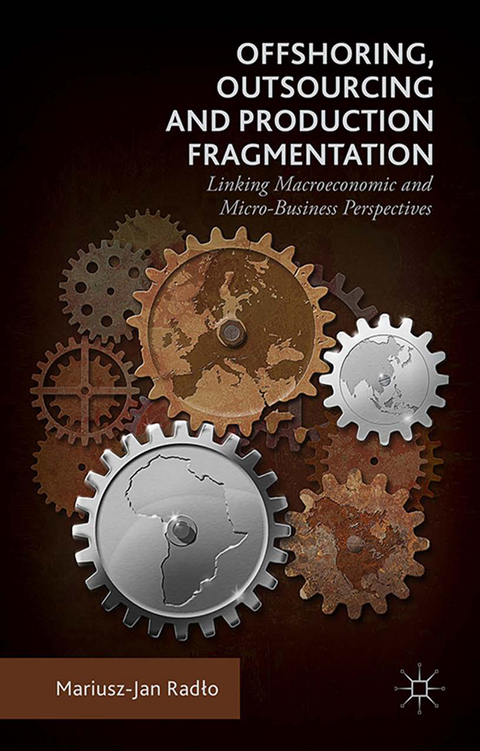
Offshoring, Outsourcing and Production Fragmentation (eBook)
216 Seiten
Palgrave Macmillan UK (Verlag)
978-1-137-57125-0 (ISBN)

In this book, Radlo increases understanding of offshoring, outsourcing and international production fragmentation, and explains the impact of this phenomenon on the economies and enterprises. Key features include a comprehensive theoretical explanation of offshoring and outsourcing at both macroeconomic and microeconomic level, as well as an explanation of practical consequences of the mentioned phenomenon for the development of the global economy, national economies, concrete industries and enterprises. Unlike other publications, which are often characterized by narrow management or a macroeconomic approach to the analysis of offshoring and outsourcing, Radlo's text offers real insight into the global impact of production fragmentation.
Mariusz-Jan Radlo is an economist with experience in private, central government, and academic sectors. Since 2004, he has worked as a research fellow at the Warsaw School of Economics. Since 2009 he is a managing partner at SEENDICO in Warsaw, Poland.
List of Figures List of Tables Acknowledgements Introduction PART I: OFFSHORING, OUTSOURCING, PRODUCTION FRAGMENTATION: DEFINITIONS, MEASURES AND ORIGIN OF THE RESEARCH 1.1. Introduction 1.2. Definitions and taxonomies of offshoring and outsourcing 1.3. Origin and main issues in research on offshoring and outsourcing 1.4. Measuring offshoring and outsourcing 1.5. Summary and conclusions PART II: OFFSHORING AND OUTSOURCING IN ECONOMIC THEORIES 2.1. Introduction2.2. Offshoring and outsourcing in neoclassical theory of the firm2.3. Offshoring and outsourcing in the new institutional economics2.4. Offshoring and outsourcing in light trade theory 2.5. Offshoring and outsourcing in the perspective of foreign direct investment theories 2.6. Summary and conclusions PART III: EXPLAINING AND MODELLING OFFSHORING AND OUTSOURCING IN ENTERPRISES 3.1. Introduction 3.2. Evolution of the scope and structure of offshoring and outsourcing in enterprises 3.3. Offshoring and outsourcing in enterprises: motives and location factoors3.4. Models offshoring and outsourcing in enterprises 3.5. Summary and conclusions PART IV: EVOLUTIONARY VIEW OF INTERNATIONAL PRODUCTION FRAGMENTATION IN ENTERPRISES 4.1. Introduction 4.2. Case and comparative studies: data, method, results, and discussion 4.3. Industry case studies 4.4. Discussion of results 4.5. Summary and Conclusions PART V: PRODUCTION FRAGMENTATION IN THE WORLD ECONOMY 5.1. Introduction 5.2. Main trends in trade and FDI flows 5.3. Trade in intermediate goods and intrafirm trade 5.4. Trade in services 5.5. Offshoring intensity in selected economies 5.6. Offshoring impact on employment, wages and labor productivity 5.7. Summary and conclusions Summary and conclusions References
| Erscheint lt. Verlag | 29.3.2016 |
|---|---|
| Zusatzinfo | XII, 216 p. |
| Verlagsort | London |
| Sprache | englisch |
| Themenwelt | Technik |
| Wirtschaft ► Betriebswirtschaft / Management ► Planung / Organisation | |
| Wirtschaft ► Volkswirtschaftslehre ► Makroökonomie | |
| Wirtschaft ► Volkswirtschaftslehre ► Wirtschaftspolitik | |
| Schlagworte | BPO • business • Economics • Employment • FDI flows • Foreign Direct Investment • Foreign direct investment theories • Intrafirm trade • Labour productivity • Light trade theory • Macroeconomics • Neoclassica theory • New Institutional Economics • Offshoring • organization • Outsourcing • Production • production fragmentation • Service • Theory of the Firm • Trade • Trade Theory • Wages |
| ISBN-10 | 1-137-57125-X / 113757125X |
| ISBN-13 | 978-1-137-57125-0 / 9781137571250 |
| Informationen gemäß Produktsicherheitsverordnung (GPSR) | |
| Haben Sie eine Frage zum Produkt? |
 PDF (Wasserzeichen)
DRM: Digitales Wasserzeichen
Dieses eBook enthält ein digitales Wasserzeichen und ist damit für Sie personalisiert. Bei einer missbräuchlichen Weitergabe des eBooks an Dritte ist eine Rückverfolgung an die Quelle möglich.
Dateiformat: PDF (Portable Document Format)
Mit einem festen Seitenlayout eignet sich die PDF besonders für Fachbücher mit Spalten, Tabellen und Abbildungen. Eine PDF kann auf fast allen Geräten angezeigt werden, ist aber für kleine Displays (Smartphone, eReader) nur eingeschränkt geeignet.
Systemvoraussetzungen:
PC/Mac: Mit einem PC oder Mac können Sie dieses eBook lesen. Sie benötigen dafür einen PDF-Viewer - z.B. den Adobe Reader oder Adobe Digital Editions.
eReader: Dieses eBook kann mit (fast) allen eBook-Readern gelesen werden. Mit dem amazon-Kindle ist es aber nicht kompatibel.
Smartphone/Tablet: Egal ob Apple oder Android, dieses eBook können Sie lesen. Sie benötigen dafür einen PDF-Viewer - z.B. die kostenlose Adobe Digital Editions-App.
Buying eBooks from abroad
For tax law reasons we can sell eBooks just within Germany and Switzerland. Regrettably we cannot fulfill eBook-orders from other countries.
aus dem Bereich