


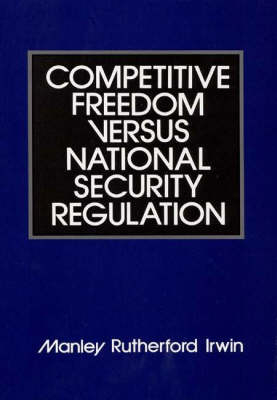
Competitive Freedom versus National Security Regulation
Seiten
1989
Praeger Publishers Inc (Verlag)
978-0-89930-233-1 (ISBN)
Praeger Publishers Inc (Verlag)
978-0-89930-233-1 (ISBN)
Irwin asserts that the federal government, in the name of preserving national security, has imposed such additional regulation on American businesses that their competitive position in global markets has been severely compromised. In his well-written, cogently argued account of the impact of national security regulations on competitive freedom, Irwin demonstrates that federal government agencies--the Departments of State, Commerce, and Defense; the National Technical Information Services; the Federal Communications Commission; and others--all attempt to micromanage the firm's decision to sell, buy, invest, innovate, and compete internationally. In addition, Irwin shows, jurisdictional disputes among the various federal agencies for control over corporate economic activities further exacerbate the problem by hampering the corporation's ability to react quickly to market conditions. As his analysis clearly illustrates, the end result is a price/cost squeeze on U.S. firms that handicaps their ability to compete with overseas rivals.
Some of the results of increased government oversight Irwin identifies directly threaten overall U.S. competitiveness abroad. U.S. corporations find that the compliance cost of regulation is privatized, thus lifting total costs. The combination of dampened revenues and inflated costs curtails the resources for future product development--a vital factor in maintaining market position. And, Irwin demonstrates, this federal policy which acts to reward offshore rivals at the expense of U.S. firms is grounded on political consensus: the political right favors export control while the political left supports import control. The effect of this dual policy emphasis, Irwin argues, is a national security policy that serves to punish the U.S. firm in an environment of increased global risk, competition, and rivalry. Students of international business and public policy, as well as government decision makers themselves, will find Irwin's study enlightening and provocative.
Some of the results of increased government oversight Irwin identifies directly threaten overall U.S. competitiveness abroad. U.S. corporations find that the compliance cost of regulation is privatized, thus lifting total costs. The combination of dampened revenues and inflated costs curtails the resources for future product development--a vital factor in maintaining market position. And, Irwin demonstrates, this federal policy which acts to reward offshore rivals at the expense of U.S. firms is grounded on political consensus: the political right favors export control while the political left supports import control. The effect of this dual policy emphasis, Irwin argues, is a national security policy that serves to punish the U.S. firm in an environment of increased global risk, competition, and rivalry. Students of international business and public policy, as well as government decision makers themselves, will find Irwin's study enlightening and provocative.
MANLEY RUTHERFORD IRWIN is Professor of Economics at the University of New Hampshire. The author of numerous books and articles that address issues of U.S. telecommunications and public policy, he has served as consultant to the Federal Communications Commission, the Office of Telecommunications Planning, and the President's Task Force on Communications Policy
Telecommunications Services Introduction Telecommunications Equipment Networks as Corporate Strategy Firm Entry as a Process Telecommunications Services and Manufacutring Jurisdictional Gridlock Regulation versus Private Sector The Double Squeeze Issues and Options Appendix Index
| Erscheint lt. Verlag | 23.1.1989 |
|---|---|
| Sprache | englisch |
| Themenwelt | Recht / Steuern ► Arbeits- / Sozialrecht ► Arbeitsrecht |
| Recht / Steuern ► EU / Internationales Recht | |
| Wirtschaft ► Betriebswirtschaft / Management ► Unternehmensführung / Management | |
| ISBN-10 | 0-89930-233-5 / 0899302335 |
| ISBN-13 | 978-0-89930-233-1 / 9780899302331 |
| Zustand | Neuware |
| Informationen gemäß Produktsicherheitsverordnung (GPSR) | |
| Haben Sie eine Frage zum Produkt? |
Mehr entdecken
aus dem Bereich



aus dem Bereich
mit den wichtigsten Bestimmungen zum Arbeitsverhältnis, …
Buch | Softcover (2025)
dtv Verlagsgesellschaft
CHF 20,85
mit Wahlordnung | Handkommentar
Buch | Hardcover (2024)
Franz Vahlen (Verlag)
CHF 132,95
Durchführung, Inhalte, Mitbestimmung
Buch (2024)
Franz Vahlen (Verlag)
CHF 24,95


