Kosher USA (eBook)
Columbia University Press (Verlag)
978-0-231-54093-3 (ISBN)

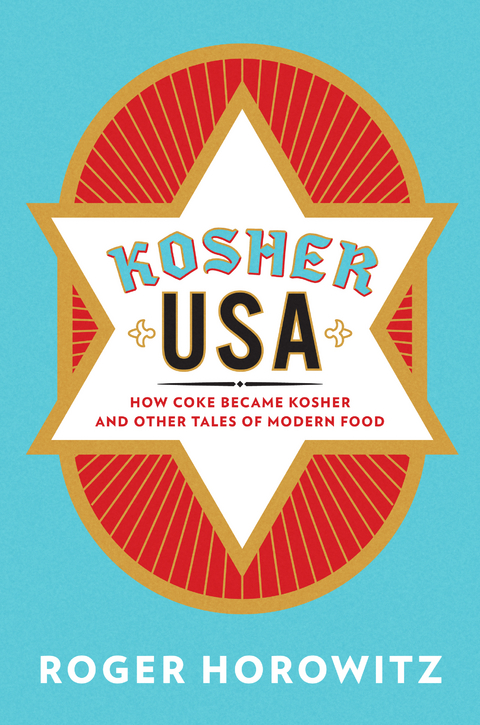
Kosher USA follows the fascinating journey of kosher food through the modern industrial food system. It recounts how iconic products such as Coca-Cola and Jell-O tried to become kosher; the contentious debates among rabbis over the incorporation of modern science into Jewish law; how Manischewitz wine became the first kosher product to win over non-Jewish consumers (principally African Americans); the techniques used by Orthodox rabbinical organizations to embed kosher requirements into food manufacturing; and the difficulties encountered by kosher meat and other kosher foods that fell outside the American culinary consensus. Kosher USA is filled with big personalities, rare archival finds, and surprising influences: the Atlanta rabbi Tobias Geffen, who made Coke kosher; the lay chemist and kosher-certification pioneer Abraham Goldstein; the kosher-meat magnate Harry Kassel; and the animal-rights advocate Temple Grandin, a strong supporter of shechita, or Jewish slaughtering practice. By exploring the complex encounter between ancient religious principles and modern industrial methods, Kosher USA adds a significant chapter to the story of Judaism's interaction with non-Jewish cultures and the history of modern Jewish American life as well as American foodways.
Roger Horowitz is a food historian and director of the Center for the History of Business, Technology, and Society at the Hagley Museum and Library. He is the author of Negro and White, Unite and Fight: A Social History of Industrial Unionism in Meatpacking, 1930–1990 (1997) and Putting Meat on the American Table: Taste, Technology, Transformation (2005).
Prologue: Uncle Stu's Question1. My Family's Sturgeon2. Kosher Coke, Kosher Science3. The Great Jell-O Controversy4. Who Says It's Kosher?5. Industrial Kashrus6. Man-O-Manischewitz7. Harry Kassel's Meat8. ShechitaConclusion: Kosher Ethics/Ethical Kosher?Epilogue: Remembering, Discovering, ThankingNotesIndex
| Erscheint lt. Verlag | 12.4.2016 |
|---|---|
| Reihe/Serie | Arts and Traditions of the Table: Perspectives on Culinary History | Arts and Traditions of the Table: Perspectives on Culinary History |
| Zusatzinfo | 27 b&w illustrations |
| Verlagsort | New York |
| Sprache | englisch |
| Themenwelt | Sachbuch/Ratgeber ► Essen / Trinken ► Länderküchen |
| Geisteswissenschaften ► Geschichte ► Regional- / Ländergeschichte | |
| Geschichte ► Teilgebiete der Geschichte ► Kulturgeschichte | |
| Geisteswissenschaften ► Religion / Theologie ► Judentum | |
| Sozialwissenschaften ► Pädagogik | |
| Sozialwissenschaften ► Soziologie ► Spezielle Soziologien | |
| Technik | |
| Wirtschaft | |
| ISBN-10 | 0-231-54093-0 / 0231540930 |
| ISBN-13 | 978-0-231-54093-3 / 9780231540933 |
| Informationen gemäß Produktsicherheitsverordnung (GPSR) | |
| Haben Sie eine Frage zum Produkt? |
 EPUB (Adobe DRM)
Kopierschutz: Adobe-DRM
Adobe-DRM ist ein Kopierschutz, der das eBook vor Mißbrauch schützen soll. Dabei wird das eBook bereits beim Download auf Ihre persönliche Adobe-ID autorisiert. Lesen können Sie das eBook dann nur auf den Geräten, welche ebenfalls auf Ihre Adobe-ID registriert sind.
Details zum Adobe-DRM
Dateiformat: EPUB (Electronic Publication)
EPUB ist ein offener Standard für eBooks und eignet sich besonders zur Darstellung von Belletristik und Sachbüchern. Der Fließtext wird dynamisch an die Display- und Schriftgröße angepasst. Auch für mobile Lesegeräte ist EPUB daher gut geeignet.
Systemvoraussetzungen:
PC/Mac: Mit einem PC oder Mac können Sie dieses eBook lesen. Sie benötigen eine
eReader: Dieses eBook kann mit (fast) allen eBook-Readern gelesen werden. Mit dem amazon-Kindle ist es aber nicht kompatibel.
Smartphone/Tablet: Egal ob Apple oder Android, dieses eBook können Sie lesen. Sie benötigen eine
Geräteliste und zusätzliche Hinweise
Buying eBooks from abroad
For tax law reasons we can sell eBooks just within Germany and Switzerland. Regrettably we cannot fulfill eBook-orders from other countries.
aus dem Bereich