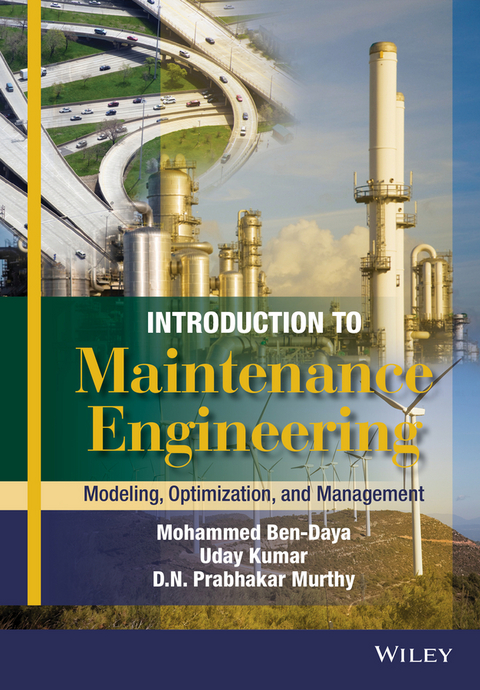
Introduction to Maintenance Engineering (eBook)
John Wiley & Sons (Verlag)
978-1-118-92642-0 (ISBN)
This introductory textbook links theory with practice using real illustrative cases involving products, plants and infrastructures and exposes the student to the evolutionary trends in maintenance.
- Provides an interdisciplinary approach which links, engineering, science, technology, mathematical modelling, data collection and analysis, economics and management
- Blends theory with practice illustrated through examples relating to products, plants and infrastructures
- Focuses on concepts, tools and techniques
- Identifies the special management requirements of various engineered objects (products, plants, and infrastructures)
Mohamed Ben-Daya is a Professor in the Department of Systems Engineering at King Fahd University of Petroleum and Minerals, Dhahran, Saudi Arabia. He received his PhD in Operations Research from Georgia Institute of Technology, USA. His research interests are in the areas of production planning and scheduling, maintenance, quality control, supply chain management, and risk management in product development. He teaches course in the areas of facilities planning, Production and inventory control, scheduling, Quality control, Maintenance and reliability engineering and supply chain management. Dr. Ben-Daya is the Associate Editor of the Journal of Quality in Maintenance Engineering and on the Editorial Board of the Journal of Logistics. He has published over eighty papers in refereed journals and conference proceedings and co-edited five books.
Pra Murthy obtained B.E. and M.E. degrees from Jabalpur University and the Indian Institute of Science in India and M.S. and Ph.D. degrees from Harvard University. At The University of Queensland he was responsible for setting up the Technology Management Centre (offering master's program in technology management) and Reliability Engineering and Risk Management Group (offering postgraduate programs in reliability and maintenance). He has held visiting appointments at fifteen universities in the USA, Europe and Asia. His current research interests include various aspects of reliability, maintenance, warranties and service contracts. He has authored or co-authored 20 book chapters, 165 journal papers and 150 conference papers. He is a co-author of 7, and co-editor of 3, books. He has run short courses for industry on various topics in technology management, operations management and post-sale support in Australia, Asia, Europe and the USA.
Uday Kumar obtained his B. Tech from IIT BHU, India and worked 7 years in industry before joining the postgraduate program of Luleå University of Technology, Luleå, Sweden to obtain a PhD degree in field of Reliability and Maintenance Engineering during 1990. He worked as a Senior Lecturer and Associate Professor at Luleå University and joined University of Stavanger, Norway as a Professor of Mechanical Engineering (Maintenance) in 1997. In July 2001, he was appointed as a Professor of Operation and Maintenance Engineering at Luleå University of Technology, Luleå, Sweden. He has been guest faculty at Helsinki University of Technology, Helsinki, Imperial College London and Stavanger University, University of Tromsö, Norway, University of Cincinnati, USA. His research interests are equipment maintenance, reliability and maintainability analysis, etc. He has published more than 275 papers in International Journals and Conference Proceedings.
This introductory textbook links theory with practice using real illustrative cases involving products, plants and infrastructures and exposes the student to the evolutionary trends in maintenance. Provides an interdisciplinary approach which links, engineering, science, technology, mathematical modelling, data collection and analysis, economics and management Blends theory with practice illustrated through examples relating to products, plants and infrastructures Focuses on concepts, tools and techniques Identifies the special management requirements of various engineered objects (products, plants, and infrastructures)
Mohamed Ben-Daya is a Professor in the Department of Systems Engineering at King Fahd University of Petroleum and Minerals, Dhahran, Saudi Arabia. He received his PhD in Operations Research from Georgia Institute of Technology, USA. His research interests are in the areas of production planning and scheduling, maintenance, quality control, supply chain management, and risk management in product development. He teaches course in the areas of facilities planning, Production and inventory control, scheduling, Quality control, Maintenance and reliability engineering and supply chain management. Dr. Ben-Daya is the Associate Editor of the Journal of Quality in Maintenance Engineering and on the Editorial Board of the Journal of Logistics. He has published over eighty papers in refereed journals and conference proceedings and co-edited five books. Pra Murthy obtained B.E. and M.E. degrees from Jabalpur University and the Indian Institute of Science in India and M.S. and Ph.D. degrees from Harvard University. At The University of Queensland he was responsible for setting up the Technology Management Centre (offering master's program in technology management) and Reliability Engineering and Risk Management Group (offering postgraduate programs in reliability and maintenance). He has held visiting appointments at fifteen universities in the USA, Europe and Asia. His current research interests include various aspects of reliability, maintenance, warranties and service contracts. He has authored or co-authored 20 book chapters, 165 journal papers and 150 conference papers. He is a co-author of 7, and co-editor of 3, books. He has run short courses for industry on various topics in technology management, operations management and post-sale support in Australia, Asia, Europe and the USA. Uday Kumar obtained his B. Tech from IIT BHU, India and worked 7 years in industry before joining the postgraduate program of Luleå University of Technology, Luleå, Sweden to obtain a PhD degree in field of Reliability and Maintenance Engineering during 1990. He worked as a Senior Lecturer and Associate Professor at Luleå University and joined University of Stavanger, Norway as a Professor of Mechanical Engineering (Maintenance) in 1997. In July 2001, he was appointed as a Professor of Operation and Maintenance Engineering at Luleå University of Technology, Luleå, Sweden. He has been guest faculty at Helsinki University of Technology, Helsinki, Imperial College London and Stavanger University, University of Tromsö, Norway, University of Cincinnati, USA. His research interests are equipment maintenance, reliability and maintainability analysis, etc. He has published more than 275 papers in International Journals and Conference Proceedings.
1
An Overview
Learning Outcomes
After reading this chapter, you should be able to:
- Define maintenance and explain its importance from a strategic business perspective;
- List the three main aspects of maintenance;
- Provide a classification of engineered objects;
- Describe reliability and non-reliability performance measures of engineered objects;
- Describe the factors that affect performance degradation;
- Recognize the consequences of poor maintenance;
- Describe the main categories of maintenance costs;
- Explain that there is a trade-off between preventive maintenance effort and maintenance costs;
- Explain that there are maintenance decision-making problems at the strategic, tactical, and operational levels;
- Describe the evolution of maintenance over time and the new trends;
- Understand the structure of the book.
1.1 Introduction
Modern societies use a range of engineered objects for many different purposes. The objects are designed and built for specific functions. These include a variety of products (used by households, businesses, and government in their daily operations), plants, and facilities (used by businesses to deliver goods and services) and a range of infrastructures (networks such as rail, road, water, gas, electricity; dams, buildings, etc.) to ensure the smooth functioning of a society.
Every engineered object is unreliable in the sense that it degrades with age and/or usage and ultimately fails. A dictionary definition of failure is “falling short in something expected, attempted, desired, or in some way deficient or lacking.” From an engineering point of view, an engineered object is said to have failed when it is no longer able to carry out its intended function for which it was designed and built. Failures occur in an uncertain manner and are influenced by several factors such as design, manufacture (or construction), maintenance, and operation. In addition, the human factor is also important in this context.
The consequence of a product failure may vary from mere inconvenience (for example, a dishwasher failure) to something serious (for example, an automobile brake failure leading to economic and possibly human loss). The failure of an industrial plant or commercial facility may have major economic consequences for a business as it affects the delivery of goods and services (outputs of the business) and the revenue generation. The daily loss in revenue as a result of the product being out of action due to failure may be very high. Rough estimates (circa 2000) for the revenue lost due to engineered objects being out of action are as follows:
- Large aircraft (A340 or Boeing 747) ~ $500 000/day;
- Dragline (used in open cut mining) ~ $1 million/day;
- A large manufacturer (for example, Toyota) ~ $1–2 millions/hour.
Definition 1.1
Maintenance is the combination of all technical, administrative, and managerial actions during the life cycle of an item intended to retain it in, or restore it to, a state in which it may perform the required function (CEN, 2001).
In a sense, maintenance may be viewed as actions to compensate for the unreliability of an engineered object. Building in reliability is costly and is constrained by technical limits and economic considerations. However, not having adequate reliability is costlier due to the consequence of failures. Thus, maintenance becomes an important issue in this context. Table 1.1 shows the maintenance costs (as a fraction of the operating costs) in different industry sectors, as reported in Campbell (1995).
Table 1.1 Maintenance as a percentage of operating cost.
| Industry sector | Maintenance cost (%) |
| Mining (highly mechanized) | 20–50 |
| Primary metals | 15–20 |
| Electric utilities | 5–15 |
| Manufacturing processing | 3–15 |
| Fabrication/assembly | 3–5 |
There are several aspects to maintenance and they may be grouped broadly into the following three categories:
- Technical (engineering, science, technology, etc.);
- Commercial (economics, legal, marketing, etc.);
- Management (from several different perspectives – manufacturer, customer and maintenance service provider when maintenance is outsourced).
This implies that maintenance decisions need to be made in a framework that takes into account these issues from an overall business perspective. Figure 1.1 shows the link between maintenance (strategic and operational) and production from a business perspective.1
Figure 1.1 Maintenance from a business perspective.
In this book we discuss all of these aspects and this chapter gives a broad overview of the book.
The outline of the chapter is as follows. Section 1.2 deals with the classification of engineered objects and presents some examples that are used in later chapters to illustrate different concepts and issues. The performance of an engineered object degrades with age and/or usage and this is the focus of Section 1.3, where we look at both reliability and non-reliability performance measures. Maintenance consists of actions to ensure the desired performance and this is discussed in Section 1.4, where we look at a range of such types of maintenance, the consequence of poor maintenance, maintenance costs, and so on. Although maintenance has been practiced since the dawn of civilization (maintaining shelters to live, stone tools, etc.), the theory of maintenance evolved only recently (in the early part of the twentieth century). Since then it has been growing at an ever-increasing pace and this issue is discussed in Section 1.5, where we look at both the past and future trends. These sections provide the background to highlight the focus of the book, which is discussed in Section 1.6. We conclude the chapter with a brief outline of the various chapters of the book in Section 1.7.
1.2 Classification of Engineered Objects
Engineered objects may be grouped into three broad categories, as indicated in Table 1.2.
Table 1.2 Classification of engineered objects.
| Products | Consumer: Household appliances, automobiles, and so on |
| Commercial and Industrial: Also referred to as equipment, machinery, and so on |
| Defense: Ships, tanks, planes, and so on |
| Plants | Collection of several elements: Power plant composed of boiler turbine, generators, and so on |
| Infrastructures | Discrete: Buildings, dams, and so on |
| Distributed networks: Rail, road, gas, water, and so on |
Each of these categories may be subdivided, and this is discussed in subsequent sections.
1.2.1 Products
Products may be classified into three groups, as indicated in Table 1.2. Each group may be divided into two subgroups: (i) standard (or off-the-shelf) and (ii) custom-built.
- Consumer products: These are mostly standard products (for example, television sets, appliances, automobiles, and personal computers) that are consumed by society at large. (These products are also consumed by businesses and government agencies.) As such, the number of customers is large, with a small to medium number of manufacturers. The complexity of the product may vary considerably, and the typical small consumer is often not sufficiently well informed to evaluate product performance, especially in cases involving complex products (computers, cars, etc.).
- Commercial and industrial products: These may be either standard or custom-built (for example, mainframe computers, CNC machines, pumps, X-ray machines, and aircraft), with a small number of customers and manufacturers. The technical complexity of such products and their mode of usage may vary considerably. The products may be either complete units, such as cars, trucks, pumps, and so forth, or product components needed by another manufacturer, such as batteries, drill bits, electronic modules, turbines, and so on.2
- Defense products: These are specialized products (for example, military aircraft, ships, rockets) with a single customer and a relatively small number of manufacturers. The products are usually complex and expensive and involve state-of-the-art technology with considerable research and development effort required from the manufacturers. These products are usually designed and built to customers’ requirements.
1.2.2 Plants and Facilities
Plants are used to produce a variety of goods. They may be classified into several categories, as indicated in Table 1.3.
Table 1.3 Classification of plants.
| Industry sector | Operations and outputs |
| Mining | Extracting and enriching raw materials (for example, ore,... |
| Erscheint lt. Verlag | 3.3.2016 |
|---|---|
| Sprache | englisch |
| Themenwelt | Technik ► Maschinenbau |
| Wirtschaft ► Betriebswirtschaft / Management ► Unternehmensführung / Management | |
| Schlagworte | Business & Management • Concepts • condition based maintenance • Decision Making • Degradation • e-maintenance • Engineering • Engineering Technology Management • engineers • Failure • graduate • Industrial Engineering • Industrielle Verfahrenstechnik • Industry • infrastructures • Introduction • Maintenance • Maintenance economics • maintenance management • Maintenance Modelling • Maintenance Optimization • maintenance planning • Maintenance Scheduling • Management • Maschinenbau • mechanical engineering • Modelling • Models • Optimization • Overview • plants • Practice • Preventive maintenance • Products • senior undergraduate • students • Technologiemanagement • Technologies for maintenance • Technology • theory • undergraduate • Wirtschaft u. Management |
| ISBN-10 | 1-118-92642-0 / 1118926420 |
| ISBN-13 | 978-1-118-92642-0 / 9781118926420 |
| Informationen gemäß Produktsicherheitsverordnung (GPSR) | |
| Haben Sie eine Frage zum Produkt? |
 EPUB (Adobe DRM)
Kopierschutz: Adobe-DRM
Adobe-DRM ist ein Kopierschutz, der das eBook vor Mißbrauch schützen soll. Dabei wird das eBook bereits beim Download auf Ihre persönliche Adobe-ID autorisiert. Lesen können Sie das eBook dann nur auf den Geräten, welche ebenfalls auf Ihre Adobe-ID registriert sind.
Details zum Adobe-DRM
Dateiformat: EPUB (Electronic Publication)
EPUB ist ein offener Standard für eBooks und eignet sich besonders zur Darstellung von Belletristik und Sachbüchern. Der Fließtext wird dynamisch an die Display- und Schriftgröße angepasst. Auch für mobile Lesegeräte ist EPUB daher gut geeignet.
Systemvoraussetzungen:
PC/Mac: Mit einem PC oder Mac können Sie dieses eBook lesen. Sie benötigen eine
eReader: Dieses eBook kann mit (fast) allen eBook-Readern gelesen werden. Mit dem amazon-Kindle ist es aber nicht kompatibel.
Smartphone/Tablet: Egal ob Apple oder Android, dieses eBook können Sie lesen. Sie benötigen eine
Geräteliste und zusätzliche Hinweise
Buying eBooks from abroad
For tax law reasons we can sell eBooks just within Germany and Switzerland. Regrettably we cannot fulfill eBook-orders from other countries.
aus dem Bereich