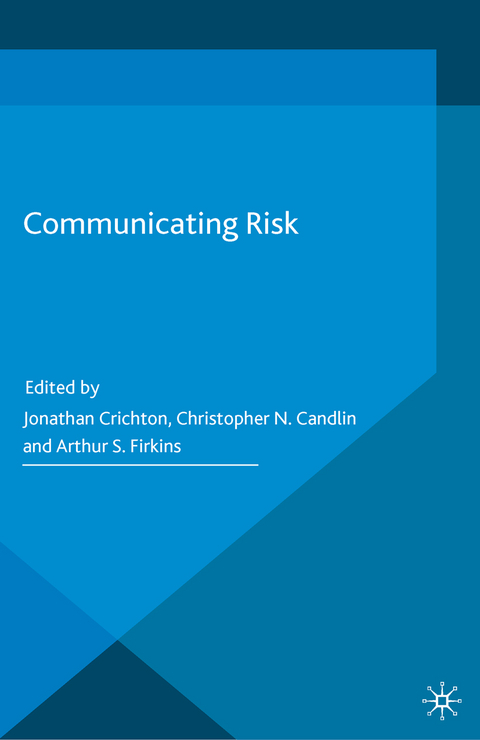
Communicating Risk (eBook)
XVIII, 368 Seiten
Palgrave Macmillan UK (Verlag)
9781137478788 (ISBN)
Andy Alaszewski, University of Kent, UK Suellen Allen, Australian Commission on Safety & Quality in Health Care Jos Arts, University of Groningen, the Netherlands Katja Beitat, NSW Health Care Complaints Commission, Australia Clea D. Bourne, Goldsmiths, University of London, UK Kate Bower, University of Tasmania, Sydney, Australia Christopher N. Candlin, Macquarie University, Australia Sally Candlin, Macquarie University, Australia Stephen Case, Swansea University, UK Michael Coffey, Swansea University, UK Juanne Clarke, Wilfrid Laurier University in Waterloo, Canada Jonathan Crichton, University of South Australia Paul De Barro, CSIRO Biosecurity Flagship, Australia Arthur Stuart Firkins, Macquarie University, Australia Iina Hellsten, VU University Amsterdam, the Netherlands Su-yin Hor, University of Tasmania, Australia Rick Iedema, NSW Ministry of Health - Agency of Clinical Innovation, Australia Rodney Jones, City University of Hong Kong Philippe Hanna, University of Groningen, The Netherlands Karen Henwood, Cardiff School of Social Sciences, UK Changpeng Huan, Macquarie University, Australia Sue McKell, The University of Queensland, Australia Susan Mello, The Ohio State University, USA Donya Mosleh, Wilfrid Laurier University of Waterloo, Canada Brigitte Nerlich, University of Nottingham, UK Pat O'Malley, University of Sydney, Australia Catherine O'Grady, Macquarie University, Australia Bindu Patel, University of Sydney, Australia David Peiris, University of Sydney, Australia Nick Pidgeon, Cardiff University, UK Donella Piper, Independent Scholar Fiona O'Neill, University of South Australia Mandie Scamell, City University London, UK Tony Stanley, London Borough of Tower Hamlets, UK Christopher Shaw, University of Oxford, UK Tim Usherwood, University of Sydney Westmead, Australia Frank Vanclay, University of Groningen, The Netherlands Joe Yates, Liverpool John Moores University, UK
We live in world increasingly shaped by risk, a fact underscored by recent events in the financial markets, science and technology, environmental policy and biosecurity, law enforcement and criminal justice. Risk assessment has become a central concern of governments, organisations and the professions, and the communication of risk is a crucial part of professional work. Exploring how risk is discursively constructed across these domains is therefore central to our understanding of how professional practice affects people's lives. Communicating Risk takes up this challenge, with contributions from leading researchers and practitioners that examine key issues of risk communication across diverse professional domains.
Jonathan Crichton is Senior Lecturer in Applied Linguistics and Member of the Research Centre for Languages and Cultures at the University of South Australia. His research focuses on the role of language in professional-lay interactions. He has published in a wide range of international journals and edited collections and is the author of The Discourse of Commercialization (2010), and co-editor, with Christopher N. Candlin, of Discourses of Deficit (2011) and Discourses of Trust (2013).Christopher N. Candlin was Senior Research Professor Emeritus in the Department of Linguistics at Macquarie University, Sydney, and a Fellow of the UK Academy of Social Sciences. His research and publications lie in the critical analysis of professional/institutional discourses. He was a member of the Editorial Boards of major international journals and co-edited, with Srikant Sarangi, the Journal of Applied Linguistics and Professional Practice. Recent publications include Discourses of Deficit (2011) and Discourses of Trust (2013) both co-edited with Jonathan Crichton.Arthur S. Firkins has had extensive involvement with risk communication in the public and private sectors. His doctoral research focused on the discursive framing of risk, he has co-authored recent papers with Christopher N. Candlin on the communication of risk in social care and currently works for BAE-Systems.
1. Crucial Sites and Research Orientations: Exploring the Communication of Risk; Christopher N. Candlin, Jonathan Crichton and Arthur FirkinsPART I: COMMUNICATING RISK IN HEALTHCARE2. Risk and Clinical Incident Disclosure: Navigating between Morality and Liability; Rick Iedema, Donella Piper, Katja Beitat, Suellen Allen, Kate Bower and Suyin Hor3. 'Being Diplomatic with the Truth': The Discursive Management of Risk in Accounts of People Leaving Forensic Psychiatric Settings; Michael Coffey4. Risk and Safety in Linguistic and Cultural Diversity: A Narrative Intervention in Residential Aged Care; Jonathan Crichton and Fiona O'Neill5. Choice, Risk and Moral Judgement: Using Discourse Analysis to Identify the Moral Component of Midwives' Discourses; Mandie Scamell and Andy AlaszewskiPART II: COMMUNICATING RISK IN LEGAL PROCESSES6. Risk, Law and Security; Pat O'Malley7. 'Making a Raise' and 'Dusting the Feds': Contextualising Constructions of Risk and Youth Crime; Joe YatesPART III: COMMUNICATING RISK IN SOCIAL CARE8. The Discourse of Risk in Youth Justice: A Numbers Game; Stephen Case9. Working with Risk in Child Welfare Settings; Tony StanleyPART IV: COMMUNICATING RISK IN ENVIRONMENTAL MANAGEMENT AND BIOSECURITY10. Interpretive Environmental Risk Research: Affect, Discourses and Change; Karen L. Henwood and Nick Pidgeon11. Social Risk, Relationships with Communities, and Corporate Culture; Philippe Hanna, Frank Vanclay and Jos Arts12. How Structured Dialectical Discourse of Risk Eased Tension in North American LNG Siting Conflicts; Susan Mello13. Framing Risk and Uncertainty in Social Science Articles on Climate Change, 1995-2012; Christopher Shaw, Iina Hellsten and Brigitte Nerlich 14. Between Two Absolutes Lies Risk: Risk Communication in Biosecurity Discourse; Sue McKell and Paul De BarroPART V: MEDIATING RISK15. Negotiating Risk in Chinese and Australian Hard News Reporting on Food Safety: A Corpus-based Study; Changpeng Huan16. The Uses of Biological Sciences to Justify the Risks of Children's Mental Health and Developmental Disorders in North American Newsmagazines: 1990 to 2012; Juanne N. Clarke and Donya Mosleh17. 'It's Just Statistics ... I'm Kind of a Glass Half-full Sort of Guy': The Challenge of Differing Doctor-Patient Perspectives in the Context of Electronically-mediated Cardiovascular Risk Management; Catherine O'Grady, Bindu Patel, Sally Candlin, Christopher N Candlin, David Peiris and Tim UsherwoodPART VI: REGULATING RISK18. Central Banking in Risk Discourses: 'Remaking the Economy After Crisis; Clea D Bourne19. Projecting a Definition of Risk Situation: Travel Advice and the Prudent Traveller; Arthur S. Firkins and Christopher N. Candlin20. Suicide Candy: Tracing the Discourse Itineraries of Food Risk; Rodney H. Jones
| Erscheint lt. Verlag | 5.1.2016 |
|---|---|
| Reihe/Serie | Communicating in Professions and Organizations | Communicating in Professions and Organizations |
| Zusatzinfo | XVIII, 368 p. |
| Verlagsort | London |
| Sprache | englisch |
| Themenwelt | Geisteswissenschaften ► Psychologie ► Sozialpsychologie |
| Geisteswissenschaften ► Sprach- / Literaturwissenschaft ► Sprachwissenschaft | |
| Technik | |
| Wirtschaft ► Betriebswirtschaft / Management | |
| Schlagworte | Applied Linguistics • Communication • conflict • Corporate Communication • discourse • Discourse analysis • Linguistics • Personality • Professional communication • Psychology • Risk • Social Psychology • Social Science • Sociology • Work |
| ISBN-13 | 9781137478788 / 9781137478788 |
| Informationen gemäß Produktsicherheitsverordnung (GPSR) | |
| Haben Sie eine Frage zum Produkt? |
 PDF (Wasserzeichen)
DRM: Digitales Wasserzeichen
Dieses eBook enthält ein digitales Wasserzeichen und ist damit für Sie personalisiert. Bei einer missbräuchlichen Weitergabe des eBooks an Dritte ist eine Rückverfolgung an die Quelle möglich.
Dateiformat: PDF (Portable Document Format)
Mit einem festen Seitenlayout eignet sich die PDF besonders für Fachbücher mit Spalten, Tabellen und Abbildungen. Eine PDF kann auf fast allen Geräten angezeigt werden, ist aber für kleine Displays (Smartphone, eReader) nur eingeschränkt geeignet.
Systemvoraussetzungen:
PC/Mac: Mit einem PC oder Mac können Sie dieses eBook lesen. Sie benötigen dafür einen PDF-Viewer - z.B. den Adobe Reader oder Adobe Digital Editions.
eReader: Dieses eBook kann mit (fast) allen eBook-Readern gelesen werden. Mit dem amazon-Kindle ist es aber nicht kompatibel.
Smartphone/Tablet: Egal ob Apple oder Android, dieses eBook können Sie lesen. Sie benötigen dafür einen PDF-Viewer - z.B. die kostenlose Adobe Digital Editions-App.
Buying eBooks from abroad
For tax law reasons we can sell eBooks just within Germany and Switzerland. Regrettably we cannot fulfill eBook-orders from other countries.
aus dem Bereich