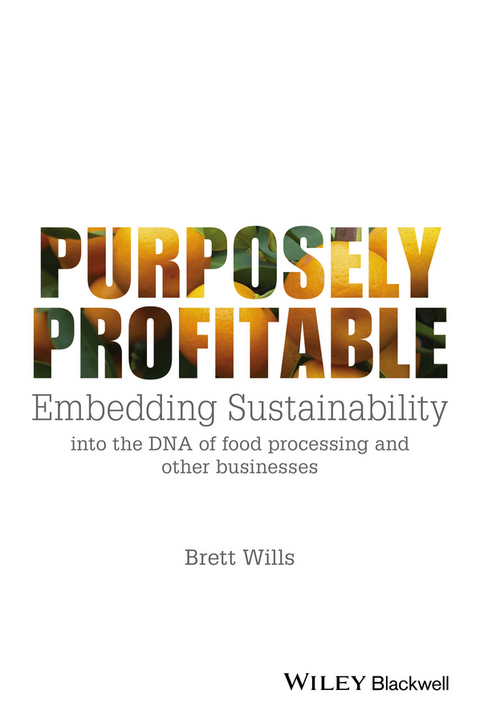
Purposely Profitable (eBook)
John Wiley & Sons (Verlag)
978-1-118-97814-6 (ISBN)
Competing and winning in today?s competitive marketplace requires a strategy that includes sustainability. Business leaders who embrace it and convey a strong sense of purpose behind their strategy are propelling their organizations into revenue-increasing, cost-reducing outcomes.
Purposely Profitable: Embedding Sustainability into the DNA of Food Processing and other Businesses provides a proven, step-by-step methodology for integrating sustainability into the strategic plan to develop a strategy that is sustainable and aligned to a greater purpose. This book notably includes the following:
- A primer on Sustainability that defines Sustainable Business and presents the Business Case for Sustainability
- What is an organizational purpose and why is it so important in today?s competitive marketplace
- Step by step instructions, supported by a case study, for developing each component of the strategic plan (Purpose, Vision, Strategic Pillars, KPI?s, Goals, Programs Action Plans, and Tactical Execution)
- A suite of tools and resources to support the development and execution of the strategic plan
Scientists and managers in the global food supply chain, sustainability professionals, researchers, students, regulators, executives and business owners will come to learn and understand a powerful system for developing a strategy that is sustainable in order to maximize organizational performance.
Competing and winning in today's competitive marketplace requires a strategy that includes sustainability. Business leaders who embrace it and convey a strong sense of purpose behind their strategy are propelling their organizations into revenue-increasing, cost-reducing outcomes. Purposely Profitable: Embedding Sustainability into the DNA of Food Processing and other Businesses provides a proven, step-by-step methodology for integrating sustainability into the strategic plan to develop a strategy that is sustainable and aligned to a greater purpose. This book notably includes the following: A primer on Sustainability that defines Sustainable Business and presents the Business Case for Sustainability What is an organizational purpose and why is it so important in today's competitive marketplace Step by step instructions, supported by a case study, for developing each component of the strategic plan (Purpose, Vision, Strategic Pillars, KPI's, Goals, Programs Action Plans, and Tactical Execution) A suite of tools and resources to support the development and execution of the strategic plan Scientists and managers in the global food supply chain, sustainability professionals, researchers, students, regulators, executives and business owners will come to learn and understand a powerful system for developing a strategy that is sustainable in order to maximize organizational performance.
BRETT WILLS is President, Green Enterprise Movement Inc.; Director Sustainability, HPS Inc.; and Professor, Seneca College, Toronto, Canada.
About the Author, x
Sustainability Primer, xi
Understanding sustainability, xi
The sustainable organization, xiv
Business case for sustainability, xxii
Introduction - Setting the Stage, xxvi
Chapter 1 Finding Purpose, 1
1.1 Why a purpose?, 3
1.2 Finding purpose and developing a purpose statement, 4
Step 1: Articulating the purpose, 5
Step 2: Crafting a purpose statement, 6
Step 3: Finalizing the purpose statement, 7
Chapter 2 Creating a Shared Vision of the Future, 9
2.1 Crafting a meaningful vision statement, 11
Step 1: Setting the stage, 11
Step 2: Key word development, 12
Step 3: Key word grouping, 13
Step 4: Key word identification, 13
Step 5: Drafting a vision statement, 13
Step 6: Finalizing the vision statement, 14
2.2 Creating a shared vision, 14
2.2.1 Painting a clear picture of the future state, 15
2.2.2 Aligning daily activities to the vision, 16
Chapter 3 Getting Focused - Pillar Development, 18
3.1 The power of pillars, 19
3.1.1 Providing clear direction and focus, 19
3.1.2 Creating a culture of Sustainability, 21
3.2 Building the pillars, 22
Step 1: Pillar identification, 22
Step 2: Integrating Sustainability into the pillars, 25
Step 3: Pillar key word development, 32
Step 4: Key word grouping, 35
Step 5: Developing pillar mission statements, 36
3.3 Visually illustrating the pillars, 38
Chapter 4 Financial Objectives, 41
4.1 Understanding business objectives, 42
4.2 Setting business objectives, 44
4.2.1 Setting a Revenue objective, 45
4.2.2 Setting a Gross Margin objective, 46
4.2.3 Setting an Overhead objective, 48
Chapter 5 Measuring What Matters - KPI Development, 51
5.1 Understanding KPIs and metrics, 52
5.1.1 Leading vs lagging, 53
5.1.2 Absolute vs normalized measures, 54
5.2 Pillar KPI development, 55
Step 1: Identify what needs to be measured, 56
Step 2: Identifying KPIs vs metrics, 58
Step 3: Defining the KPI number, 62
Step 4: Building the baselines, 64
5.3 Building a dashboard, 66
Chapter 6 Setting Expectations - KPI Goal Development, 69
External benchmarking, 73
Internal benchmarking, 74
Opportunity based benchmarking, 74
6.1 Pillar goal development, 75
Step 1: Choose goal-setting approach, 75
Step 2: Setting a commitment level (goal), 79
Step 3: Setting milestones, 83
Step 4: Assigning ownership, 86
Chapter 7 Adding Value - Program Development, 89
7.1 Program development, 92
Step 1: Gap analysis, 92
Step 2: Pareto analysis, 93
Step 3: Program identification, 94
Step 4: Program metric development, 96
Step 5: Program goal development, 97
Step 6: Action plan development, 99
Chapter 8 Getting Tactical - Strategy Execution, 102
8.1 Communicating the strategic plan, 103
8.1.1 Purpose, 104
8.1.2 Pillars, 106
8.1.3 KPIs, 107
8.1.4 Goals (aka Commitments), 107
8.1.5 Programs, 108
8.2 Cascading the strategic plan, 108
8.3 Building accountability, 109
8.4 Managing strategy execution, 112
8.4.1 Building the right team, 114
8.4.2 Being disciplined, 115
8.4.3 Locking in the gains, 116
8.5 Leveraging technology, 117
Final Thoughts: Making the Leap, 119
Tools and Resources, 126
References, 140
Index, 141
Sustainability Primer
Understanding sustainability
Viewed by many as one of the largest movements in history, Sustainability means many things to many people. Ask the mayor of a city and they may talk about reducing the social and environmental impacts of urban development, ask a farmer and they may talk about environmentally friendlier agricultural practices or the importance of local food, ask a corporate executive and they may talk about energy conservation or strategic philanthropy.
Because Sustainability means many things to many people, it can be challenging to understand. Why are there so many views or “definitions” of Sustainability? The answer is quite simple but requires an understanding of the basic, fundamental concept of Sustainability which is to balance and continually improve social, environmental and economic performance. Recognizing this basic concept leads to understanding how a farmer would define Sustainability differently than an executive or mayor since the focus for improving social, environmental and economic performance will vary based on the end goal. For example, a farmer may be focused on the long term health of soil, where a corporate executive may be focused on energy conservation. At the end of the day, while the detailed description of how to achieve Sustainability may differ depending on who is asked, the basic concept and end game remains the same.
Given the focus of this book is on enhancing organizational performance, the concept of Sustainability as presented in this Primer and throughout other chapters, refers to Sustainability as it applies to organizations, regardless of the type of organization. The organization may be a private business, non-profit organization, even government organization.
To clearly define Sustainability as it applies to an organization, it’s easier to start with a broad definition and distill this down to provide a more specific understanding. At a holistic, global level, one of the most popular definitions of Sustainability comes from the Brundtland Report (WCED, 1987) and defines Sustainability as “The ability to meet the needs of today’s generation without compromising the ability of future generations to meet their own needs”. While this provides a good start to defining Sustainability at a macro level, it leaves many questions unanswered when it comes to Sustainability on a more micro of firm level.
Fortunately, in the mid-1980s another widely accepted definition of Sustainability emerged when an organization called The Natural Step (TNS) was founded by a Swedish Doctor – Karl Henrik Robert. TNS set out to further clarify the meaning of Sustainability. In their efforts, TNS realized it was incredibly difficult to define what Sustainability is since it can mean so many things to so many people and thus, took a reverse angle to defining Sustainability. Instead of defining what Sustainabilityis, TNS asked what cannot happen if a system is to be sustainable? With this thinking, TNS developed four system conditions that must be satisfied in order for a system to be sustainable (www.thenaturalstep.org); let’s explore these further.
The Natural Step four system conditions for sustainability
System condition no. 1
Resources from the Earth’s crust (i.e. oil, copper, etc.) cannot be extracted faster than they can be regenerated. Since resources in the Earth’s crust take thousands of years to develop, they are, for all intents and purposes, non-renewable. Like anything finite, continuing to consume these resources will eventually lead to their depletion which, in the long term, is unsustainable. This suggests that extraction of resources from the Earth’s crust must stop (or dramatically slow down) and practices must migrate to more renewable and sustainable solutions. How to do this becomes a focus of Sustainability efforts based on the types of resources being consumed.
System condition no. 2
Toxins and pollutants cannot be discharged into the atmosphere faster than the earth can clean or otherwise deal with them. Picture a bubble that is closed off from everything around it (similar to Earth’s closed atmosphere). Inside this bubble, there is one smoke stack and one tree. If the tree can clean 1 tonne of CO2e out of the air every year and thesmoke stack discharges 1 tonne of CO2e every year, there is a balance inside that bubble that can be sustained over time. However, once the stack discharges more than 1 tonne of CO2e, balance is disrupted, a build-up of toxins and pollutants occurs, resulting in environmental destruction, which is unsustainable over the long term. The point being, that while some “pollution” can be cleaned and tolerated by the Earth, it must be at a level that is sustainable. Additionally, there can be no toxins or pollutants discharged into the atmosphere or the environment that the Earth cannot deal with or handle, such as some fire retardants. Since these types of toxins and pollutants cannot be broken down by the environment, they stick around forever resulting in environmental destruction, which over the long term is also unsustainable. Again, how this is achieved becomes the focus of Sustainability efforts based on the types of toxins and pollutants be discharged.
System condition no. 3
Surface level resources (both on land and underwater) cannot be destroyed faster than they can be regenerated. Take a lake, for example, if fish in the lake are harvested faster than they regenerate, eventually there will be no fish left. Not only is this unsustainable for the specific species of fish, it can have a negative ripple effect on other species and the overall eco-system of which they belong. The point here is that the harvesting or destruction of surface level resources need not necessarily stop. Rather it needs to be done at a rate that allows for regeneration enabling continual use or harvesting over the long term, making it a sustainable source of resources. Once again, how this is achieved becomes the focus of Sustainability efforts based on the types of surface level resources being harvested or destroyed.
These first three system conditions are clearly focused on the environmental dimension of Sustainability, while the following fourth and final system condition looks at the higher level social and economic dimensions.
System condition no. 4
The world’s resources cannot be inequitably distributed such that basic human needs are not met for all people around the world. In other words, social and economic systems must ensure at least the basic human needs of food, shelter, and water have been met for all people on Earth. If people do not have their basic human needs met,people focus solely on meeting those basic human needs and nothing else (i.e. reducing environmental impact). Therefore the social and economic conditions of the system must operate in a way that, at a minimum, covers the basic needs of people within that system. Now, this is where the definition of Sustainability differs between say a country or city vs that of a business or other type of organization.
This definition offered up by The Natural Step provides a much clearer picture of what Sustainability means at a broad, macro level. Clearly, satisfying these four system conditions would allow “current generations to meet their own needs without compromising the ability of future generations to meet their needs.” The problem here is that this high-level picture of Sustainability is so broad that it becomes challenging to apply this at the macro of firm level, particularly when it comes the fourth system condition relating to the social and economic dimensions of Sustainability.
The sustainable organization
Building on the broader definitions provided by Brundtland and The Natural Step, organizations around the world began asking how the concept of Sustainability could be more specifically applied to the business world. Many argue this movement was sparked by the publication of Paul Hawken’s (1993) ground-breaking bookThe Ecology of Commerce. In this best-selling book, Paul Hawken aims to revolutionize the relationship between business and the environment. Sparked, perhaps by Paul Hawken’s book or whatever the impetus may have been, organizations around the world began to have a closer look at how Sustainability applied specifically to organizations. After much discussion, many conferences, summits, boardroom meetings, round tables, etc., a refined notion of Sustainability, one that applies specifically to organizational Sustainability, emerged in the early to mid-1990s. Let’s take a closer look at what Sustainability means from an organizational perspective.
In the business world, many terms for Sustainability have been used including: Environmental & Social Governance (ESG); “triple bottom line” or People (Social), Planet (Environmental) and Profit (Economic). Today it is widely accepted to simply use the term “Sustainability.” Regardless of what one calls it, Sustainability at the micro or firm level is similar to the global view in that it is basedupon improving the three basic dimensions of Sustainability: social, environmental, and economic performance (Fig. P.1). More specifically, Sustainability from a business perspective can be defined as continuously improving and balancing social, environmental, and economic...
| Erscheint lt. Verlag | 25.2.2016 |
|---|---|
| Sprache | englisch |
| Themenwelt | Naturwissenschaften ► Biologie |
| Naturwissenschaften ► Chemie | |
| Technik ► Lebensmitteltechnologie | |
| Wirtschaft ► Betriebswirtschaft / Management | |
| Weitere Fachgebiete ► Land- / Forstwirtschaft / Fischerei | |
| Schlagworte | Agriculture • Chemie • Chemistry • Corporate Social Responsibility • Embedding Sustainability • Environmental sustainability • Food Management • Food Science & Technology • Key Performance Indicators • Landwirtschaft • Lebensmittelforschung u. -technologie • Lebensmittel-Management • Nachhaltiger u. organischer Landbau • Nachhaltige u. Grüne Chemie • Nachhaltige u. Grüne Chemie • purpose driven organizations • Strategic Planning • Strategy • strategy alignment • Strategy Execution • sustainability • Sustainable & Organic Agriculture • Sustainable Chemistry & Green Chemistry |
| ISBN-10 | 1-118-97814-5 / 1118978145 |
| ISBN-13 | 978-1-118-97814-6 / 9781118978146 |
| Informationen gemäß Produktsicherheitsverordnung (GPSR) | |
| Haben Sie eine Frage zum Produkt? |
 EPUB (Adobe DRM)
Kopierschutz: Adobe-DRM
Adobe-DRM ist ein Kopierschutz, der das eBook vor Mißbrauch schützen soll. Dabei wird das eBook bereits beim Download auf Ihre persönliche Adobe-ID autorisiert. Lesen können Sie das eBook dann nur auf den Geräten, welche ebenfalls auf Ihre Adobe-ID registriert sind.
Details zum Adobe-DRM
Dateiformat: EPUB (Electronic Publication)
EPUB ist ein offener Standard für eBooks und eignet sich besonders zur Darstellung von Belletristik und Sachbüchern. Der Fließtext wird dynamisch an die Display- und Schriftgröße angepasst. Auch für mobile Lesegeräte ist EPUB daher gut geeignet.
Systemvoraussetzungen:
PC/Mac: Mit einem PC oder Mac können Sie dieses eBook lesen. Sie benötigen eine
eReader: Dieses eBook kann mit (fast) allen eBook-Readern gelesen werden. Mit dem amazon-Kindle ist es aber nicht kompatibel.
Smartphone/Tablet: Egal ob Apple oder Android, dieses eBook können Sie lesen. Sie benötigen eine
Geräteliste und zusätzliche Hinweise
Buying eBooks from abroad
For tax law reasons we can sell eBooks just within Germany and Switzerland. Regrettably we cannot fulfill eBook-orders from other countries.
aus dem Bereich