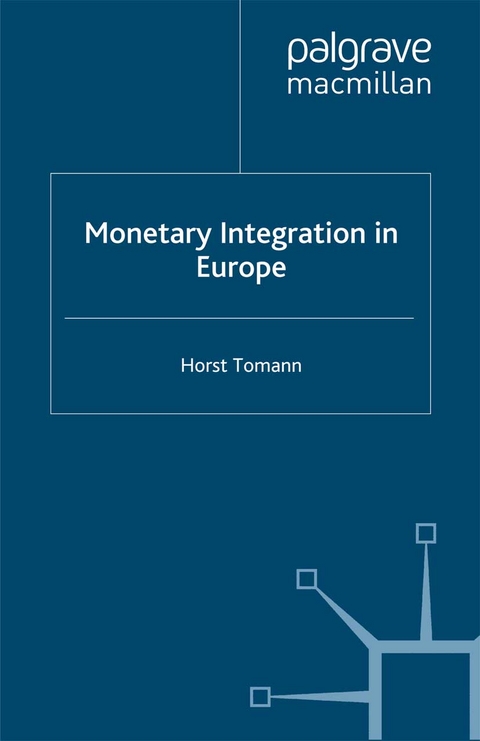
Monetary Integration in Europe (eBook)
XIV, 154 Seiten
Palgrave Macmillan UK (Verlag)
978-0-230-28862-1 (ISBN)
Can the European Economic and Monetary Union survive as an institution providing the highest degree of monetary integration? Can it withstand crises in international markets and contribute to the stability of the global financial system? This book addresses these questions, emphasising the need for new forms of economic policy coordination.
HORST TOMANN is Jean Monnet Professor for European Economic Policy at the Economics Department, Freie University of Berlin, Germany. He received his academic education at the Universities of Cologne and the Saarland, and was a staff member at the German Council of Economic Experts. He has had several appointments as Visiting Professor, among others at the University of Pennsylvania (Wharton School) and the University of Birmingham. His main research field is applied economics with a special focus on the economics of European integration. He is the co-editor of Palgrave Macmillan's book series Studies in Economic Transition.
Cover 1
Series 2
Title 4
Copyright 5
Half-Title 6
Dedication 7
Content 8
List of Figures, Tables and Boxes 10
List of Abbreviations 12
Preface 14
1 The History of Monetary Integration in Europe 16
1.1 The European Payments Union 17
1.2 The Bretton Woods System 21
1.3 A currency system of 'no commitments' 24
1.4 The European Monetary System 26
2 Theory of Optimum Currency Areas 32
2.1 Wage rigidity and money illusion 35
2.2 The credibility of a common currency 38
2.3 Effects of collusion in the labour market 40
3 The Economic and Monetary Union: Institutions and Credibility 47
3.1 The new money constitution 48
3.2 Independence, accountability and transparency 53
3.3 The EMU as a regime of low inflation 58
4 The Monetary Policy Strategy of EMU 63
4.1 How monetary policy affects expenditures and prices 63
4.2 Concepts of monetary policy 70
4.3 The performance of the Eurosystem 77
5 Fiscal Policy Coordination and the Stability and Growth Pact 89
5.1 How fiscal policy affects aggregate demand 90
5.2 Is there a need for a national fiscal policy? 93
5.3 The Stability and Growth Pact 95
5.4 Fiscal policy in EMU 98
5.5 The reform debate 101
6 The EMU and the Wage Bargain 106
6.1 How the wage bargain affects employment and real wages 108
6.2 Real wage flexibility in the EMU 115
6.3 Interaction of monetary policy and the wage bargain 125
7 Real Convergence in a Monetary Union 133
7.1 Long-term effects of a monetary union 134
7.2 Wage and price adjustments and the catch-up 136
7.3 Real interest rates and growth divergence 141
7.4 Policy implications 143
8 The New European Monetary System 147
8.1 Basic choices for pre-ins 148
8.2 Features of ERM II 153
8.3 The performance of monetary convergence 156
Index 162
| Erscheint lt. Verlag | 5.2.2016 |
|---|---|
| Reihe/Serie | Studies in Economic Transition | Studies in Economic Transition |
| Zusatzinfo | XIV, 154 p. 3 illus. |
| Verlagsort | London |
| Sprache | englisch |
| Themenwelt | Wirtschaft ► Betriebswirtschaft / Management |
| Wirtschaft ► Volkswirtschaftslehre ► Finanzwissenschaft | |
| Wirtschaft ► Volkswirtschaftslehre ► Makroökonomie | |
| Schlagworte | Economic Policy • Fiscal Policy • growth • monetary policy • Monetary Union |
| ISBN-10 | 0-230-28862-6 / 0230288626 |
| ISBN-13 | 978-0-230-28862-1 / 9780230288621 |
| Informationen gemäß Produktsicherheitsverordnung (GPSR) | |
| Haben Sie eine Frage zum Produkt? |
 PDF (Wasserzeichen)
DRM: Digitales Wasserzeichen
Dieses eBook enthält ein digitales Wasserzeichen und ist damit für Sie personalisiert. Bei einer missbräuchlichen Weitergabe des eBooks an Dritte ist eine Rückverfolgung an die Quelle möglich.
Dateiformat: PDF (Portable Document Format)
Mit einem festen Seitenlayout eignet sich die PDF besonders für Fachbücher mit Spalten, Tabellen und Abbildungen. Eine PDF kann auf fast allen Geräten angezeigt werden, ist aber für kleine Displays (Smartphone, eReader) nur eingeschränkt geeignet.
Systemvoraussetzungen:
PC/Mac: Mit einem PC oder Mac können Sie dieses eBook lesen. Sie benötigen dafür einen PDF-Viewer - z.B. den Adobe Reader oder Adobe Digital Editions.
eReader: Dieses eBook kann mit (fast) allen eBook-Readern gelesen werden. Mit dem amazon-Kindle ist es aber nicht kompatibel.
Smartphone/Tablet: Egal ob Apple oder Android, dieses eBook können Sie lesen. Sie benötigen dafür einen PDF-Viewer - z.B. die kostenlose Adobe Digital Editions-App.
Buying eBooks from abroad
For tax law reasons we can sell eBooks just within Germany and Switzerland. Regrettably we cannot fulfill eBook-orders from other countries.
aus dem Bereich