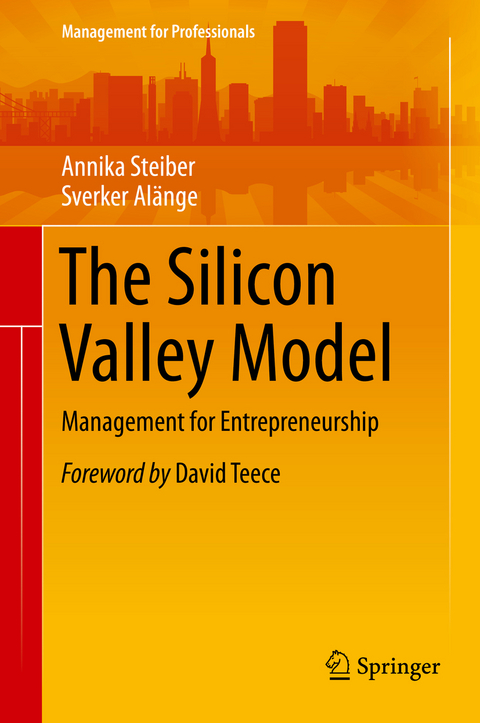
The Silicon Valley Model (eBook)
XV, 171 Seiten
Springer International Publishing (Verlag)
978-3-319-24921-6 (ISBN)
This book presents a new management model that has evolved in Silicon Valley. The future will favor companies that can migrate to a management model, better suited for the times. The abilities to remain entrepreneurial and innovate constantly will be essential for all companies in an innovation economy. However, most firms still use industrial-age management models that are not suited to attracting and energizing entrepreneurial talent. This book imbibes latest results from a year-long study of Google's approaches to management, and finds similar principles being applied at companies including, Facebook, LinkedIn, Twitter, Tesla Motors, and Apigee. By distilling on the aspects that work across a variety of innovative firms, the authors present a synthesis that could have profound implications for managers everywhere.
Annika Steiber, PhD Researcher, Lecturer and Advisor in Management Dr. Steiber is an international authority in the field of innovation management and the author of several award-winning articles and a book (The Google Model: Managing Continuous Innovation in a Rapidly Changing World). She holds a Ph.D. in Management and Organization from Chalmers University of Technology in Sweden and has 18 years of experience in creating growth for companies in the private sector. Currently she works as a lecturer, researcher and advisor. In her consultancy work she is affiliated with Strategos Inc., an American company founded by the thought leader Gary Hamel with cutting-edge competence in the management of innovation. Dr. Steiber is the author of 'The Google Model' (Springer, 2014).
Sverker Alänge is Associate Professor in the Department of Technology Management and Economics at Chalmers University of Technology, Gothenburg, Sweden. He has a Ph.D. in Industrial Management and an M.Sc. in Mechanical Engineering. His research interests are innovation and change processes in firms and innovation systems, entrepreneurship and sustainable business development.
Annika Steiber, PhD Researcher, Lecturer and Advisor in Management and Organization. Dr. Steiber is an international authority in the field of management and the author of several award-winning articles and books. She has over 18 years of operational experience in creating growth for both start-ups and larger companies in the private sector. Currently she is the Founder and CEO of INNOWAY and works as a lecturer, researcher and advisor. In her consultancy work she is affiliated with Berkeley Research Group, founded by thought leader professor David Teece and with Strategos, founded by thought leader Gary Hamel. Dr. Steiber is the author of "The Google Model" (Springer, 2014).Sverker Alänge is Associate Professor in the Department of Technology Management and Economics at Chalmers University of Technology, Gothenburg, Sweden. He has a Ph.D. in Industrial Management and an M.Sc. in Mechanical Engineering. His research interests are innovation and change processes in firms and innovation systems, entrepreneurship and sustainable business development.
Foreword 6
Preface: It´s Time for a New Model 8
Contents 12
1: The World Is Changing 17
1.1 Introducing a New Management Model 17
1.2 The Changing Nature of Change (And What It Means for Management) 19
1.2.1 Implications for Management: Drawbacks of the Old Way 21
1.2.2 The New Model: Essentially Entrepreneurial 22
1.3 Tales of Two Industries 23
1.3.1 The Clothing Industries: Textiles, Garments, Shoes, Retail 23
1.3.2 Telephones and Phone Services 25
1.3.3 What Can We Learn? 27
1.4 The High Road Versus the Missed Turn: Comparing New and Old Management Models 28
1.4.1 Finding the High Road: The Entrepreneurial Path 28
1.4.2 Missing the Turn: The Case of Kodak 31
1.5 Moving On 32
References 32
2: Six Basic Principles for a Changing World 34
2.1 Dynamic Capabilities 36
2.1.1 When `Core Competencies´ Aren´t Enough 36
2.1.2 Dynamic Capabilities: A New Concept of Corporate Resources 37
2.2 A Continually Changing Organization 39
2.2.1 Some Practices Allowing Continual Change 39
2.3 A People-Centric Approach 41
2.4 An Ambidextrous Organization 43
2.5 An Open Organization That Networks with Its Surroundings 45
2.6 A Systems Approach 46
2.7 Moving On 49
References 49
3: Silicon Valley: A Cradle of Management Innovation 51
3.1 The Forces That Drive Management Innovation, in Brief 52
3.2 Management Innovation: The Influence of IT 54
3.2.1 New Ways of Managing Emerge 55
3.3 Management Innovation: The Influence of Regional Culture 57
3.3.1 The Early Electronics Industry 58
3.4 Management Innovation: New Levels of Networking 60
3.5 Management Innovation: People Focus, from Postwar to the Present 61
3.6 Closing Notes (With Remarks on `Replicating´ Silicon Valley) 64
References 65
4: Entrepreneurship: What It Really Is, and Why It Must Be Integrated into Management of the Firm 66
4.1 What Is Entrepreneurship? 67
4.1.1 A Modern Understanding (and a New Definition) 68
4.1.2 The Company as `Entrepreneur´ 70
4.2 The Divide Between Entrepreneurship and Management: Obstacles and Evolutionary Forces 71
4.2.1 How Business Schools Reinforced the Split 72
4.2.2 Toward a Re-synthesis of Entrepreneurship and Management 74
4.3 What Can a Company Do? 75
References 75
5: A Special Breed of People 77
5.1 Focusing on the `Special Breed,´ from Google Onward 78
5.2 On `Multidimensional´ People and the Need for Them 80
5.3 Cornerstones of Success: Five Core Qualities of the `Special Breed´ 82
5.3.1 Entrepreneurial 83
5.3.2 Adaptable 83
5.3.3 Passionate 85
5.3.4 Constantly Questioning the Status Quo 85
5.3.5 Collaborative 86
5.4 Attracting the Special Breed 87
5.5 How Do We Keep These People? 90
5.5.1 The Ugly Duckling 90
5.5.2 Meaningful Work, Perks and Benefits 91
5.5.3 The Employer-Employee Alliance 93
5.6 Conclusions (and a Start) 96
References 96
6: Culture: The New Black 98
6.1 What `Culture´ Consists Of 98
6.2 External Influences on Culture 100
6.3 The People Effect: How Founders Shape Culture 101
6.4 Steps to Building a Strong Culture 103
6.5 The `10 Commandments´: Core Attributes of the Cultures We Studied 104
6.5.1 Not an Ordinary Company 105
6.5.2 Things Change Constantly and We Need to Be Adaptable 106
6.5.3 Move Fast, Speed Matters 107
6.5.4 Hiring Is the Most Important Thing We Do 108
6.5.5 Product Excellence Is Key 109
6.5.6 Data-Driven Decision Making and Fast Learning 110
6.5.7 A Flat Organization with Minimal Bureaucracy 111
6.5.8 Openness and Transparency 112
6.5.9 Leaders, Not Managers 112
6.5.10 Build an Ecosystem, Not Just a Company 114
6.6 Concluding Comments 115
References 115
7: Leading for Entrepreneurship 116
7.1 Top Leaders´ Roles 117
7.2 Providing Direction and Expectation Level 118
7.3 Communication and Leader Behavior 120
7.4 Founder Entrepreneurs 123
7.5 The Role of Leaders on the Middle Levels 124
7.6 Decision-Making 125
7.7 Incentives and Motivation 126
7.8 Hiring and Developing Leaders 128
7.9 Concluding Comments 129
References 130
8: The Entrepreneurial Organization Is Dynamic and Ambidextrous 132
8.1 Dynamic Capabilities 133
8.1.1 Ambidexterity in Theory 134
8.1.2 The Challenge of Ambidexterity 135
8.2 Innovation by Many, Inside Present Operations 136
8.2.1 Top Executive Focus 136
8.2.2 The `Semi-Structured´ State 137
8.2.3 Small Teams 137
8.2.4 Transparency and Openness 138
8.2.5 Heuristics or `Simple Rules´ 138
8.2.6 Intrinsic Incentives in Meaningful Work 140
8.2.7 Rapid Learning Processes 141
8.2.8 Big Data on User Behavior 142
8.3 Innovation by Separate Innovation Units 142
8.3.1 Acquisitions 143
8.3.2 Corporate Ventures 143
8.3.3 Small Firm-Large Firm Ventures 145
8.3.4 Spin-Ins and Incubation 145
8.4 Open Innovation Approaches 146
8.4.1 University Interaction 147
8.4.2 Suppliers as Innovators 147
8.4.3 Crowdsourcing from Users and Communities 147
8.4.4 External Development Platforms 149
8.4.5 Cultivating Ecosystems 149
8.5 Concluding Comments 150
References 151
9: The Silicon Valley Model 154
9.1 The Evolution of a New Breed of Organizations 154
9.1.1 The New Model´s Roots in `Adhocracy´ 155
9.2 The Silicon Valley Model: `A Startup in a Large Suit´ 157
9.2.1 Major Elements of the Silicon Valley Model 158
9.3 A Conceptual Model, Visualized 160
9.4 Differences Between a Traditional Management Model and the Silicon Valley Model 161
9.5 The Silicon Valley Model and the Six Basic Principles for a Changing World 164
9.6 Wrapping Up And Looking Ahead 165
References 166
10: Implications Beyond Silicon Valley 167
10.1 The Use of Elements of the Silicon Valley Model in Other Companies 168
10.1.1 An Inspiring and Socially Significant Vision 168
10.1.2 Visionary, Entrepreneurial and Growth-oriented Top Leadership 169
10.1.3 Belief and Investment in Entrepreneurial People 170
10.1.4 A Culture That Guides and Motivates Entrepreneurial People 171
10.1.5 Leaders Who Support Entrepreneurial People 171
10.1.6 An Ambidextrous Organization 172
10.1.7 Open Innovation 173
10.1.8 Coordination 174
10.1.9 Information and Communication Technologies: Do the Silicon Valley Companies Have a Unique Edge? 175
10.2 Can the Whole System of Interlinked Elements Be Used Outside Silicon Valley? 176
10.2.1 Startup Culture in Mature Companies 176
10.2.2 A System of Interconnected Elements 177
10.3 Use of the Model in an Innovation Unit Within a Large Company 178
10.4 Concluding Comments 179
References 180
| Erscheint lt. Verlag | 11.12.2015 |
|---|---|
| Reihe/Serie | Management for Professionals | Management for Professionals |
| Zusatzinfo | XV, 171 p. 2 illus. in color. |
| Verlagsort | Cham |
| Sprache | englisch |
| Themenwelt | Wirtschaft ► Betriebswirtschaft / Management ► Logistik / Produktion |
| Wirtschaft ► Betriebswirtschaft / Management ► Unternehmensführung / Management | |
| Schlagworte | Facebook • Innovation Management • LinkedIn • Organization development • Silicon Valley • Tesla Motors |
| ISBN-10 | 3-319-24921-5 / 3319249215 |
| ISBN-13 | 978-3-319-24921-6 / 9783319249216 |
| Informationen gemäß Produktsicherheitsverordnung (GPSR) | |
| Haben Sie eine Frage zum Produkt? |
 PDF (Wasserzeichen)
DRM: Digitales Wasserzeichen
Dieses eBook enthält ein digitales Wasserzeichen und ist damit für Sie personalisiert. Bei einer missbräuchlichen Weitergabe des eBooks an Dritte ist eine Rückverfolgung an die Quelle möglich.
Dateiformat: PDF (Portable Document Format)
Mit einem festen Seitenlayout eignet sich die PDF besonders für Fachbücher mit Spalten, Tabellen und Abbildungen. Eine PDF kann auf fast allen Geräten angezeigt werden, ist aber für kleine Displays (Smartphone, eReader) nur eingeschränkt geeignet.
Systemvoraussetzungen:
PC/Mac: Mit einem PC oder Mac können Sie dieses eBook lesen. Sie benötigen dafür einen PDF-Viewer - z.B. den Adobe Reader oder Adobe Digital Editions.
eReader: Dieses eBook kann mit (fast) allen eBook-Readern gelesen werden. Mit dem amazon-Kindle ist es aber nicht kompatibel.
Smartphone/Tablet: Egal ob Apple oder Android, dieses eBook können Sie lesen. Sie benötigen dafür einen PDF-Viewer - z.B. die kostenlose Adobe Digital Editions-App.
Buying eBooks from abroad
For tax law reasons we can sell eBooks just within Germany and Switzerland. Regrettably we cannot fulfill eBook-orders from other countries.
aus dem Bereich