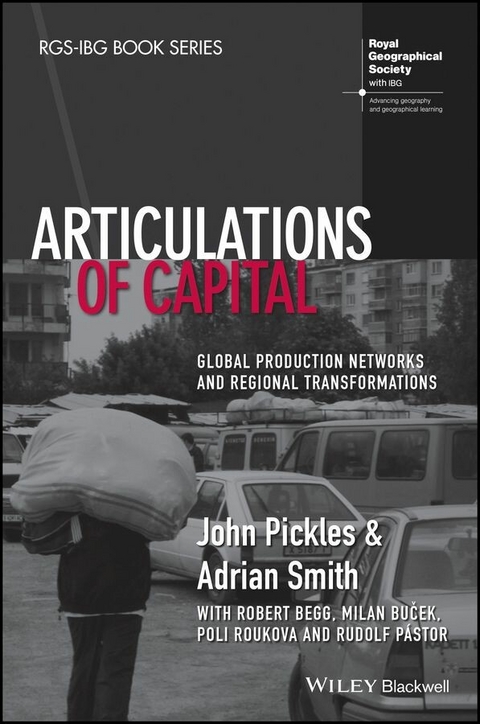
Articulations of Capital (eBook)
320 Seiten
Wiley (Verlag)
978-1-118-63288-8 (ISBN)

- Proposes a new theorization of global value chains as part of a conjunctural economic geography
- Develops a set of conceptual and theoretical arguments concerning the regional embeddedness of global production
- Draws on longitudinal empirical research from over 20 years in the Bulgarian and Slovakian apparel industries
- Makes a major intervention into the debate over the economic geographies of European integration and EU enlargement
John Pickles is Earl N. Phillips Distinguished Professor of International Studies in the Department of Geography at the University of North Carolina, Chapel Hill. His publications include A History of Spaces: Cartographic Reason, Mapping, and the Geo-Coded World (2004), Globalization and Regionalization in Post-socialist Economies: the Common Economic Spaces of Europe (edited, 2009), and Towards Better Work: Understanding Labour in Apparel Global Value Chains (co-edited with A. Rossi and A Luinstra, 2014).
Adrian Smith is Professor of Human Geography and Dean for Research in the Faculty of Humanities and Social Sciences at Queen Mary University of London. Editor-in-Chief of the journal European Urban and Regional Studies, Dr. Smith has authored and co-edited five books on post-socialist Europe, including Domesticating Neo-Liberalism: Spaces of Economic Practice and Social Reproduction in Post-Socialist Cities (with A. Stenning, A. Rochovská, and D. '6;wi?tek, Wiley, 2010).
Robert Begg is Professor Emeritus of Geography and Regional Planning at Indiana University of Pennsylvania.
Milan Bu?ek is Professor and Head of the Department Public Administration and Regional Developmente at the University of Economics in Bratislava.
Poli Roukova is a Senior Research Fellow in Economic and Social Geography at the Bulgarian Academy of Sciences.
Rudolf Pástor is Assistant Professor of Geography in the Department Public Administration and Regional Developmente at the University of Economics in Bratislava.
Articulations of Capital offers an accessible, grounded, yet theoretically-sophisticated account of the geographies of global production networks, value chains, and regional development in post-socialist Eastern and Central Europe. Proposes a new theorization of global value chains as part of a conjunctural economic geography Develops a set of conceptual and theoretical arguments concerning the regional embeddedness of global production Draws on longitudinal empirical research from over 20 years in the Bulgarian and Slovakian apparel industries Makes a major intervention into the debate over the economic geographies of European integration and EU enlargement
John Pickles is Earl N. Phillips Distinguished Professor of International Studies in the Department of Geography at the University of North Carolina, Chapel Hill. His publications include A History of Spaces: Cartographic Reason, Mapping, and the Geo-Coded World (2004), Globalization and Regionalization in Post-socialist Economies: the Common Economic Spaces of Europe (edited, 2009), and Towards Better Work: Understanding Labour in Apparel Global Value Chains (co-edited with A. Rossi and A Luinstra, 2014). Adrian Smith is Professor of Human Geography and Dean for Research in the Faculty of Humanities and Social Sciences at Queen Mary University of London. Editor-in-Chief of the journal European Urban and Regional Studies, Dr. Smith has authored and co-edited five books on post-socialist Europe, including Domesticating Neo-Liberalism: Spaces of Economic Practice and Social Reproduction in Post-Socialist Cities (with A. Stenning, A. Rochovská, and D. Swiatek, Wiley, 2010). Robert Begg is Professor Emeritus of Geography and Regional Planning at Indiana University of Pennsylvania. Milan Bucek is Professor and Head of the Department Public Administration and Regional Developmente at the University of Economics in Bratislava. Poli Roukova is a Senior Research Fellow in Economic and Social Geography at the Bulgarian Academy of Sciences. Rudolf Pástor is Assistant Professor of Geography in the Department Public Administration and Regional Developmente at the University of Economics in Bratislava.
Series Editors' Preface vii
List of Figures viii
List of Tables xi
Preface and Acknowledgements xii
Abbreviations xxi
Part One Articulating Capital in Global Production Networks 1
1 Articulations of Capital 3
2 Economic Geography, Conjuncture and the Dynamics of Capital 23
Part Two Working off the Past: Context and Complexity in Apparel Global Production Networks 53
3 Working in the Post-Socialist Apparel Economy 55
4 Managing Europe's Golden Bands: Trade Policy and the Regulation of Production Networks (with Robert Begg) 86
5 Transformations, Legacies and Networks: The State and Market Globalizations (with Robert Begg and Milan Buce^ k) 104
Part Three Industrial Dynamics, Regionalization and the Conjunctural Economy of Global Production Networks 135
6 Theorizing Transition and the Dynamics of Capital: The Diverse Trajectories of Post-socialist Firms (with
Robert Begg, Milan Bucek, Poli Roukova, and Rudolf Pastor) 137
7 Border Reconfigurations and the Frontiers of Capital (with Robert Begg, Milan Buc^ek, and Rudolf Pastor) 162
8 Regionalization and the Palimpsests of Production: Delocalization, Legacies and Firm Differentiation (with Robert Begg and Poli Roukova) 182
9 The Cultural Economies of Post-Socialism: Ethnicity, Garage Firms and Regional Markets (with Robert Begg and Poli Roukova) 214
Part Four Conclusion 237
10 Conclusion 239
Appendix 1 Firm-level Restructuring in the Slovak Textiles and Clothing Sector, 2004-2013 253
Appendix 2 Key to Figure 9.14 Dimitrovgrad Market, 2011 257
References 260
Index 281
'Articulations of Capital is an intellectually refreshing and stimulating analysis of the shifts in the global apparel industry and its regional and local manifestations in East-Central Europe. Pickles and Smith excel in a theoretically and conceptually rich but empirically grounded critical approach that challenges some widely held assumptions about the contemporary apparel industry, postsocialism and East-Central Europe.'
-- Petr Pavlínek, Professor of Geography, University of Nebraska at Omaha, USA
'This book presents a well grounded and historically contextualized analysis of the political economy of regional transformation in a changing world of apparel global production networks. I particularly like its focus on "actually existing transitions" in selected East Central European regional economies. In this way, the authors have eschewed the snapshot approach in most studies of inter-firm industrial governance and shed much better empirical light on the critical issue of industrial upgrading.'
-- Henry Wai-chung Yeung, Professor of Economic Geography and Co-Director of the GPN@NUS Centre, National University of Singapore
Preface and Acknowledgements
Articulations of Capital weaves together three primary threads of conceptual and empirical research. First, it is concerned with the geographies of contemporary economic change, particularly with the ways in which late twentieth-century and early twenty-first-century rounds of globalization have been scripted in terms of post-national spatial formations. As economic geographers we are, first and foremost, concerned with the ways in which what Peter Dicken calls “the global shift” is variously scripted through spatialized concepts such as footloose capital, slippery space, chain dynamics and network forms of integration. These emerging geographies and scriptings have important implications for the ways in which we understand contemporary spatial divisions of labour and the regional futures they portend, particularly for the employed and unemployed in communities throughout Europe.
Second, the book is grounded in the geographies of global value chains and global production networks. Each of these bodies of research – in conversation with each other – has opened up new ways of understanding the changing social composition and geographies of the global economy. We are particularly interested in the ways in which the study of inter-firm chains and networks enable and limit possibilities for thinking about capital–labour relations in a globalizing economy and their effects on the structures and practices of regional production systems. We focus on the detailed practices of the social economy in order to unpack chain and network analytics and the emerging multiplication of labour’s forms under contemporary global capitalism.
Third, this is a work of methodology and social theory. The book makes three related epistemological moves. In the first, we are committed to regional analysis, grounded theory and actually occurring economic practices. The result is recognition of the value and necessity of abstract concepts, but with a deep suspicion of the generic concept divorced from the specificities of the concrete. Ours is a regional analysis that seeks to practise what Gilles Deleuze and Félix Guattari called “subtraction”, stepping down a level to the constitutive elements of any particular concept. In this sense, Articulations of Capital is an economic geography of context and conjuncture, and the multiplicities of opportunities and constraints they allow. In the second, we develop a theory of the global and regional economy in which our focus is increasingly on the multiplication of labour and its corresponding spatial divisions. Here we explore the ways in which the expansion of global production networks and the integration of the apparel industry in East-Central Europe was one way in which new multiplications of labour were elaborated in the context of transformations to post-socialism. In the third epistemological move, we de-centre the geographies of European economic transformation by gradually refocusing our analysis of post-socialism away from its more common passive rendering (as a region to which external forces impose agendas) to one in which we interrogate post-socialism in terms of its dynamic and productive capacities and effects in shaping the outcomes of economic integration. Articulations of Capital is therefore about the changing economic geographies of post-socialist Europe and the many ways in which those transformations have shaped, and have been shaped by, the institutions, economies and livelihoods of people in the region.
Our analysis has involved a quarter century of research on the economic geographies and political economies of East Central European transformations and twenty years research on the global apparel industry. For one of us (John), 1986 to 1989 was a period of international exchanges with Hungarian, Bulgarian, Czechoslovak, and Russian scholars first in the USA and then in Hungary, Czechoslovakia and Bulgaria. In November 1989, we were on a study tour of Bulgaria when the environmental movement coordinated mass demonstrations in Sofia against the Zhivkov regime, and after similar movements had fundamentally changed the political lives of Central European countries. Between 1991 and 1993, the other of us (Adrian) lived just outside the town of Martin in Czechoslovakia, teaching geography, experiencing the tumultuous changes transforming the lives of people and places under-going “post-socialist” change, and subsequently completing a PhD thesis on the political economy of industrial restructuring and regional development in what had become the independent Slovak state in 1993. From these beginnings we have become devoted scholars of post-socialist transformations and critics of the simple logics of transition, with all they entail for theories of history, culture and politics. Our work together, and in collaboration with our collaborators on this book, began in earnest in the mid-1990s, not least with the publication of our edited collection, Theorising Transition, which attempted to map a critical political economy to the geographies, cultures and regional dynamics of change in post-socialism. This developed further in the late 1990s and early 2000s when we began to work more intensively on the dynamics and restructuring of the apparel industry in the region in comparative perspective.
This long period of research and writing together has attempted to develop forms of grounded theory; theoretically informed empirical research based on detailed field research in the region. We focus primarily on Bulgaria and Slovakia. These two country cases were chosen to reflect their different stages of involvement in export production, the importance of the apparel sector to national and regional economies in each country, different forms of market integration and product specificity, and distinct impacts of European Union (EU) enlargement policies. In each country, the most important apparel-producing areas were selected for study: the two capital city regions of Sofia and Bratislava, two older producing regions (Plovdiv, Bulgaria and Trenčín, Slovakia), and two more economically marginal regions (Kurdjali/Haskovo in southern Bulgaria and Prešov, East Slovakia) (Figures 5.3 and 5.6). The research has spanned extensive annual fieldwork and on-going collaborations with many colleagues in these regions as well as research visits to Brussels to interview European Commission personnel, European trade union organizations and European industrial association representatives, and interviews with apparel buyers and retailers in the EU. Fieldwork took place over varying periods of time in 2003, 2004, 2008, 2012, 2013 and 2014. The research in Bulgaria and Slovakia involved an extensive number of interviews with firm managers and other company personnel, trade unions representatives, workers, government agencies, and professional associations, as well as a survey of 311 apparel firms. Over this time, we have carried out over one hundred in-depth semi-structured interviews with managers, trade unionists, workers, industry professionals and buyers, and national and EU-level policy-makers, combined with follow-up surveys and data collection from factories. Managers in several of the key firms were interviewed several times over this period, allowing for a longitudinal analysis of firm strategies and trajectories of firm development in some of the most significant apparel firms in each region. We attempted to include all of the key former state-owned enterprises in each region in our research and to undertake follow-up in-depth longitudinal interviews with a sub-sample of key firms mostly, but not only, from those involved in the initial survey. In the text which follows, our convention in naming firms is that we do so where we have secured the permission of managers or where the firm is no longer in existence (normally due to bankruptcy and closure). In all other cases we name the location of the firm and the approximate form (e.g. joint venture, etc.) in order to avoid explicitly identifying the company.
In the years since the late 1980s, we have benefitted enormously from the support and friendship of like-minded colleagues. Throughout, Robert Begg, Milan Buček, Poli Roukova, and Rudolf Pástor have been our constant co-researchers/authors, interlocutors, colleagues and friends. Much of the work in the book is based on detailed fieldwork on which we worked together in various combinations. It also partly draws on and extensively updates and reworks material we have co-written with them, some of which has been published previously although very significantly reworked, theorized more extensively and thoroughly updated here. Where we have co-authored material in the chapters with them we indicate which are co-authored by whom. Articulations of Capital is, then, a thoroughly collaborative project which could not have been possible without any of its authors.
We have also benefitted from working closely with colleagues and the institutions that were our hosts and supporters. In Sofia, we have depended on the support, friendship, and intellectual insights of colleagues at the Department of Geography, Kliment Ohridiski University, particularly Anton Popov, Stelian Dimitrov, Stefan Stefanov, Katya Mileva and their colleagues in the Department of Geography. Poli Roukova has been our colleague and collaborator throughout and Stefan Velev, Rumi Dobrinova, Didi Mikhova, Mariana...
| Erscheint lt. Verlag | 10.12.2015 |
|---|---|
| Reihe/Serie | RGS-IBG Book Series |
| RGS-IBG Book Series | RGS-IBG Book Series |
| Co-Autor | Robert Begg, Milan Bucek, Poli Roukova, Rudolf P stor |
| Sprache | englisch |
| Themenwelt | Naturwissenschaften ► Geowissenschaften ► Geografie / Kartografie |
| Sozialwissenschaften ► Soziologie ► Makrosoziologie | |
| Technik | |
| Wirtschaft ► Volkswirtschaftslehre | |
| Schlagworte | Anthropogeographie • Economic Geography • entwicklungsgeographie • Geographie • Geography • Geography of Development • Global value chains, global production networks, post-socialism, trade, employment, work, regional development, Eastern and Central Europe, economic geography, economic sociology, economic anthropology, human geography, regulation, apparel industry, development studies, European economies, European Union, ethnicity, Bulgaria, Slovakia • Human geography • Wirtschaftsgeographie |
| ISBN-10 | 1-118-63288-5 / 1118632885 |
| ISBN-13 | 978-1-118-63288-8 / 9781118632888 |
| Informationen gemäß Produktsicherheitsverordnung (GPSR) | |
| Haben Sie eine Frage zum Produkt? |
 EPUB (Adobe DRM)
Kopierschutz: Adobe-DRM
Adobe-DRM ist ein Kopierschutz, der das eBook vor Mißbrauch schützen soll. Dabei wird das eBook bereits beim Download auf Ihre persönliche Adobe-ID autorisiert. Lesen können Sie das eBook dann nur auf den Geräten, welche ebenfalls auf Ihre Adobe-ID registriert sind.
Details zum Adobe-DRM
Dateiformat: EPUB (Electronic Publication)
EPUB ist ein offener Standard für eBooks und eignet sich besonders zur Darstellung von Belletristik und Sachbüchern. Der Fließtext wird dynamisch an die Display- und Schriftgröße angepasst. Auch für mobile Lesegeräte ist EPUB daher gut geeignet.
Systemvoraussetzungen:
PC/Mac: Mit einem PC oder Mac können Sie dieses eBook lesen. Sie benötigen eine
eReader: Dieses eBook kann mit (fast) allen eBook-Readern gelesen werden. Mit dem amazon-Kindle ist es aber nicht kompatibel.
Smartphone/Tablet: Egal ob Apple oder Android, dieses eBook können Sie lesen. Sie benötigen eine
Geräteliste und zusätzliche Hinweise
Buying eBooks from abroad
For tax law reasons we can sell eBooks just within Germany and Switzerland. Regrettably we cannot fulfill eBook-orders from other countries.
aus dem Bereich