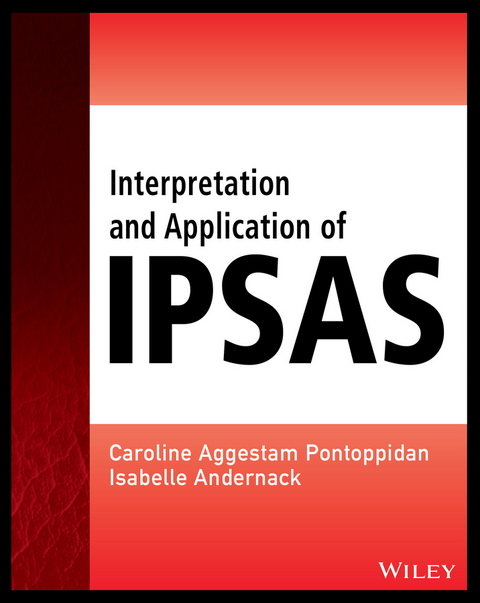
Interpretation and Application of IPSAS (eBook)
John Wiley & Sons (Verlag)
978-1-119-01030-2 (ISBN)
Interpretation and Application of IPSAS provides practical guidance on the implementation and application of the International Public Sector Accounting Standards. This book brings readers up to date on the standards, and describes their proper interpretation and real-world application. Examples and mini-case studies clarify the standards' roles throughout, giving readers a better understanding of complex processes, especially where the IPSAS deviate from IFRS. Readers also gain insight into smoothly navigating the transition for a public sector entity, which is moving to either IPSAS under accrual basis of accounting or to cash accounting IPSAS, plus an overview of IPSAS adoption status and methods around the world.
Global public sector accounting is highly diversified, resulting in ongoing moves to harmonise standards worldwide. The IPSAS are international standards that largely follow the IFRS model, but differ in some key areas and include standards in places where IFRS has none. This book provides complete guidance to IPSAS, with clear explanation and expert insight.
- Understand the meaning and role of each standard
- Apply the standards to real-world scenarios
- Manage the process of transition to IPSAS
These standards are meant to be followed by all public sector entities, including national and regional governments and local authorities. They've been adopted by the UN, NATO, the European Commission, and others, and either have been or soon will be adopted in Malaysia, Switzerland, Spain, and more.
Clear, practical IPSAS guidance, explanation, and examples Interpretation and Application of IPSAS provides practical guidance on the implementation and application of the International Public Sector Accounting Standards. This book brings readers up to date on the standards, and describes their proper interpretation and real-world application. Examples and mini-case studies clarify the standards' roles throughout, giving readers a better understanding of complex processes, especially where the IPSAS deviate from IFRS. Readers also gain insight into smoothly navigating the transition for a public sector entity, which is moving to either IPSAS under accrual basis of accounting or to cash accounting IPSAS, plus an overview of IPSAS adoption status and methods around the world. Global public sector accounting is highly diversified, resulting in ongoing moves to harmonise standards worldwide. The IPSAS are international standards that largely follow the IFRS model, but differ in some key areas and include standards in places where IFRS has none. This book provides complete guidance to IPSAS, with clear explanation and expert insight. Understand the meaning and role of each standard Apply the standards to real-world scenarios Manage the process of transition to IPSAS These standards are meant to be followed by all public sector entities, including national and regional governments and local authorities. They've been adopted by the UN, NATO, the European Commission, and others, and either have been or soon will be adopted in Malaysia, Switzerland, Spain, and more.
Caroline Aggestam Pontoppidan, Copenhagen, Denmark is an Associate Professor in Public Sector Accounting and Auditing at Copenhagen Business School. She is also a project manager for UNOPS (an operational arm of the United Nations, helping a range of partners implement $1 billion worth of aid and development projects every year) overseeing the implementation of International Public Sector Accounting (IPSAS). Previous experience includes audit work and project management with The Global Fund to fight Aids, Tuberculosis and Malaria, Geneva, Switzerland, UNCTAD, Geneva, Switzerland and the UNICEF Supply Division, Copenhagen. Isabelle Andernack, Meudon-la-Forêt, France is Accountancy Administrator, BIPM (International Bureau of Weights & Measures). She is the project leader of the BIPM transition from cash accounting to the accrual basis of accounting under IPSAS. Her current teaching activities include: IPSAS, consolidation and public management courses at Paris I Panthéon-Sorbonne (Master 2 Audit, Contrôle et Management Public), IFRS in order to prepare the CIIA at CFAF (Training Centre for Financial Analysts). She is formerly a Partner, and Technical Director of audit division, Fiducial Audit, as well as having worked in the Audit and IFRS teams at Deloitte, PwC and KPMG.
Foreword vii
Acknowledgements ix
About the Authors xi
List of IPSAS with Corresponding IFRS xiii
List of IPSAS with Brief Description xv
Part 1 Introducing Public Sector Accounting
1 Introduction 3
2 Why Converge Public Sector Accounting Practices? 11
3 The IPSASB 17
Part 2 Accrual-based IPSAS
4 The IPSASB Conceptual Framework and Key Accrual Accounting Concepts 35
5 Financial Statements 55
6 Disclosure Standards 109
7 Long-Term (Non-Current) Assets 123
8 Current Assets 167
9 Service Concession Arrangements: Grantor 175
10 Leases and Leasing Arrangements 187
11 Revenues and Expenses 207
12 Employee Benefits, Social Benefits, and Other Liabilities 243
13 Provisions and Contingencies 257
14 Budget Reporting 271
15 Financial Instruments 285
16 Consolidations and Strategic Investments 307
17 Specific Standards: Accounting for Agriculture and Accounting in Hyperinflation Economies 327
18 Recommended Practice Guidelines (RPGs) 339
Part 3 Cash-Based IPSAS
19 Cash Basis IPSAS 351
Part 4 Making the Transition to IPSAS and Closing
20 Making the Transition to IPSAS 375
Conclusion 407
Annex 1: Brief Description of IPSAS 409
Annex 2: Key Characteristics of Public Sector Entities 413
Annex 3: Employee Benefits: An Overview of the Key Principles 415
Annex 4: Appendix to Chapter 21. Transition to IPSAS. Case Example: Iceland IPSAS Implementation Plan 417
Bibliography 425
Index
1 Introduction
International Public Sector Accounting Standards (IPSAS) are gaining increasing acceptance globally (see Table 1.1 for a full listing of all IPSAS). Public administrators are today encountering important challenges in reducing the distance between accounting systems within countries as well as across borders. This entails a move towards harmonization1 of accounting practices in the public sector and thus requires choosing an appropriate set of accounting and financial reporting standards (see also Caperchione, 2015).
Table 1.1 Full listing of all IPSAS and IFRS “equivalent” as at 1 March 2015
| IPSAS | IFRS “equivalent” (if applicable) |
| IPSAS 1—Presentation of Financial Statements | IAS 1 |
| IPSAS 2—Cash Flow Statements | IAS 7 |
| IPSAS 3—Accounting Policies, Changes in Accounting Estimates and Errors | IAS 8 |
| IPSAS 4—The Effects of Changes in Foreign Exchange Rates | IAS 21 |
| IPSAS 5—Borrowing Costs | IAS 23 |
| IPSAS 6—Consolidated and Separate Financial Statements6 | IAS 27 (replaced) |
| IPSAS 7—Investments in Associates7 | IAS 28 (replaced) |
| IPSAS 8—Interests in Joint Ventures8 | IAS 31 (replaced) |
| IPSAS 9—Revenue from Exchange Transactions | IAS 18 |
| IPSAS 10—Financial Reporting in Hyperinflationary Economies | IAS 29 |
| IPSAS 11—Construction Contracts | IAS 11 |
| IPSAS 12—Inventories | IAS 2 |
| IPSAS 13—Leases | IAS 17 |
| IPSAS 14—Events after the Reporting Date | IAS 10 |
| IPSAS 15— (withdrawn)9 |
| IPSAS 16—Investment Property | IAS 40 |
| IPSAS 17—Property, Plant, and Equipment | IAS 16 |
| IPSAS 18—Segment Reporting | IAS 14 (replaced) |
| IPSAS 19—Provisions, Contingent Liabilities and Contingent Assets | IAS 37 |
| IPSAS 20—Related Party Disclosures | IAS 24 |
| IPSAS 21—Impairment of Non-Cash-Generating Assets | N/A10 |
| IPSAS 22—Disclosure of Information about the General Government Sector | N/A |
| IPSAS 23—Revenue from Non-Exchange Transactions (Taxes and Transfers) | N/A |
| IPSAS 24—Presentation of Budget Information in Financial Statements | N/A |
| IPSAS 25—Employee Benefits | IAS 19 |
| IPSAS 26—Impairment of Cash-Generating Assets | IAS 36 |
| IPSAS 27—Agriculture | IAS 41 |
| IPSAS 28—Financial Instruments: Presentation | IAS 32 |
| IPSAS 29—Financial Instruments: Recognition and Measurement | IAS 39 |
| IPSAS 30—Financial Instruments: Disclosures | IFRS 7 |
| IPSAS 31—Intangible Assets | IAS 38 |
| IPSAS 32—Service Concession Arrangements: grantor | N/A |
| IPSAS 33—First-Time Adoption of Accrual Basis IPSASs An entity shall apply those amendments for annual financial statements covering periods beginning on or after 1 January 2017. Earlier application is permitted. If an entity applies IPSAS 33 for a period beginning before 1 January 2017, the amendments shall also be applied for that earlier period. | IFRS 1 |
| IPSAS 34—Separate Financial Statements An entity shall apply this Standard for annual financial statements covering periods beginning on or after 1 January 2017. Earlier application is encouraged. If an entity applies this Standard for a period beginning before 1 January 2017, it shall disclose that fact and apply IPSAS 35, IPSAS 36, IPSAS 37, and IPSAS 38 at the same time. | IAS 27 (2011) |
| IPSAS 35—Consolidated Financial Statements An entity shall apply this Standard for annual financial statements covering periods beginning on or after 1 January 2017. Earlier application is encouraged. If an entity applies this Standard for a period beginning before 1 January 2017, it shall disclose that fact and apply IPSAS 34, Separate Financial Statements, IPSAS 36, IPSAS 37, and IPSAS 38 at the same time. | IFRS 10 |
| IPSAS 36—Investments in Associates and Joint Ventures An entity shall apply this Standard for annual financial statements covering periods beginning on or after 1 January 2017. Earlier application is encouraged. If an entity applies this Standard for a period beginning before 1 January 2017, it shall disclose that fact and apply IPSAS 34, IPSAS 35, IPSAS 37, and IPSAS 38, Disclosure of Interests in Other Entities, at the same time. | IAS 28 (2011) |
| IPSAS 37—Joint Arrangements An entity shall apply this Standard for annual financial statements covering periods beginning on or after 1 January 2017. Earlier application is encouraged. If an entity applies this Standard for a period beginning before 1 January 2017, it shall disclose that fact and apply IPSAS 34, IPSAS 35, IPSAS 36 and IPSAS 38, Disclosure of Interests in Other Entities, at the same time. | IFRS 11 |
| IPSAS 38—Disclosure of Interests in Other Entities An entity shall apply this Standard for annual financial statements covering periods beginning on or after 1 January 2017. Earlier application is encouraged. | IFRS 12 |
The focus on creating one common set of standards at the global level is relatively new, in comparison to what we have witnessed for the private sector, with the global spread and institutionalization of International Financial Reporting Standards (IFRS) (see also for example Ball, 2012).
Many governments across the globe operate on a cash basis (or modified cash basis2) and do not account for many significant items, such as liabilities for public sector pensions and financial instruments. Accrual accounting is a fundamental tenet of strong accounting and reporting for public companies, and so it should be for governments as well. This is why the adoption of accrual accounting by public sector entities should result in a more comprehensive and accurate view of the financial position, and help to ensure that governments and other public sector entities are transparent and accountable. It should also be noted, however, that in some cases, governments do not have standardized practices for applying cash-basis accounting and, in such cases, applying cash-basis IPSAS could be a first step towards transparency and accountability.
The International Public Sector Accounting Standards Board (IPSASB) and the IPSAS that it establishes have increasingly become a point for international standardization and reference within the area of public sector accounting. The IPSASB is, today, an independent standard-setting board under the auspices of the International Federation of Accountants (IFAC). It has been said that the issuing of the complete Conceptual Framework in 2014 has served as a “landmark document that firmly places IPSASB alongside its private sector counterpart, the International Accounting Standards Board (IASB), as an international standard setter” (Cain, 2014).
Aim of the Book
The aim of this book is to provide the reader with an overview of IPSAS with a focus on their practical application and interpretation. With this in mind, the book includes numerous examples of their application by governments and public sector entities that are issuing IPSAS-compliant financial statements. By drawing on examples, practice highlights on specific accounting and reporting issues, and IPSAS, this book seeks to be a comprehensive guide on how to apply accrual-based IPSAS as well as cash basis. The book thus aims to serve as a practical implementation guide for IPSAS for practitioners, policy makers, academics, and students. Nevertheless, we would like to emphasize that this book is not a replacement for reading the standards themselves. We therefore recommend reading this book in conjunction with the full suite of IPSAS3 in order to ensure that knowledge of all aspects of IPSAS is gained.
Readers will be able to find the answers to questions such as:
- What is the role and history of IPSASB?
- What is the scope of accrual-based IPSAS?
- What is prescribed in the suite of IPSAS for accrual basis accounting?
- What options do accrual-based IPSAS provide for measurement...
| Erscheint lt. Verlag | 30.11.2015 |
|---|---|
| Reihe/Serie | Wiley Regulatory Reporting |
| Wiley Regulatory Reporting | Wiley Regulatory Reporting |
| Sprache | englisch |
| Themenwelt | Recht / Steuern ► Wirtschaftsrecht |
| Sozialwissenschaften ► Politik / Verwaltung ► Staat / Verwaltung | |
| Wirtschaft ► Betriebswirtschaft / Management ► Rechnungswesen / Bilanzen | |
| Wirtschaft ► Betriebswirtschaft / Management ► Unternehmensführung / Management | |
| Wirtschaft ► Volkswirtschaftslehre ► Wirtschaftspolitik | |
| Schlagworte | 2015 IPSAS • Accounting • Accounting Special Topics • Caroline Aggestam-Pontoppidan • cash accounting IPSAS • Government Accounting • International Accounting • International accounting standards • Internationales Rechnungswesen • International Public Sector Accounting Standards • Interpretation and Application of IPSAS • IPSAS accrual basis • IPSAS adoption • IPSAS application • IPSASB • IPSAS compliance • IPSAS examples • IPSAS explained • IPSAS how to • IPSAS implementation • IPSAS in English • IPSAS interpretation • IPSAS reference • IPSAS resources • IPSAS text • IPSAS transition • IPSAS vs. IFRS • practical IPSAS • Public Sector Accounting Standards • Rechnungswesen • Spezialthemen Rechnungswesen • Staatliches Rechnungswesen |
| ISBN-10 | 1-119-01030-6 / 1119010306 |
| ISBN-13 | 978-1-119-01030-2 / 9781119010302 |
| Informationen gemäß Produktsicherheitsverordnung (GPSR) | |
| Haben Sie eine Frage zum Produkt? |
 EPUB (Adobe DRM)
Kopierschutz: Adobe-DRM
Adobe-DRM ist ein Kopierschutz, der das eBook vor Mißbrauch schützen soll. Dabei wird das eBook bereits beim Download auf Ihre persönliche Adobe-ID autorisiert. Lesen können Sie das eBook dann nur auf den Geräten, welche ebenfalls auf Ihre Adobe-ID registriert sind.
Details zum Adobe-DRM
Dateiformat: EPUB (Electronic Publication)
EPUB ist ein offener Standard für eBooks und eignet sich besonders zur Darstellung von Belletristik und Sachbüchern. Der Fließtext wird dynamisch an die Display- und Schriftgröße angepasst. Auch für mobile Lesegeräte ist EPUB daher gut geeignet.
Systemvoraussetzungen:
PC/Mac: Mit einem PC oder Mac können Sie dieses eBook lesen. Sie benötigen eine
eReader: Dieses eBook kann mit (fast) allen eBook-Readern gelesen werden. Mit dem amazon-Kindle ist es aber nicht kompatibel.
Smartphone/Tablet: Egal ob Apple oder Android, dieses eBook können Sie lesen. Sie benötigen eine
Geräteliste und zusätzliche Hinweise
Buying eBooks from abroad
For tax law reasons we can sell eBooks just within Germany and Switzerland. Regrettably we cannot fulfill eBook-orders from other countries.
aus dem Bereich