Zum Hauptinhalt springen
Nicht aus der Schweiz? Besuchen Sie lehmanns.de
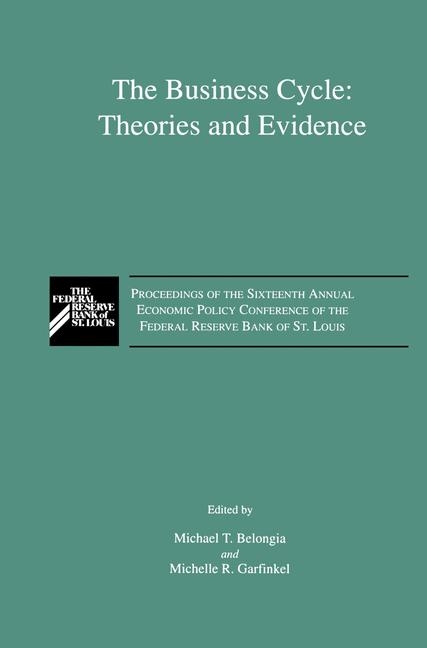
Business Cycle: Theories and Evidence -

Business Cycle: Theories and Evidence (eBook)

Proceedings of the Sixteenth Annual Economic Policy Conference of the Federal Reserve Bank of St. Louis
eBook Download: PDF
2012
Springer Netherlands (Verlag)
978-94-011-2956-5 (ISBN)
Systemvoraussetzungen
109,25 inkl. MwSt
(CHF 106,70)
Der eBook-Verkauf erfolgt durch die Lehmanns Media GmbH (Berlin) zum Preis in Euro inkl. MwSt.
  • Download sofort lieferbar
  • Zahlungsarten anzeigen
These proceedings, from a conference held at the Federal Reserve Bank of St. Louis on October 17-18, 1991, attempted to layout what we currently know about aggregate economic fluctuations. Identifying what we know inevitably reveals what we do not know about such fluctuations as well. From the vantage point of where the conference's participants view our current understanding to be, these proceedings can be seen as suggesting an agenda for further research. The conference was divided into five sections. It began with the formu- lation of an empirical definition of the "e;business cycle"e; and a recitation of the stylized facts that must be explained by any theory that purports to capture the business cycle's essence. After outlining the historical develop- ment and key features of the current "e;theories"e; of business cycles, the conference evaluated these theories on the basis of their ability to explain the facts. Included in this evaluation was a discussion of whether (and how) the competing theories could be distinguished empirically. The conference then examined the implications for policy of what is known and not known about business cycles. A panel discussion closed the conference, high- lighting important unresolved theoretical and empirical issues that should be taken up in future business cycle research. What Is a Business Cycle? Before gaining a genuine understanding of business cycles, economists must agree and be clear about what they mean when they refer to the cycle.
PDFPDF (Adobe DRM)

Kopierschutz: Adobe-DRM
Adobe-DRM ist ein Kopierschutz, der das eBook vor Mißbrauch schützen soll. Dabei wird das eBook bereits beim Download auf Ihre persönliche Adobe-ID autorisiert. Lesen können Sie das eBook dann nur auf den Geräten, welche ebenfalls auf Ihre Adobe-ID registriert sind.
Details zum Adobe-DRM

Dateiformat: PDF (Portable Document Format)
Mit einem festen Seiten­layout eignet sich die PDF besonders für Fach­bücher mit Spalten, Tabellen und Abbild­ungen. Eine PDF kann auf fast allen Geräten ange­zeigt werden, ist aber für kleine Displays (Smart­phone, eReader) nur einge­schränkt geeignet.

Systemvoraussetzungen:
PC/Mac: Mit einem PC oder Mac können Sie dieses eBook lesen. Sie benötigen eine Adobe-ID und die Software Adobe Digital Editions (kostenlos). Von der Benutzung der OverDrive Media Console raten wir Ihnen ab. Erfahrungsgemäß treten hier gehäuft Probleme mit dem Adobe DRM auf.
eReader: Dieses eBook kann mit (fast) allen eBook-Readern gelesen werden. Mit dem amazon-Kindle ist es aber nicht kompatibel.
Smartphone/Tablet: Egal ob Apple oder Android, dieses eBook können Sie lesen. Sie benötigen eine Adobe-ID sowie eine kostenlose App.
Geräteliste und zusätzliche Hinweise

Buying eBooks from abroad
For tax law reasons we can sell eBooks just within Germany and Switzerland. Regrettably we cannot fulfill eBook-orders from other countries.

Mehr entdecken
aus dem Bereich
Mit den Besonderheiten beim Auto- und Dienstradleasing sowie beim …

von Wolfgang Grundmann

eBook Download (2025)
Springer Gabler (Verlag)
CHF 53,70
Wohlstand steigern – Ungleichheit verringern – Demokratie stärken

von Hans-Jörg Naumer

eBook Download (2024)
Springer Fachmedien Wiesbaden (Verlag)
CHF 38,95