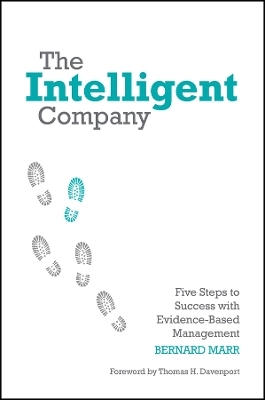
The Intelligent Company – Five steps to Success with Evidence–Based Management
John Wiley & Sons Inc (Hersteller)
978-1-119-20864-8 (ISBN)
- Keine Verlagsinformationen verfügbar
- Artikel merken
Bernard Marr is a leading global authority and best-selling author on organisational performance and business success. In this capacity he regularly advises leading companies, organisations and governments across the globe, which makes him an acclaimed and award-winning keynote speaker, researcher, consultant and teacher. Bernard Marr is acknowledged by the CEO Journal as one of today s leading business brains. Bernard Marr has written a number of seminal books and over 200 high profile reports and articles on managing and improving organisational performance. This includes the best-sellers Managing and Delivering Performance and Strategic Performance Management', a number of Gartner Reports, and the world s largest research studies on the topic. Today, Bernard Marr heads up the famed Advanced Performance Institute, where he can be contacted at www.ap-institute.com.
ABOUT THE AUTHOR. ACKNOWLEDGEMENTS. FOREWORD. 1 THE DATA KNOWLEDGE CRUNCH. Introduction. The data and information explosion. The failure to turn data into mission-critical insights. Investment in business intelligence. Evidence-based management. Conclusions. 2 THE EVIDENCE-BASED MANAGEMENT MODEL. Introduction. Evidence-based medicine. The scientific method. The EbM model explained. Conclusions. 3 IDENTIFYING OBJECTIVES AND INFORMATION NEDS. Introduction. How a police 'SWAT' team uses EbM. Step 1 sub-step one: what do we need to know? Strategic performance management frameworks. A strategy map as a hypothesis. Who needs to know what, when and why? What are the most important unanswered questions? Ten steps for creating good KPQs and KAQs. Conclusions. 4 COLLECTING THE RIGHT DATA. Introduction. Key performance indicators and building evidence. Collecting the right data. What is evidence and what is data? Data collection methodologies. Quantitative data collection methods. Qualitative data techniques. Using both quantitative and qualitative data. Making data collection part of the job. Engaging people in data collection. Assigning meaning to data. Reliability and validity. Planning the data collection process. The role of IT infrastructure and applications in the collection of data. Conclusions. 5 ANALYSE THE DATA AND GAIN INSIGHTS. Introduction. Data analysis. Budgeting and planning. Reporting and consolidation. Value-driver modelling. Experimentation. Role of IT infrastructure and applications in analysing data. Conclusions. 6 PRESENT AND COMMUNICATE THE INFORMATION. Introduction. How to get the attention of decision makers. Publishing analogies. Guidance for presenting information. The role of IT infrastructure and applications in presenting information. Conclusions. 7 TURNING INFORMATION INTO ACTIONABLE KNOWLEDGE. Introduction. Ensure that the available evidence is used to make the best decisions. Turning knowledge into action. The knowing doing gap. Conclusions. 8 CONCLUSIONS AND ACTION CHECKLIST. Introduction. Action checklist. Final words. REFERENCES. INDEX.
| Erscheint lt. Verlag | 3.10.2015 |
|---|---|
| Verlagsort | New York |
| Sprache | englisch |
| Maße | 152 x 229 mm |
| Gewicht | 666 g |
| Themenwelt | Wirtschaft ► Betriebswirtschaft / Management ► Unternehmensführung / Management |
| ISBN-10 | 1-119-20864-5 / 1119208645 |
| ISBN-13 | 978-1-119-20864-8 / 9781119208648 |
| Zustand | Neuware |
| Informationen gemäß Produktsicherheitsverordnung (GPSR) | |
| Haben Sie eine Frage zum Produkt? |
aus dem Bereich