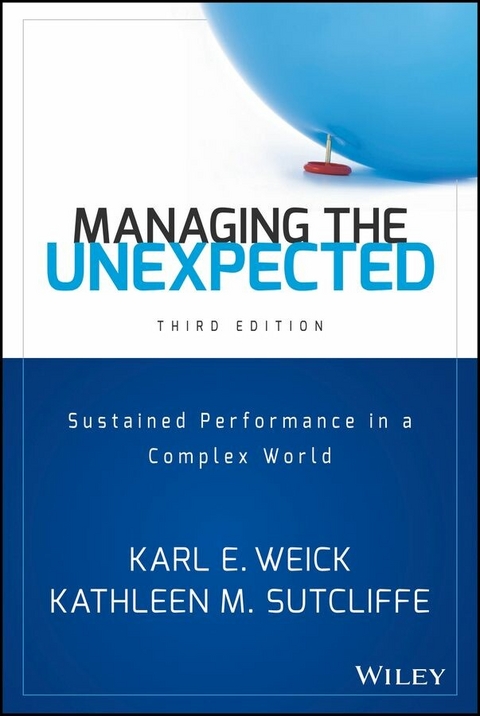
Managing the Unexpected (eBook)
John Wiley & Sons (Verlag)
978-1-118-86249-0 (ISBN)
Managing the Unexpected, Third Edition is a thoroughly revised text that offers an updated look at the groundbreaking ideas explored in the first and second editions, Revised to reflect events emblematic of the unique challenges that organizations have faced in recent years, including bank failures, intelligence failures, quality failures, and other organizational misfortunes, often sparked by organizational actions, this critical book focuses on why some organizations are better able to sustain high performance in the face of unanticipated change, High reliability organizations (HROs), including commercial aviation, emergency rooms, aircraft carrier flight operations, and firefighting units, are looked to as models of exceptional organizational preparedness, This essential text explains the development of unexpected events and guides you in improving your organization for more reliable performance,
'Expect the unexpected' is a popular mantra for a reason: it's rooted in experience, Since the dawn of civilization, organizations have been rocked by natural disasters, civil unrest, international conflict, and other unexpected crises that impact their ability to function, Understanding how to maintain function when catastrophe strikes is key to keeping your organization afloat,
- Explore the many different kinds of unexpected events that your organization may face
- Consider updated case studies and research
- Discuss how highly reliable organizations are able to maintain control during unexpected events
- Discover tactics that may bolster your organization's ability to face the unexpected with confidence
Managing the Unexpected, Third Edition offers updated, valuable content to professionals who want to strengthen the preparedness of their organizations-and confidently face unexpected challenges,
KARL E, WEICK is the Rensis Likert Distinguished University Professor Emeritus of Organizational Behavior and Psychology at the University of Michigan, Weick received the Irwin Award and Best Article of the Year award from the Academy of Management, Fast Company's Senior Editor Keith Hammonds calls Weick 'the smartest business thinker that you've never heard of,'
KATHLEEN M, SUTCLIFFE is a Bloomberg Distinguished Professor of Business and Medicine at Johns Hopkins University and the Gilbert and Ruth Whitaker Professor Emerita of Business Administration at the Ross School of Business, University of Michigan, She was named Researcher of the year and has served on a National Academy of Science panel to assess the resilience of the Department of Homeland Security,
KARL E. WEICK is the Rensis Likert Distinguished University Professor Emeritus of Organizational Behavior and Psychology at the University of Michigan. Weick received the Irwin Award and Best Article of the Year award from the Academy of Management. Fast Company's Senior Editor Keith Hammonds calls Weick "the smartest business thinker that you've never heard of." KATHLEEN M. SUTCLIFFE is a Bloomberg Distinguished Professor of Business and Medicine at Johns Hopkins University and the Gilbert and Ruth Whitaker Professor Emerita of Business Administration at the Ross School of Business, University of Michigan. She was named Researcher of the year and has served on a National Academy of Science panel to assess the resilience of the Department of Homeland Security.
Preface vii
Acknowledgments xi
Chapter 1 Mismanaging the Unexpected 1
Chapter 2 The Infrastructure of Mindful Organizing 21
Chapter 3 Principle 1: Preoccupation with Failure 45
Chapter 4 Principle 2: Reluctance to Simplify 62
Chapter 5 Principle 3: Sensitivity to Operations 77
Chapter 6 Principle 4: Commitment to Resilience 94
Chapter 7 Principle 5: Deference to Expertise 112
Chapter 8 Organizational Culture and Reliability 129
Chapter 9 Sustaining Sustained Performance 148
Notes 163
About the Authors 195
Index 197
Chapter 1
Mismanaging the Unexpected
“A breakdown is not a negative situation to be avoided, but a situation of nonobviousness.”1
—Terry Winograd and Fernando Flores
“Danger, disquiet, anxiety attend the unknown—the first instinct is to eliminate those distressing states. First principle: any explanation is better than none.…The first idea which explains that the unknown is in fact the known does so much good that one ‘holds it for true.’”2
—Friedrich Nietzsche
Nonobvious breakdowns happen all the time. Some are a big deal. Most are not. But which are which? The answer to that question is hazy because we tend to settle for the “first explanation” that makes us feel in control. That explanation turns the unknown into the known, which makes the explanation appear to be “true.” That can be a serious misjudgment. This book is about what we could call “the second explanation,” the one that—discomforting though it may be—treats the unknown as knowable. This second explanation is built from processes that produce an ongoing focus on failures, simplifications, operations, options, and expertise. Organizing that incorporates processes with these five areas of focus helps make breakdowns more knowable. These processes are an effortful means to maintain reliable performance, but previous work on high reliability organizations (HROs) shows that effortful processes like these make breakdowns more obvious at earlier stages in their development.
Our ideas come from an evolving body of work that originated with studies of safe operations on the flight decks of aircraft carriers, the generation and transmission of electrical power, and the dispatching of aircraft at an en route air traffic control center.3 The common problem faced by all three was a million accidents waiting to happen that didn't. In each case the question was, How were the units organized to accomplish this outcome? Among the answers that have been proposed are the existence of a unique culture, capability for self-design, networks built on expertise, hybrid structures with special attention to redundancy, training and routines, situation awareness, mind-sets involved in sensemaking, relational strategies, and information processing.4 In an effort to synthesize a workable set of principles from this rich array, we focused on processes that were mixtures of variety and stability or, as the late Michael Cohen called them, “patterns in variety.”5 One pattern that seemed to recur was a sustained focus on small failures, less abstract specifics, ongoing operations, alternative pathways to keep going, and the mobilization of expertise. The variety within this pattern came from local customizing that produced meaningful practices that did not compromise the adaptive capacity that the pattern generated.
Once that adaptive capacity weakens, reliability suffers. To illustrate how problems with reliability develop over time, in this chapter we analyze the collapse of the Washington Mutual Bank (WaMu). Although this example involves the financial industry, the problems and lessons apply to other industries as well.6 This wider application occurs because all of us, just as was true for those at WaMu, have to act in situations we can't possibly understand.7 And the reason we can't understand them is because all of us “have to apply limited conceptions to unlimited interdependencies.”8 The conceptions and the ways we apply them are what matter. If we change these conceptions, then we change our ability to function under conditions of nonobviousness. As we will see, WaMu underestimated its interdependencies and overestimated its conceptual grasp of those interdependencies it did see.
Washington Mutual Mismanages the Unexpected
Washington Mutual Bank (WaMu) failed and was seized by the Federal Deposit Insurance Corporation (FDIC) on September 25, 2008, at 6 PM, and sold to JP Morgan Chase. We take a closer look at a sample of surprises in this unit that affected its reliability. And we describe one way to think about these fluctuations in reliability. Our interpretation is grounded in the idea that managing the unexpected is an ongoing effort to define and monitor weak signals9 of potentially more serious threats and to take adaptive action as those signals begin to crystallize into more complex chains of unintended consequences. The phrase “begin to crystallize” is crucial to our argument because managing is an active process that is spread over time as the signals and situations change. As a problem begins to unfold, weak signals are hard to detect but easy to remedy. As time passes, this state of affairs tends to reverse. Signals become easy to detect but hard to remedy. As weak signals change, so do the requirements for adaptive functioning. It is that adapting that became more and more flawed at WaMu.
Overview of Washington Mutual Bank Failure10
During the 1980s WaMu, nearly 100 years old, was a retail savings and loan (S&L) bank that, under chief executive officer (CEO) Louis Pepper, had grown from 35 branches to 50 and from $2 billion in assets to $7 billion. The organization was held together by five values, all nouns: ethics, respect, teamwork, innovation, and excellence.11 When Pepper was replaced in December 1988 by Kerry Killinger, the values were changed to three adjectives: fair, caring, and human.12 Later, as the bank aggressively tried to become the largest at several lines of business (largest S&L, largest mortgage lender,13 and largest home equity lender14) and focused increasingly on high-risk, subprime loans, two new adjectives replaced all other values: dynamic and driven.15 These last two values were christened “The WaMu way.”16
In 1998 WaMu acquired Long Beach Mortgage (LB), a small subprime lender with $328 million in assets. Subprime lending had become fashionable in the banking industry. WaMu had never made these kinds of loans although they appeared to be more profitable than conventional mortgages, albeit riskier. Subprime loans were more profitable because banks charged higher interest rates and higher fees, but they were riskier because borrowers couldn't qualify for regular prime mortgages.
An early weak signal of unexpected events occurred in the summer of 2003. A sampling of 270 LB loans reviewed by the compliance department revealed that 40 percent were deemed “unacceptable because of a critical error.”17 Underwriting standards had been loosened to sell more loans. An internal flyer had said “a thin file is a good file,”18 suggesting that less effort spent on documentation meant more time to sell more loans. For example, one loan application had a picture of a mariachi singer, and his income is “stated” as being in six figures. However, the picture was not a picture of the borrower, nor was that the borrower's income.19
As the bank moved into a higher risk strategy for residential loans, the chief risk officer, James Vanasek, faced the unenviable position of being “in charge of balancing risk, at a bank that was loading up on it.”20 Much later during a congressional hearing, Senator Tom Coburn asked Vanasek, “How do you account for the fact that somebody has seen a [housing] bubble, and by definition, a bubble is going to burst, and then their corporate strategy is to jump into the middle of the bubble?”21 Vanasek had no answer then, nor did he have any success earlier when he tried to limit the number of “stated income” loans being made (loans with no proof of income). He resigned.
There was a continuing push to sell high-margin products, such as home equity loans and subprime loans. A new risk officer, Ron Cathcart, was hired as Vanasek's replacement, and soon thereafter, Cathcart told CEO Killinger that the Federal Office of Thrift Supervision (OTS) was about to downgrade the bank's “health” rating. Killinger said, “I don't like to hear bad news.” Cathcart replied, “It's my job to deliver bad news,” but Killinger was already out the door before Cathcart finished his sentence.22
During this period former CEO Pepper sent his protégé Killinger a blunt letter. The gist of it was that Killinger was not leading in the face of the bank's continuing decline.23 For example, as Pepper put it, Killinger still held on to the title chief operating officer (COO) but operations were a mess. Even though Pepper said that it was imperative that Killinger hire a COO, Killinger didn't and kept the title.24 Pepper was also deeply worried about Killinger's optimism and his failure to discuss worst-case scenarios. Pepper's worries were shared by insiders: “Don't listen to him, he's a Pollyanna.”25 As Pepper said in his letter, “There is no alternative but to give the worst case to the decision makers or later be in an untenable position of failing to make full disclosure. If you make full disclosure you may lose money but failure to do so has much worse penalties.” No disclosure was made and much worse penalties did occur. As problems mounted the directors did next to nothing because they had...
| Erscheint lt. Verlag | 28.8.2015 |
|---|---|
| Sprache | englisch |
| Themenwelt | Wirtschaft ► Betriebswirtschaft / Management ► Unternehmensführung / Management |
| Schlagworte | Business & Management • confidently facing the unexpected • Crisis Management • Crisis Preparedness • emergency management • how to prepare an organization for the unexpected • Karl E. Weick • Katastrophenschutz • Kathleen M. Sutcliffe • Management • managing organizational response to surprises • Managing the Unexpected • Managing the Unexpected: Sustained Performance in a Complex World • Organizational Management • organizational preparedness • preparing for unexpected crises • security management • Sicherheitsmanagement • tactics to improve organizational preparedness and resilience • Wirtschaft u. Management |
| ISBN-10 | 1-118-86249-X / 111886249X |
| ISBN-13 | 978-1-118-86249-0 / 9781118862490 |
| Informationen gemäß Produktsicherheitsverordnung (GPSR) | |
| Haben Sie eine Frage zum Produkt? |
 EPUB (Adobe DRM)
Kopierschutz: Adobe-DRM
Adobe-DRM ist ein Kopierschutz, der das eBook vor Mißbrauch schützen soll. Dabei wird das eBook bereits beim Download auf Ihre persönliche Adobe-ID autorisiert. Lesen können Sie das eBook dann nur auf den Geräten, welche ebenfalls auf Ihre Adobe-ID registriert sind.
Details zum Adobe-DRM
Dateiformat: EPUB (Electronic Publication)
EPUB ist ein offener Standard für eBooks und eignet sich besonders zur Darstellung von Belletristik und Sachbüchern. Der Fließtext wird dynamisch an die Display- und Schriftgröße angepasst. Auch für mobile Lesegeräte ist EPUB daher gut geeignet.
Systemvoraussetzungen:
PC/Mac: Mit einem PC oder Mac können Sie dieses eBook lesen. Sie benötigen eine
eReader: Dieses eBook kann mit (fast) allen eBook-Readern gelesen werden. Mit dem amazon-Kindle ist es aber nicht kompatibel.
Smartphone/Tablet: Egal ob Apple oder Android, dieses eBook können Sie lesen. Sie benötigen eine
Geräteliste und zusätzliche Hinweise
Buying eBooks from abroad
For tax law reasons we can sell eBooks just within Germany and Switzerland. Regrettably we cannot fulfill eBook-orders from other countries.
aus dem Bereich