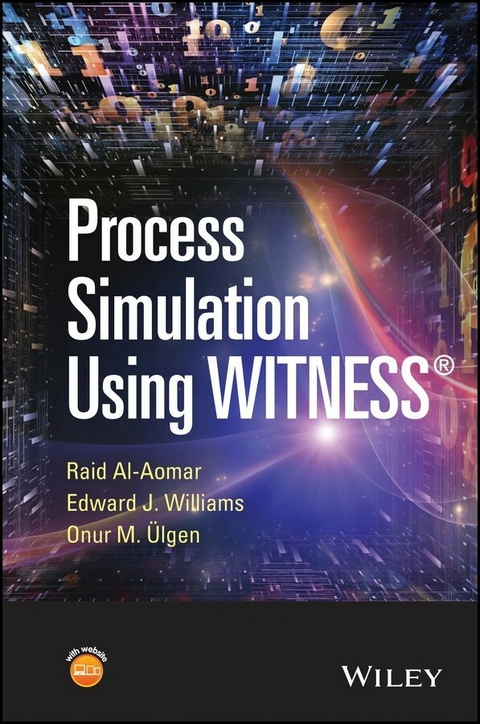
Process Simulation Using WITNESS (eBook)
John Wiley & Sons (Verlag)
978-1-119-01976-3 (ISBN)
Teaches basic and advanced modeling and simulation techniques to both undergraduate and postgraduate students and serves as a practical guide and manual for professionals learning how to build simulation models using WITNESS, a free-standing software package.
This book discusses the theory behind simulation and demonstrates how to build simulation models with WITNESS. The book begins with an explanation of the concepts of simulation modeling and a “guided tour” of the WITNESS modeling environment. Next, the authors cover the basics of building simulation models using WITNESS and modeling of material-handling systems. After taking a brief tour in basic probability and statistics, simulation model input analysis is then examined in detail, including the importance and techniques of fitting closed-form distributions to observed data. Next, the authors present simulation output analysis including determining run controls and statistical analysis of simulation outputs and show how to use these techniques and others to undertake simulation model verification and validation. Effective techniques for managing a simulation project are analyzed, and case studies exemplifying the use of simulation in manufacturing and services are covered. Simulation-based optimization methods and the use of simulation to build and enhance lean systems are then discussed. Finally, the authors examine the interrelationships and synergy between simulation and Six Sigma.
- Emphasizes real-world applications of simulation modeling in both services and manufacturing sectors
- Discusses the role of simulation in Six Sigma projects and Lean Systems
- Contains examples in each chapter on the methods and concepts presented
Process Simulation Using WITNESS is a resource for students, researchers, engineers, management consultants, and simulation trainers.
Raid Al-Aomar is a Simulation Expert and a Professor of Industrial Engineering at in College of Engineering at Abu Dhabi University in the UAE.
Edward J. Williams works at the Production Modeling Corporation in Dearborn, Michigan, and teaches courses in Business Analytics at the University of Michigan - Dearborn.
Onur M. Ülgen is a Professor in the Industrial and Manufacturing Systems Engineering Department at the University of Michigan in Dearborn, Michigan. He is also the President of Production Modeling Corporation, a process simulation company with offices in USA (HQ), Sweden, and India.
Teaches basic and advanced modeling and simulation techniques to both undergraduate and postgraduate students and serves as a practical guide and manual for professionals learning how to build simulation models using WITNESS, a free-standing software package. This book discusses the theory behind simulation and demonstrates how to build simulation models with WITNESS. The book begins with an explanation of the concepts of simulation modeling and a guided tour of the WITNESS modeling environment. Next, the authors cover the basics of building simulation models using WITNESS and modeling of material-handling systems. After taking a brief tour in basic probability and statistics, simulation model input analysis is then examined in detail, including the importance and techniques of fitting closed-form distributions to observed data. Next, the authors present simulation output analysis including determining run controls and statistical analysis of simulation outputs and show how to use these techniques and others to undertake simulation model verification and validation. Effective techniques for managing a simulation project are analyzed, and case studies exemplifying the use of simulation in manufacturing and services are covered. Simulation-based optimization methods and the use of simulation to build and enhance lean systems are then discussed. Finally, the authors examine the interrelationships and synergy between simulation and Six Sigma. Emphasizes real-world applications of simulation modeling in both services and manufacturing sectors Discusses the role of simulation in Six Sigma projects and Lean Systems Contains examples in each chapter on the methods and concepts presented Process Simulation Using WITNESS is a resource for students, researchers, engineers, management consultants, and simulation trainers.
Raid Al-Aomar is a Simulation Expert and a Professor of Industrial Engineering at in College of Engineering at Abu Dhabi University in the UAE. Edward J. Williams works at the Production Modeling Corporation in Dearborn, Michigan, and teaches courses in Business Analytics at the University of Michigan - Dearborn. Onur M. Ülgen is a Professor in the Industrial and Manufacturing Systems Engineering Department at the University of Michigan in Dearborn, Michigan. He is also the President of Production Modeling Corporation, a process simulation company with offices in USA (HQ), Sweden, and India.
CHAPTER 1
CONCEPTS OF SIMULATION MODELING
1.1 OVERVIEW
Driven by growing competition and globalization and to remain competitive, companies across the world strive to maintain high product and service quality, low production costs, short lead times, an efficient supply chain, and high customer satisfaction. To this end, companies often relay on traditional process improvement and cost reduction measures and adopt emerging initiatives of quality management, lean manufacturing, and Six Sigma. These initiatives are widely used for system-level design, improvement, and problem-solving with the aim of integrating continuous improvement into the company's policy and strategic planning.
Successful deployment of such initiatives, therefore, requires an accurate system-level representation of underlying production and business processes. Examples of process representation range from transfer functions to process mapping, flow-charting, modeling, and value stream mapping. Real-world production and business systems are, however, characterized by complexity and dynamic and stochastic behavior. This makes mathematical approximation, static representation, and deterministic models less effective in representing the actual system behavior. Alternatively, simulation facilitates better representation of real-world systems and its application for system-level modeling is increasingly used as a common platform in emerging methods of system design, problem-solving, and improvement.
Simulation modeling, as an industrial engineering (IE) tool, has undergone a tremendous development in the last decade. This development can be pictured through the growing capabilities of simulation software tools and the application of simulation solutions to a variety of real-world problems. With the aid of simulation, companies nowadays can design efficient production and business systems, troubleshoot potential problems, and validate/tradeoff proposed solution alternatives to improve performance metrics, and, consequently, cut cost, meet targets, and boost sales and profits.
WITNESS® simulation software is a modern modeling tool that has been increasingly utilized in a wide range of production and business applications. WITNESS® is mainly characterized by ease-of-use, well-designed simulation modules, and integrated tools for system analysis and optimization. WITNESS® is also linked to emerging initiatives of Six Sigma and Lean Techniques through modules that facilitate Sigma calculation and process optimization.
This book discusses the theoretical and practical aspects of simulation modeling in the context of WITNESS® simulation environment. This chapter provides an introduction to the basic concepts of simulation and clarifies the simulation role and rationale. This includes an introduction to the concept, terminology, and types of models, a justification for utilizing simulation in real-world applications, and a brief discussion on the simulation process. Such background is essential to establish a basic understanding of what simulation is all about and to understand the key simulation role in process engineering and emerging technologies.
1.2 SYSTEM MODELING
System modeling as a term includes two important commonly used concepts; system and modeling. It is imperative to clarify such concepts before attempting to focus on their relevance to the “Simulation” topic. This section will introduce these two concepts and provide a generic classification to the different types of systeml models.
1.2.1 System Concept
System thinking is a fundamental skill in simulation modeling. The word system is commonly used in its broad meaning in a variety of engineering and nonengineering fields. In simple words, a system is often referred to as a set of elements or operations that are logically related and effectively configured toward the attainment of a certain goal or objective. To attain the intended goal or to serve the desired function, it is necessary for the system to receive a set of inputs, process them correctly, and produce the required outcomes. To sustain such flow, a certain control is required to govern the system behavior. Given such definition, we can analyze any system (S) based on the architecture shown in Figure 1.1.
Figure 1.1 Definition of system concept.
El-Haik, B., Al-Aomar, R. (2006). Reproduced with permission of John Wiley & Sons, Inc.
As shown in Figure 1.1, each system (S) can be mainly defined in terms of a set of Inputs (I) received by a Process (P) and transformed into a specific set of Outputs (O). The process consists of a set of system Elements or Entities (EN) that are configured based on a set of logical Relationships (RL). An overall Goal (G) is often defined to represent the purpose and objective of the system. To sustain a flawless flow and correct functionality of I–P–O, some kind of controls (C) is essentially applied to system Inputs, Process, and Outputs. Thus, building a system or a system model primarily requires the following:
- 1. Defining the goal (G) or the overall system objective and relating system structure to the goal attainment.
- 2. Specifying the set of outcomes (O) that should be produced and their specifications that result in attaining the specified Goal (G).
- 3. Specifying the set of system Inputs (I) that are required in order to produce the specified system Outcomes (O) along with the specifications of these Inputs (I).
- 4. Listing system entities S = (EN1, EN2, EN3, …, ENn) and defining the characteristics and the individual role of each entity (resources, storage, etc.).
- 5. Setting the logical relationships (RL1, RL2, RL3, …, RLm) among the defined set of system elements to perform the specified process activities.
- 6. Specifying the system Controls (C) and their role in monitoring the specifications of system Inputs (I) and Outputs (O) and adjusting the operation of the Process (P) to meet the specified Goal (G).
This understanding requires for any arrangement of objects to be called a system to be structured logically and to have an interaction that leads to a useful outcome. Transforming system inputs into desired outputs is often performed through system resources. Correct processing is often supported by controls and inventory systems to assure quality and maintain steady performance. This understanding of system concept is our gateway to the broader subject of system engineering. Examples of common real-life systems include classrooms, computer systems, factories, hospitals, and so on. In the classroom example, students are subject to various elements of the educational process (P) in the classroom, which involves attendance, participation in class activities, submitting assignments, passing examinations, and so on in order to complete the class with certain qualifications and skills. Applying the definition of system to the classroom example leads to the following:
- 1. The overall system goal (G) is set to educate students on a certain subject and provide quality education to students attending classes.
- 2. System Inputs (I) are students of certain age, academic level, major, and so on.
- 3. System Outputs (O) are also students upon fulfilling class requirements.
- 4. The set of system entities is defined as follows:
- 5. The defined entities in S are logically related through a set of relationships (RL). For example, chairs are located around tables that face the instructor, the instructor stands in front of students and writes on whiteboard, and so on.
- 6. Finally, class regulations and policies for admission, attendance, grading, and graduation represent process Controls (C).
It is worth mentioning that the term “system” covers both products and processes. A product system can be an automobile, a cellular telephone, a computer, a calculator, and so on. Any of these products involves the defined components of the system in terms inputs, outputs, elements, relationships, controls, and goal. Try to analyze all the mentioned examples from this perspective. On the other hand, a process system can be a manufacturing process, an assembly line, a power plant, and a business process. Similarly, any of these processes involves the defined components of the system. Try to analyze all the mentioned examples from this perspective.
1.2.2 Modeling Concept
The word modeling refers to the process of representing a system with a selected model that is easier to understand and less expensive to build compared to the actual system. The system model includes a representation of system elements, relationships, inputs, controls, and outputs. Modeling a system, therefore, has two prerequisites:
- 1. Understanding the structure of the actual (real-world) system and the functionality of its components. It is imperative for the analyst to be familiar with the system and understand its purpose and functionality. For example, in an automobile assembly plant, the modeler needs to be familiar with the production system of building vehicles before attempting to model the vehicle assembly...
| Erscheint lt. Verlag | 28.8.2015 |
|---|---|
| Sprache | englisch |
| Themenwelt | Technik ► Elektrotechnik / Energietechnik |
| Technik ► Maschinenbau | |
| Wirtschaft ► Betriebswirtschaft / Management ► Logistik / Produktion | |
| Schlagworte | basic probability • Business & Management • Electrical & Electronics Engineering • Elektrotechnik u. Elektronik • Industrial Engineering • Industrial Engineering / Project Management • Industrielle Verfahrenstechnik • manufacturing simulation case studies • modeling material handling systems • model verification • Projektmanagement i. d. Industriellen Verfahrenstechnik • Qualitätsmanagement • Qualitätsmanagement • Quality management • risk function • service simulation case studies • simulation-based optimization methods • simulation for lean systems • simulation input modeling • Simulation Modeling • simulation output analysis • simulation project management • Six Sigma • statistics for simulation • Systems Engineering & Management • Systemtechnik u. -management • verification techniques • Wirtschaft u. Management • Witness • WITNESS environment |
| ISBN-10 | 1-119-01976-1 / 1119019761 |
| ISBN-13 | 978-1-119-01976-3 / 9781119019763 |
| Informationen gemäß Produktsicherheitsverordnung (GPSR) | |
| Haben Sie eine Frage zum Produkt? |
 EPUB (Adobe DRM)
Kopierschutz: Adobe-DRM
Adobe-DRM ist ein Kopierschutz, der das eBook vor Mißbrauch schützen soll. Dabei wird das eBook bereits beim Download auf Ihre persönliche Adobe-ID autorisiert. Lesen können Sie das eBook dann nur auf den Geräten, welche ebenfalls auf Ihre Adobe-ID registriert sind.
Details zum Adobe-DRM
Dateiformat: EPUB (Electronic Publication)
EPUB ist ein offener Standard für eBooks und eignet sich besonders zur Darstellung von Belletristik und Sachbüchern. Der Fließtext wird dynamisch an die Display- und Schriftgröße angepasst. Auch für mobile Lesegeräte ist EPUB daher gut geeignet.
Systemvoraussetzungen:
PC/Mac: Mit einem PC oder Mac können Sie dieses eBook lesen. Sie benötigen eine
eReader: Dieses eBook kann mit (fast) allen eBook-Readern gelesen werden. Mit dem amazon-Kindle ist es aber nicht kompatibel.
Smartphone/Tablet: Egal ob Apple oder Android, dieses eBook können Sie lesen. Sie benötigen eine
Geräteliste und zusätzliche Hinweise
Buying eBooks from abroad
For tax law reasons we can sell eBooks just within Germany and Switzerland. Regrettably we cannot fulfill eBook-orders from other countries.
aus dem Bereich