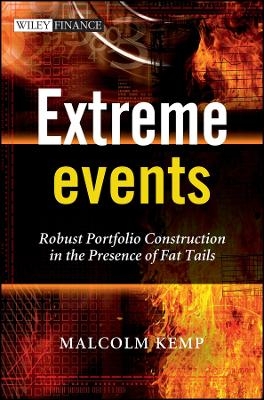
Extreme Events – Robust Portfolio Construction in the Presence of Fat Tails
John Wiley & Sons Inc (Hersteller)
978-1-119-20703-0 (ISBN)
- Keine Verlagsinformationen verfügbar
- Artikel merken
It then explains how to refine these methodologies to accommodate real world behaviour. Throughout, the book highlights the importance of expert opinion, showing that even the most data-centric portfolio construction approaches ultimately depend on practitioner assumptions about how the world might behave. The book includes: * Key concepts and methods involved in analysing extreme events * A comprehensive treatment of mean-variance investing, Bayesian methods, market consistent approaches, risk budgeting, and their application to manager and instrument selection * A systematic development of the refinements needed to traditional portfolio construction methodologies to cater for fat-tailed behaviour * Latest developments in stress testing and back testing methodologies * A strong focus on the practical implementation challenges that can arise at each step in the process and on how to overcome these challenges Understanding how to model and analyse the risk of extreme events is a crucial part of the risk management process. This book provides a set of techniques that allow practitioners to do this comprehensively.
Paul Sweeting, Professor of Actuarial Science, University of Kent How can the likeliness of crises affect the construction of portfolios? This question is highly topical in times where we still have to digest the last financial collapse. Malcolm Kemp gives the answer. His book is highly recommended to experts as well as to students in the financial field. Christoph Krischanitz, President Actuarial Association of Austria, Chairman WG Market Consistency of Groupe Consultatif
Malcolm Kemp (London, UK) is Founder and Managing director of Nematrian Ltd, a consulting firm delivering services to the quantitative finance and actuarial communities. Previously, he was Director and Head of the Quantitative Research Team at Threadneedle Asset Management, responsible for the derivative desk and its portfolio risk measurement and management activities. He is a leading expert on derivatives, performance measurement, risk measurement, liability driven investment and other quantitative investment techniques. Prior to this, Malcolm was a partner at Bacon & Woodrow in their investment consultancy practice. He holds a first class degree in Mathematics from Cambridge University and is also a Fellow of the Institute of Actuaries. He is a regular on the conference circuit, including Risk Europe and GARP events where he speaks on a range of portfolio management and derivatives topics.
Preface. Acknowledgements. Abbreviations. Notation. 1 Introduction. 1.1 Extreme events. 1.2 The portfolio construction problem. 1.3 Coping with really extreme events. 1.4 Risk budgeting. 1.5 Elements designed to maximise benefit to readers. 1.6 Book structure. 2 Fat Tails In Single (i.e., Univariate) Return Series. 2.1 Introduction. 2.2 A fat tail relative to what? 2.3 Empirical examples of fat-tailed behaviour in return series. 2.4 Characterising fat-tailed distributions by their moments. 2.5 What causes fat tails? 2.6 Lack of diversification. 2.7 A time-varying world. 2.8 Stable distributions. 2.9 Extreme value theory (EVT). 2.10 Parsimony. 2.11 Combining different possible source mechanisms. 2.12 The practitioner perspective. 2.13 Implementation challenges. 3 Fat Tails In Joint (i.e., Multivariate) Return Series. 3.1 Introduction. 3.2 Visualisation of fat tails in multiple return series. 3.3 Copulas and marginals Sklar s theorem. 3.4 Example analytical copulas. 3.5 Empirical estimation of fat tails in joint return series. 3.6 Causal dependency models. 3.7 The practitioner perspective. 3.8 Implementation challenges. 4 Identifying Factors That Significantly Influence Markets. 4.1 Introduction. 4.2 Portfolio risk models. 4.3 Signal extraction and principal components analysis. 4.4 Independent components analysis. 4.5 Blending together principal components analysis and independent components analysis. 4.6 The potential importance of selection effects. 4.7 Market dynamics. 4.8 Distributional mixtures. 4.9 The practitioner perspective. 4.10 Implementation challenges. 5 Traditional Portfolio Construction Techniques. 5.1 Introduction. 5.2 Quantitative versus qualitative approaches? 5.3 Risk-return optimisation. 5.4 More general features of mean-variance optimisation. 5.5 Manager selection. 5.6 Dynamic optimisation. 5.7 Portfolio construction in the presence of transaction costs. 5.8 Risk budgeting. 5.9 Backtesting portfolio construction techniques. 5.10 Reverse optimisation and implied view analysis. 5.11 Portfolio optimisation with options. 5.12 The practitioner perspective. 5.13 Implementation challenges. 6 Robust Mean-Variance Portfolio Construction. 6.1 Introduction. 6.2 Sensitivity to the input assumptions. 6.3 Certainty equivalence, credibility weighting and Bayesian statistics. 6.4 Traditional robust portfolio construction approaches. 6.5 Shrinkage. 6.6 Bayesian approaches applied to position sizes. 6.7 The universality of Bayesian approaches. 6.8 Market consistent portfolio construction. 6.9 Resampled mean-variance portfolio optimisation. 6.10 The practitioner perspective. 6.11 Implementation challenges. 7 Regime Switching and Time-Varying Risk and Return Parameters. 7.1 Introduction. 7.2 Regime switching. 7.3 Investor utilities. 7.4 Optimal portfolio allocations for regime switching models. 7.5 Links with derivative pricing theory. 7.6 Transaction costs. 7.7 Incorporating more complex autoregressive behaviour. 7.8 Incorporating more intrinsically fat-tailed behaviour. 7.9 More heuristic ways of handling fat tails. 7.10 The practitioner perspective. 7.11 Implementation challenges. 8 Stress Testing. 8.1 Introduction. 8.2 Limitations of current stress testing methodologies. 8.3 Traditional stress testing approaches. 8.4 Reverse stress testing. 8.5 Taking due account of stress tests in portfolio construction. 8.6 Designing stress tests statistically. 8.7 The practitioner perspective. 8.8 Implementation challenges. 9 Really Extreme Events. 9.1 Introduction. 9.2 Thinking outside the box. 9.3 Portfolio purpose. 9.4 Uncertainty as a fact of life. 9.5 Market implied data. 9.6 The importance of good governance and operational management. 9.7 The practitioner perspective. 9.8 Implementation challenges. 10 The Final Word. 10.1 Conclusions. 10.2 Portfolio construction principles in the presence of fat tails. Appendix: Exercises. A.1 Introduction. A.2 Fat tails In single (i.e., univariate) return series. A.3 Fat tails In joint (i.e., multivariate) return series. A.4 Identifying factors that significantly influence markets. A.5 Traditional portfolio construction techniques. A.6 Robust mean-variance portfolio construction. A.7 Regime switching and time-varying risk and return parameters. A.8 Stress testing. A.9 Really extreme events. References. Index.
| Verlagsort | New York |
|---|---|
| Sprache | englisch |
| Maße | 152 x 229 mm |
| Gewicht | 666 g |
| Themenwelt | Wirtschaft ► Betriebswirtschaft / Management |
| ISBN-10 | 1-119-20703-7 / 1119207037 |
| ISBN-13 | 978-1-119-20703-0 / 9781119207030 |
| Zustand | Neuware |
| Informationen gemäß Produktsicherheitsverordnung (GPSR) | |
| Haben Sie eine Frage zum Produkt? |
aus dem Bereich