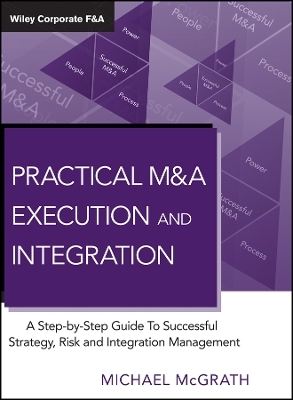
Practical M&A Execution and Integration – A Step by Step Guide To Successful Strategy, Risk and Integration Management
John Wiley & Sons Inc (Hersteller)
978-1-119-20695-8 (ISBN)
- Keine Verlagsinformationen verfügbar
- Artikel merken
The book covers the following core topics: *Fundamentals of M&A; the reasons for M&A, types of M&A deals and the challenges they present *M&A Regulation *Successful M&A, covering M&A power and providing a detailed look at the processes and people involved *Delivering M&A *The unique issues of Banking M&A, which differs significantly from other types of M&A deals. The final section consists of document templates and suggested tables of contents which are designed to be used alongside the advice in the book, thus making Practical M&A Execution and Integration the complete guide to constructing a successful M&A deal.
Dr. Michael McGrath is an established city professional, with over 15 years of experience working for some of the world's leading banks. He is currently a Head of Function for ADM Operations at Lloyds Banking Group. He is a former regional Chief Technical Officer at Merrill Lynch and Project Delivery Director at Bankers Trust and Deutsche Bank. He was a founder of Hibernia Consulting, a project delivery and risk management consulting firm serving major investment banking clients. Michael has spent his professional life implementing complex change, in particular managing Mergers and Acquisitions from the announcement of the deal through to post-merger integration. M&A deals he has worked on include Lloyds TSB Group, the Deutsche Bank acquisition of Bankers Trust (then the largest banking acquisition ever made), the Bankers Trust acquisition of NatWest Markets (then the largest banking acquisition in the UK) and IBM's acquisition of Lotus Development. Michael holds an MBA from the Smurfit School of Business; his MBA thesis won the Institute of Accountants in Ireland gold medal for research in 1996. His doctoral research examines risk behaviour in unfamiliar problem domains and he is probably the only person in the United Kingdom to hold a doctorate in banking M&A risk management.
Tables and Figures xi Foreword xv Acknowledgments xvii SECTION A: ABOUT MERGERS AND ACQUISITIONS 1 Chapter 1: Introduction 3 Fundamentals of mergers & acquisitions 5 Types of M&A deals 6 Challenges of M&A deals 11 Reasons for M&A 14 Chapter 2: Role of regulation 21 Regulatory regimes 22 UK anti-trust regime 23 European Union regulation 26 US anti-trust legislation 27 Bid process 28 SECTION B: FUNDAMENTALS OF THE DEAL 31 Chapter 3: Anatomy of a deal 33 M&A Stages 33 Phase 1: Prelude (to a deal) 36 Phase 2: Deal negotiation 40 Phase 3: Pre-change of control 44 Phase 4: Change of control 50 Phase 5: Integration 50 Phase 6: Business as usual 53 SECTION C: SUCCESSFUL M&A 55 Chapter 4: M&A power 57 Clarity 57 Capacity 61 Speed 76 Chapter 5: M&A process 79 Risk management 80 Planning, management and control 106 Project lifecycle and structure 113 Issue management 133 Risk management practice 138 Reporting 149 Assumption management 152 Dependency management 154 Scope change management 157 Quality management 162 Resource management 164 Cost management 166 Communications management 170 Stakeholder management 173 Chapter 6: M&A people 175 Culture 175 Stakeholders 179 Personnel 179 SECTION D: PULLING IT ALL TOGETHER: DELIVERING M&A 185 Chapter 7: Timing 187 Managing the integration and change of control period 187 Project organisation and control 197 SECTION E: BANKING M&A 207 What makes banking M&A unique? 207 Planning for the post-merger period 211 Planning to get to the change of control 212 Organisational approach 225 Issue management 229 What if it all goes wrong? 235 SECTION F: DOCUMENT TEMPLATES AND SUGGESTED TABLES OF CONTENTS 239 Control documents 239 Report templates 245 Project document templates 255 Bibliography 289 About the author 291 Index 293 Tables Table 5.1 Temporal impacts on risk behaviour, after Das and Teng 85 Table 5.2 Delphi participation 95 Table 5.3 Sample risk classifi cation 98 Table 5.4 Sample risk meta data 99 Table 5.5 Example classifi cation of risks identifi ed using CRIM process 104 Table 5.6 Project constraints at different stages of a deal 110 Table 5.7 Inherent project risk 144 Table 5.8 Example of Earned Value Analysis (EVA) 168 Table 6.1 Approaches to forging a common culture 180 Table 6.2 Approaches to motivation of retained and non-retained staff 183 Table 7.1 Establishing integration team contacts 1 198 Table E.1 Establishing integration team contacts 2 209 Table E.2 Example: Trading desk distribution 215 Table E.3 Build activities 217 Table E.4 Testing 217 Table E.5 Dress rehearsal planning 218 Table E.6 Operational readiness 218 Table E.7 Change of control requirements 219 Table E.8 Change of control/cutover activities 221 Table E.9 First trading day requirements 221 Table E.10 Reporting audiences 229 Figures Figure 1.1 Three capabilities for successful M&A 4 Figure 1.2 Impact of a merger 7 Figure 1.3 Impact of an acquisition 8 Figure 1.4 Impact of a demerger 9 List of Tables & Figures Figure 1.5 Merger values 1968 2007 12 Figure 1.6 Recent merger activity, 2008 2010 13 Figure 3.1 Strata model 35 Figure 3.2 High level M&A plan (1 of 2) 37 Figure 3.3 High level M&A plan (2 of 2) 38 Figure 3.4 Relationship of high level planning 41 Figure C.1 Key elements of successful M&A 56 Figure 4.1 M&A power pyramid 58 Figure 5.1 M&A process pyramid 79 Figure 5.2 Reconceptualised model of risk determinants, after Sitkin and Pablo 84 Figure 5.3 CRIM framework 88 Figure 5.4 Risk classifi cation 97 Figure 5.5 Bands of answers 102 Figure 5.6 Example results 102 Figure 5.7 Risk signifi cance (sorted) versus level of mitigation 103 Figure 5.8 Programme constraints triangle 111 Figure 5.9 Typical project lifecycle 115 Figure 5.10 Gated waterfall approach 115 Figure 5.11 Realistic waterfall approach 116 Figure 5.12 Single project iteration 117 Figure 5.13 An RAD project 118 Figure 5.14 Project controls active in each project phase 120 Figure 5.15 Initiation phase 121 Figure 5.16 Design phase 124 Figure 5.17 Execution phase 126 Figure 5.18 Testing phase 128 Figure 5.19 Implementation phase 130 Figure 5.20 Closure and review phase 132 Figure 5.21 Issue management process (1 of 2) 134 Figure 5.22 Issue management process (2 of 2) 136 Figure 5.23 Issue states 139 Figure 5.24 Risk management process (1 of 2) 141 Figure 5.25 Risk management process (2 of 2) 142 Figure 5.26 Risk signifi cance based on risk probability and impact 147 Figure 5.27 Mitigation impact 148 Figure 5.28 Risk states 150 Figure 5.29 Reporting cycle 151 Figure 5.30 Assumption management process 153 Figure 5.31 Dependency management process 156 Figure 5.32 Scope change management (1 of 2) 159 Figure 5.33 Scope change management (2 of 2) 160 Figure 5.34 Example of EVA 169 Figure 5.35 Communications planning 171 Figure 6.1 M&A people pyramid 176 Figure 6.2 Example: Cultural differences report 178 Figure 6.3 Staff motivational needs 182 Figure 7.1 Sample time line 189 Figure 7.2 Reporting hierarchy 205 Figure E.1 Cutover control infrastructure 227 Figure E.2 Issue states for CoC control 234 Figure E.3 Layout of a typical control centre 236
| Verlagsort | New York |
|---|---|
| Sprache | englisch |
| Maße | 152 x 229 mm |
| Gewicht | 666 g |
| Themenwelt | Wirtschaft ► Betriebswirtschaft / Management ► Planung / Organisation |
| ISBN-10 | 1-119-20695-2 / 1119206952 |
| ISBN-13 | 978-1-119-20695-8 / 9781119206958 |
| Zustand | Neuware |
| Informationen gemäß Produktsicherheitsverordnung (GPSR) | |
| Haben Sie eine Frage zum Produkt? |
aus dem Bereich