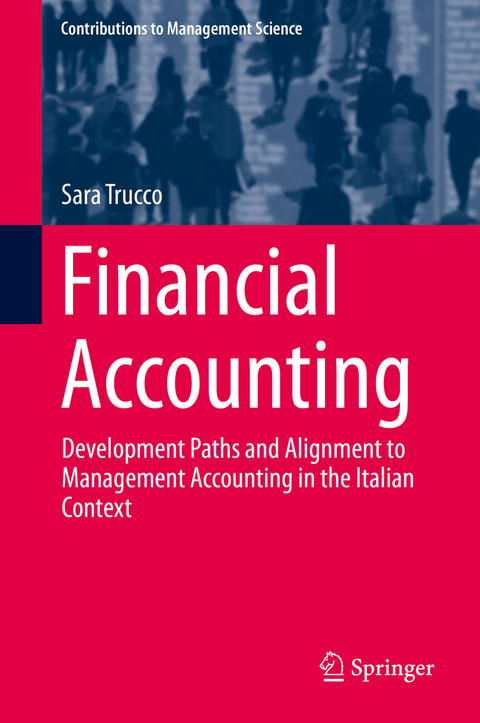
Financial Accounting (eBook)
IX, 143 Seiten
Springer International Publishing (Verlag)
978-3-319-18723-5 (ISBN)
Sara Trucco is an assistant professor at the Università degli Studi Internazionali di Roma in Rome. She got a Ph.D. in Business Administration at the University of Pisa in 2011, where she was a research fellow from 2011 to 2014. Dr. Trucco's research interests are in the fields of financial accounting, auditing and management accounting.
Sara Trucco is an assistant professor at the Università degli Studi Internazionali di Roma in Rome. She got a Ph.D. in Business Administration at the University of Pisa in 2011, where she was a research fellow from 2011 to 2014. Dr. Trucco's research interests are in the fields of financial accounting, auditing and management accounting.
Contents 8
Chapter 1: Introduction 11
1.1 A Brief Overview of the Book 11
1.2 Theoretical Contributions of the Present Work 14
1.3 Practical Contributions of the Present Work 16
1.4 Structure of the Book 16
References 17
Chapter 2: Financial Accounting: Development Paths 19
2.1 Introduction 19
2.2 Financial Accounting: A Possible Framework 19
2.2.1 Financial Accounting: An Objective Perspective 20
2.2.2 Financial Accounting: A Subjective Perspective 24
2.3 The Role of Voluntary, Non-financial and Forward-Looking Disclosure in Financial Accounting Information 25
2.3.1 Mandatory and Voluntary Disclosure: First Level of Analysis 26
2.3.2 Financial and Non-financial Information: Second Level of Analysis 28
2.3.3 Forward-Looking and Historical Information: Third Level of Analysis 30
2.4 Theories for Supporting and Containing the Evolution of Financial Accounting: An External Perspective 33
2.4.1 Agency Theory 34
2.4.2 Signalling Theory 36
2.4.3 Legitimacy Theory 37
2.4.4 Constraints on Additional Disclosure 37
2.5 Internal Determinants of Financial Accounting Development Paths 38
2.5.1 Institutional Theory 39
2.5.2 Corporate Governance and Culture 40
References 42
Chapter 3: Premises for the Convergence of Financial Accounting and Management Accounting 51
3.1 Introduction 51
3.2 A Promising Relationship 51
3.2.1 The Debut of ``Control´´ 51
3.2.2 The Internal Control System 53
3.2.3 A Brief Focus on Management Accounting 55
3.2.4 The Link Between Financial Accounting and Internal Control Systems 57
3.2.5 The Virtuous Circle Between the Forward-Looking Perspective of Financial Accounting and Forward-Looking Management Accou... 59
3.3 Premises for the Convergence 61
3.3.1 Premises for Convergence in an International Setting 61
3.3.2 Premises for Convergence in the Italian Setting 63
3.4 Convergence or Divergence of Financial Accounting and Management Accounting: Differences Among Countries and Cultures 66
References 69
Chapter 4: Drivers of the Alignment of Financial Accounting to Management Accounting 75
4.1 Introduction 75
4.2 Institutional Theory in Support of the Convergence Process of Financial Accounting and Management Accounting 75
4.3 The Viewpoints of Professional Associations and Academics 77
4.3.1 IAS/IFRS: A Possible Driver of the Convergence Process Between Financial Accounting and Management Accounting 77
4.3.2 Fair Value: A Possible Driver of the Convergence Process Between Financial Accounting and Management Accounting 80
4.4 The Role of Information Technology on the Convergence Between Financial Accounting and Management Accounting 83
References 88
Chapter 5: Financial Accounting and Alignment to Management Accounting in the Italian Context 93
5.1 Introduction 93
5.2 Research Hypotheses and Research Design 94
5.2.1 ERP and the Convergence of Financial Accounting and Management Accounting 94
5.2.2 IAS/IFRS and the Convergence of Financial Accounting and Management Accounting 97
5.2.3 Integration of Accounting Systems 101
5.2.4 The Research Design 104
5.3 Sample Selection and Data Collection 104
5.4 Variable Measurement 107
5.4.1 Exogenous Variables 107
5.4.2 Endogenous Variables 108
5.4.2.1 Integration of Accounting System Variable 108
5.4.2.2 Perceived Quality of Financial Accounting Variable 109
5.4.2.3 Perceived Quality of Management Accounting Variable 110
5.4.3 Control Variables 110
5.5 Pilot Interviews: Preliminary Analysis 111
5.5.1 Financial Accountant Interviews 111
5.5.1.1 Financial Accountant Interviews: The Development Path of Financial Accounting 111
5.5.1.2 Financial Accountant Interviews: The Changing Role of the Financial Accountant 112
5.5.1.3 Financial Accountant Interviews: The Convergence of Financial Accounting and Management Accounting 113
5.5.2 Controller Interviews 114
5.6 Survey Analysis 115
5.6.1 Descriptive Statistics 116
5.6.2 Statistical Model 120
5.6.3 Reliability and Validity of PLS-SEM Models 121
5.6.4 Empirical Findings 125
5.6.4.1 Empirical Findings: PLS-SEM Analysis on the Whole Dataset 126
5.6.4.2 Empirical Findings: PLS-SEM Analysis for the Sub-dataset of Financial Accountants 129
5.6.4.3 Empirical Findings: PLS-SEM Analysis for the Sub-dataset of Controllers 132
5.6.4.4 Summary PLS-SEM Results for the Three Samples of Respondents 135
Appendix: Survey 136
Personal Features 136
Firm´s Features 136
Convergence of Financial Accounting and Management Accounting 136
References 137
Chapter 6: Discussion on the Alignment of Financial Accounting to Management Accounting in the Italian Context 143
6.1 Introduction 143
6.2 The Antecedents and Consequences of the Alignment of Financial Accounting to Management Accounting 147
6.3 The Relationship Between the Quality of Financial Accounting and the Quality of Management Accounting 148
6.4 The Viewpoints of Controllers and Financial Accountants on Convergence 149
6.5 Further Findings: The Mediation Role of the Integration of Accounting Systems 150
6.6 Practical Implications 150
6.7 Limitations and Further Developments 151
References 152
| Erscheint lt. Verlag | 19.6.2015 |
|---|---|
| Reihe/Serie | Contributions to Management Science | Contributions to Management Science |
| Zusatzinfo | IX, 143 p. 24 illus. |
| Verlagsort | Cham |
| Sprache | englisch |
| Themenwelt | Wirtschaft ► Betriebswirtschaft / Management ► Finanzierung |
| Wirtschaft ► Betriebswirtschaft / Management ► Unternehmensführung / Management | |
| Schlagworte | Accounting convergence • Agency Theory • Financial disclosure • Forward-looking accounting • Institutional Theory • Legitimacy theory |
| ISBN-10 | 3-319-18723-6 / 3319187236 |
| ISBN-13 | 978-3-319-18723-5 / 9783319187235 |
| Informationen gemäß Produktsicherheitsverordnung (GPSR) | |
| Haben Sie eine Frage zum Produkt? |
 PDF (Wasserzeichen)
DRM: Digitales Wasserzeichen
Dieses eBook enthält ein digitales Wasserzeichen und ist damit für Sie personalisiert. Bei einer missbräuchlichen Weitergabe des eBooks an Dritte ist eine Rückverfolgung an die Quelle möglich.
Dateiformat: PDF (Portable Document Format)
Mit einem festen Seitenlayout eignet sich die PDF besonders für Fachbücher mit Spalten, Tabellen und Abbildungen. Eine PDF kann auf fast allen Geräten angezeigt werden, ist aber für kleine Displays (Smartphone, eReader) nur eingeschränkt geeignet.
Systemvoraussetzungen:
PC/Mac: Mit einem PC oder Mac können Sie dieses eBook lesen. Sie benötigen dafür einen PDF-Viewer - z.B. den Adobe Reader oder Adobe Digital Editions.
eReader: Dieses eBook kann mit (fast) allen eBook-Readern gelesen werden. Mit dem amazon-Kindle ist es aber nicht kompatibel.
Smartphone/Tablet: Egal ob Apple oder Android, dieses eBook können Sie lesen. Sie benötigen dafür einen PDF-Viewer - z.B. die kostenlose Adobe Digital Editions-App.
Buying eBooks from abroad
For tax law reasons we can sell eBooks just within Germany and Switzerland. Regrettably we cannot fulfill eBook-orders from other countries.
aus dem Bereich