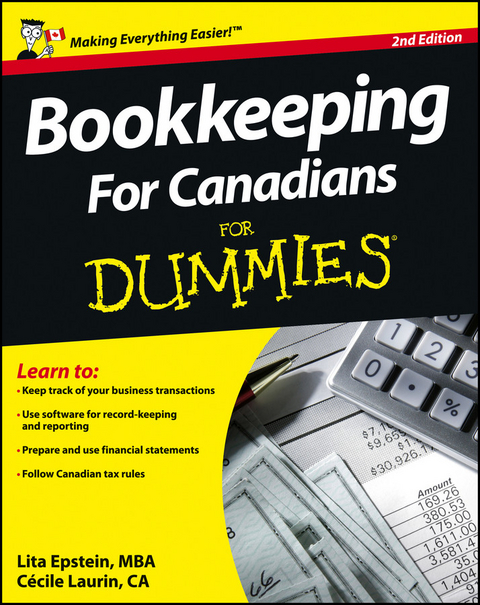
Bookkeeping For Canadians For Dummies (eBook)
384 Seiten
For Dummies (Verlag)
978-1-118-47828-8 (ISBN)
This updated and expanded second edition of Bookkeeping For Canadians For Dummies gets small business owners and managers up and running with the knowledge and skills you need to keep your books balanced, your finances in order, and the CRA off your back. From tracking transactions and keeping ledgers to producing balance sheets and year-end reports, you'll master all the important terms, procedures, forms, and processes more quickly and easily than you ever thought possible.
- Features approximately 25 percent new and updated content tailored for Canadians--the only Canada-specific guide to bookkeeping
- Includes clear and concise instructions on keeping the books, tracking transactions, recognizing assets and liabilities, and keeping ledgers and journals
- Packed with up-to-date tax information, including complete coverage of recent changes to the tax codes most important to small businesses
- Serves as an indispensable resource for small business owners who keep their own books, as well as those interested in a career as a bookkeeper
- Provides small business owners with highly-accessible, step-by-step guidance on creating professional financial statements and operating business accounts
Lita Epstein, MBA, designs and teaches online courses in investing, finance, and taxes.
Cecile Laurin, CA, teaches at Algonquin College, and is the co-author of Accounting For Canadians For Dummies.
Introduction
Bookkeepers take care of all the financial data for small businesses. If you subscribe to the idea that information is power (which we do), you must then agree that the bookkeeper has a tremendous amount of power within a business. Information tracked in the books helps business owners make key decisions that involve sales planning and product offerings, as well as the management of many other financial aspects of their business.
If it weren’t for the hard work of bookkeepers, businesses wouldn’t have any clue about what happens with their financial transactions. Without accurate financial bookkeeping, a business owner wouldn’t know how many sales her business made, how much cash it collected, or how much cash it paid for the products it sold to customers during the year. She also wouldn’t know how much cash her business paid to employees or how much cash it spent on other business expenses throughout the year.
Accurate and complete financial bookkeeping is crucial to any business owner, but it’s also important to those who work with the business, such as investors, financial institutions, and employees. People both inside the business (managers, owners, and employees) and outside the business (investors, lenders, and the government) all depend on the bookkeeper to accurately record financial transactions.
To perform the bookkeeper’s crucial job well, you need certain skills and talents. Bookkeepers must be detailed-oriented, enjoy working with numbers, and be meticulous about accurately entering those numbers in the books. They must vigilantly keep a paper or electronic trail, as well as filing and storing all needed backup information about the financial transactions entered into the books.
Whether you’re a business owner keeping the books yourself or an employee keeping the books for a small-business owner, the smooth financial operation of the business depends on your job as bookkeeper.
About This Book
In this book, we introduce you to the key aspects of bookkeeping and how to set up and use your financial books. We walk you through the basics of bookkeeping, starting with the process of setting up your business’s books and developing
A list of your business’s accounts, called the Chart of Accounts
Your business’s General Ledger, which summarizes all the activity in a business’s accounts
Your business’s journals, which give details about all your business’s financial transactions
Then, we take you through the process of recording all your transactions — sales, purchases, and other financial activity. We also talk about how to manage payroll, governmental reporting, and external financial reporting.
Finally, we show you how to start the yearly cycle all over again by closing (or emptying out) the necessary accounts for the current year so that you can start with zero balances in those accounts in the next year.
Bookkeeping is a continuous cycle, starting with financial transactions, recording those transactions in journals, posting those transactions to the General Ledger, testing your books to be sure that they’re in balance, making any necessary adjustments or corrections to the books (to keep them complete, accurate, and in balance), preparing financial statements and reports to understand how well the business did during the year, and finally getting ready to start the process all over again for the next year.
You can find out all about this cycle, starting with Chapter 2 and following the bookkeeping journey through closing out the year and getting ready for the next year in Chapter 22.
Conventions Used in This Book
We use QuickBooks throughout this book to show you how to create a set of records for a business, enter information, and generate a variety of bookkeeping reports.
Foolish Assumptions
While writing this book, we made some key assumptions about who you are and why you’ve picked up this book to get a better understanding of bookkeeping. We assume that you’re one of the following types of people:
A business owner who wants to know how to do your own books. You have a good understanding of business and its terminology, but you have little or no knowledge of bookkeeping and accounting.
A person who does bookkeeping or plans to do bookkeeping for a small business and needs to know more about how to set up and keep the books. You have some basic knowledge of business terminology but don’t know much about bookkeeping or accounting.
A staff person in a small business who’s just been asked to take over the business’s bookkeeping duties. You need to know more about how transactions are entered into the books, how to prove out transactions so that you can be sure you’re making entries correctly and accurately, and how to prepare financial statements and reports by using the data you collect.
A student who wants to get an overview of bookkeeping so that you can apply these skills to your studies and to your intended profession.
What You Don’t Have to Read
Throughout Bookkeeping For Canadians For Dummies, 2nd Edition, we include a number of examples that show how to apply the basics of bookkeeping to real-life situations. If you’re primarily reading this book to gain a general knowledge of the subject and don’t need to delve into all the nitty-gritty, day-to-day aspects of bookkeeping, you may want to skip over the paragraphs marked with the Example icon (see the section “Icons Used in This Book,” later in this Introduction). Skipping the examples shouldn’t interfere with your grasp on the key aspects of how to keep the books.
How This Book Is Organized
Bookkeeping For Canadians For Dummies is divided into six parts, which we outline in the following sections.
Part I: Basic Bookkeeping: Why You Need It
In Part I, we discuss the importance of bookkeeping, explain how it works, and help you get started with setting up your business’s books. We also touch on the terms that are unique to bookkeeping and tell you how to set up the roadmap for your books, the Chart of Accounts.
Part II: Keeping a Paper or Electronic Trail
In Part II, we explain how you enter your financial transactions in the books, how you post transactions to your General Ledger (the granddaddy of your bookkeeping system), and how you track all the transaction details in your journals. We also give tips about how to develop a good internal control system for managing your books and your business’s cash, as well as talk about your options if you decide to computerize your bookkeeping.
Part III: Tracking Day-to-Day Business Operations with Your Books
In Part III, we show you how to track your day-to-day business operations, including recording sales and purchases with applicable sales taxes as well as any adjustments to those sales and purchases, such as discounts, returns, and allowances. In addition, we talk about the basics of setting up and managing employee payroll, as well as all the government paperwork that you need to complete as soon as you decide to hire employees.
Part IV: Preparing the Books for Year’s (Or Month’s) End
In Part IV, we introduce you to the process of adjusting your books at the end of an accounting period, whether it’s the end of a month or the end of a year. These key adjustments include recording depreciation of your fixed assets, calculating and recording your interest payments and receipts in your books, accruing expenses and service revenue, and possibly adjusting for unearned revenue. This part also covers various aspects of proving out your books, from checking your cash and testing the balance of your books to making any needed adjustments or corrections.
Part V: Reporting Results and Starting Over
In Part V, we tell you how to use all the information in your books to prepare financial statements and reports that show how well your business did during the month, quarter, or year. We also lay out all the paperwork that you have to deal with, including year-end government reports and CRA forms. Finally, you can find out how to close out the books at year-end and get ready for the next year.
Part VI: The Part of Tens
The Part of Tens is the hallmark of the For Dummies series. In this part, we highlight the ten ways you can efficiently manage your business’s cash by using your books and the top ten accounts that you need to know how to manage.
Icons Used in This Book
For Dummies books use little pictures, called icons, to flag certain chunks of text that either you shouldn’t miss or you’re free to skip. The icons in Bookkeeping For Canadians For Dummies are
Look to this icon for ideas about how to improve your bookkeeping processes and how to use the information in the books to manage your business.
This icon marks anything that we want you to recall about bookkeeping after you finish reading this book.
This icon points out any aspect of bookkeeping that comes with dangers or perils that may hurt the accuracy of your entries or the way in which you use your financial information in the future. We also use this icon to mark certain things that can get you into trouble with the government, your lenders, your vendors, your employees, or your investors.
This icon points to real-life specifics about how to do a particular bookkeeping function.
Where to Go from Here
Can...
| Erscheint lt. Verlag | 13.12.2012 |
|---|---|
| Sprache | englisch |
| Themenwelt | Mathematik / Informatik ► Mathematik |
| Recht / Steuern ► Wirtschaftsrecht | |
| Technik | |
| Wirtschaft ► Betriebswirtschaft / Management ► Rechnungswesen / Bilanzen | |
| ISBN-10 | 1-118-47828-2 / 1118478282 |
| ISBN-13 | 978-1-118-47828-8 / 9781118478288 |
| Informationen gemäß Produktsicherheitsverordnung (GPSR) | |
| Haben Sie eine Frage zum Produkt? |
 EPUB (Adobe DRM)
Größe: 8,0 MB
Kopierschutz: Adobe-DRM
Adobe-DRM ist ein Kopierschutz, der das eBook vor Mißbrauch schützen soll. Dabei wird das eBook bereits beim Download auf Ihre persönliche Adobe-ID autorisiert. Lesen können Sie das eBook dann nur auf den Geräten, welche ebenfalls auf Ihre Adobe-ID registriert sind.
Details zum Adobe-DRM
Dateiformat: EPUB (Electronic Publication)
EPUB ist ein offener Standard für eBooks und eignet sich besonders zur Darstellung von Belletristik und Sachbüchern. Der Fließtext wird dynamisch an die Display- und Schriftgröße angepasst. Auch für mobile Lesegeräte ist EPUB daher gut geeignet.
Systemvoraussetzungen:
PC/Mac: Mit einem PC oder Mac können Sie dieses eBook lesen. Sie benötigen eine
eReader: Dieses eBook kann mit (fast) allen eBook-Readern gelesen werden. Mit dem amazon-Kindle ist es aber nicht kompatibel.
Smartphone/Tablet: Egal ob Apple oder Android, dieses eBook können Sie lesen. Sie benötigen eine
Geräteliste und zusätzliche Hinweise
Buying eBooks from abroad
For tax law reasons we can sell eBooks just within Germany and Switzerland. Regrettably we cannot fulfill eBook-orders from other countries.
aus dem Bereich