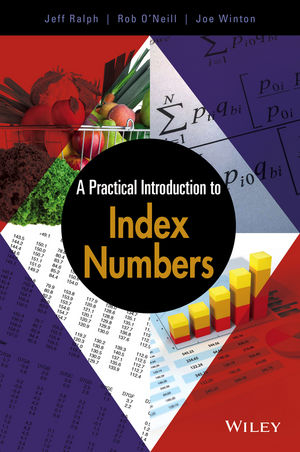
A Practical Introduction to Index Numbers (eBook)
John Wiley & Sons (Verlag)
978-1-118-97779-8 (ISBN)
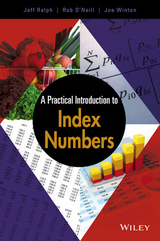
An introduction to the subject of index numbers for statisticians, economists and numerate members of the public. The ideal accompanying text for students taking the Royal Statistical Society's Ordinary and Higher examinations and for members of the Government Statistical Service. As well as covering the essential basics of the subject, it will describe important applications with a focus on the modern Consumer Prices Index (CPI) which is arguably the most important Official Statistic in the UK - the monthly release of the CPI, including UK inflation, is a high profile and widely discussed news item.
Following the syllabus of the exams of the Royal Statistical Society, this is a well-tested, logical structure for an introduction to the subject. Concepts will be illustrated by exploring the construction and use of the widely used CPI. The book will mix theoretical aspects with practical techniques to give a balanced and accessible introduction to the subject, which will be applicable to activities carried out in both the public and private sector.
This book provides an introduction to index numbers for statisticians, economists and numerate members of the public. It covers the essential basics, mixing theoretical aspects with practical techniques to give a balanced and accessible introduction to the subject. The concepts are illustrated by exploring the construction and use of the Consumer Prices Index which is arguably the most important of all official statistics in the UK. The book also considers current issues and developments in the field including the use of large-scale price transaction data. A Practical Introduction to Index Numbers will be the ideal accompaniment for students taking the index number components of the Royal Statistical Society Ordinary and Higher Certificate exams; it provides suggested routes through the book for students, and sets of exercises with solutions.
Dr Jeff Ralph, Head of Index Number Methodology, Office for National Statistics, Cardiff, UK Mr Joe Winton, Statistical Training Unit, Office for National Statistics, Cardiff, UK Dr Robert O'Neill, Lecturer in Economics, University of Huddersfield, UK
Preface
The inspiration for writing an introduction to index numbers arose from our work in delivering index number training. We provide introductory and advanced training courses for the Government Statistical Service, for the Official Statistics module of the Operational Research, Applied Statistics and Risk MSc course at Cardiff University and for students sitting the index number components of the Royal Statistical Society (RSS) Ordinary and Higher Certificates. A number of students have asked us to recommend an introductory text to supplement the training, and we have struggled to find a suitable modern book to recommend. While other statistical topics are well supported by introductory books, this is not the case for index numbers.
There are, of course, a number of very good books on index numbers; however, they are directed towards more advanced study. We wanted to write a short, practical book that would introduce the subject and be suitable for students and others who would like a general introduction to the subject. We have therefore based the content partly on the syllabuses for the two RSS Certificates and partly on the content of the workshops we have developed at the Office for National Statistics.
Index numbers is a topic whose concepts are applied very widely. In the economic sphere, many of the most prominent of our economic indicators are presented as index numbers, including the Consumer Prices Index, Gross Domestic Product and the Retail Sales Index. Readers of most newspapers will find regular mentions of these indices and many others too. However, it is not just in the economic sphere that index number concepts appear. Increasingly, they are finding application in the social sphere through composite measures such as those aiming to quantify complex concepts such as poverty and prosperity.
Despite finding widespread application, few statistics or economics books contain even a mention of index numbers, let alone any detailed description; a curious student might well wonder which academic subject they fall under. The answer is that the topic tends to fall between economics and statistics. Where it does appear, it is usually studied as part of a specialist topic, like measurement economics.
At a basic level, the subject may appear simple to the beginning student, or casual academic observer; however, in our experience this is not the case. There are many subtle and complex aspects that have gradually developed over many years and are still the subject of much discussion and academic research.1 Indeed, the practical implementation of a price index like the Consumer Prices Index is a massive undertaking that requires a considerable amount of effort and expertise on the part of National Statistics Institutes around the world. It is the intention of this book to highlight some of these aspects, hopefully resulting in an enhanced understanding of index numbers as commonly used in Official Statistics.
In common with other topics in statistics and economics, some observers may consider index numbers a dry subject, distant from the general population and perhaps not very interesting. While we can understand why this view might be held, we see the subject very differently. It is a complex and absorbing subject that provides a good return on investment in study. It should also be pointed out that through index number measures such as the Consumer Prices Index, all of our lives are affected in one way or another by the application of the subject.
This is not a book that will examine and explain all of the complex aspects of major index number outputs. However, there are facets of the Consumer Prices Index that are instructive for the student to consider, and we have included some of them in this book. We hope they will also prove interesting and will give the student a better understanding of this key indicator when watching the news, listening to the radio or reading a newspaper.
One of the significant advantages of developing and delivering training courses over a number of years is the opportunity to continuously improve the teaching material based on feedback from students. Two particular aspects of the training have proved popular with students. Firstly, including exercises that require students to calculate index numbers from a modest amount of data, and secondly, mixing material on the theoretical aspects of the subject with sections on the practical aspects of price statistics. We have continued this approach in this book.
Organisation of the book
This book has 15 chapters and includes 11 sets of exercises. Chapter 1 provides a general introduction to the concepts of an index and an index number; it identifies a range of applications from both the economic and social spheres. Chapter 2 introduces the reader to the procedure for converting a simple data series into a series of index numbers and back again. It shows how to calculate percentage change from an index series and identifies some benefits of working with data in index number form. The first exercise gives the reader the opportunity to develop the basic skills with some simple data.
One of the major applications of index numbers is the measurement of inflation; it is arguably the most important output any National Statistics Institute produces and it is the subject of Chapter 3. We explain briefly what is meant by inflation and why it is important. Chapters 4 and 5 set out the basic material to enable the student to understand how inflation is calculated in practice. Chapter 4 introduces price, quantity and value, and the application of simple unweighted price indices. An exercise follows in which the reader is invited to calculate price index numbers for goods on sale in a shop. Chapter 5 describes value change for a basket of goods between two time periods and introduces the iconic price (and quantity) indices of Étienne Laspeyres and Hermann Paasche. It explains the difference between the two indices and shows how value change can be decomposed into measures of pure price change and pure quantity change; it also introduces the index number problem. An exercise follows.
Chapters 6 and 7 explore two aspects of the subject that are important for the practical application of index numbers – domains and aggregation, and linking and chain-linking. How the Consumer Prices Index is constructed is the subject of Chapter 8; it uses the knowledge gained from Chapters 2 to 7. Two more practical topics are covered in Chapters 9 and 10 – re-referencing and rebasing, and deflation; both chapters are followed by exercises. A brief description of the major price and quantity indices produced by National Statistics Institutes is given in Chapter 11.
Chapter 12 returns to the theoretical development of the subject, considering further index formulae including the Fisher, Walsh and Törnqvist indices; an exercise includes both algebra and calculation based questions. Chapter 13 gives an overview of the various approaches that have been made to identify the ‘best’ formula to use. More advanced topics that are much discussed and studied in the index number research field are the subject of Chapter 14. They include: consumer substitution behaviour, new goods and disappearing goods, and hard to measure goods like housing. These are all challenging topics that producers of price indices need to address and we seek only to introduce them in this chapter. Current research topics, such as the role of big data in price indices are explored in Chapter 15.
Six appendices provide supporting material:
-
A: Mathematics for index numbers
Index numbers is a mathematical topic – though the level of mathematical knowledge needed is relatively modest at the introductory level that this book covers. However, we do not want readers to be inhibited by the mathematical requirements, so we have explained the mathematical notation and knowledge required in each chapter as it arises. Appendix A provides further support by providing a fuller explanation of the key mathematical concepts and index number results. -
B: Choice of index formula
This appendix provides a more detailed look at two of the approaches to index numbers that were introduced in Chapter 13 – the axiomatic and economic. This appendix is more advanced than any of the other material in the book. - C: Glossary of terms and formulae
- D: Solutions to most of the exercises
- E: Further reading
Additional material available online
The companion website, www.wiley.com/go/ralph/index_numbers, hosts additional content for this book. This includes presentations, example data and R code to run index number calculations. There is also some additional help for students who attempt the exercises.
Suggested routes through the book
While it is hoped that many readers will work through all chapters in the book, there are options for students taking the Royal Statistical Society exams2 who want to focus on the specific material they need. The following chapters are particularly relevant:
- Ordinary certificate: 1–5 and some parts of 7 and 12
- Higher certificate: 1–13 and Appendix A.
For a reader who would like to learn about the concept of index numbers, their use and some of the challenging aspects, but without wanting to develop skills in calculation, the following is a suggested subset of the book: Chapters...
| Erscheint lt. Verlag | 17.6.2015 |
|---|---|
| Sprache | englisch |
| Themenwelt | Mathematik / Informatik ► Mathematik ► Statistik |
| Mathematik / Informatik ► Mathematik ► Wahrscheinlichkeit / Kombinatorik | |
| Technik | |
| Wirtschaft ► Volkswirtschaftslehre ► Ökonometrie | |
| Schlagworte | Angewandte Wahrscheinlichkeitsrechnung u. Statistik • Applied Probability & Statistics • basket of goods • Consumer Prices Index • Cost of goods index • Cost of living index • CPI • Deflation • Economics • index numbers • Inflation • Kennzahl • Kennziffer • Price index • Statistics • Statistik • Volkswirtschaftslehre |
| ISBN-10 | 1-118-97779-3 / 1118977793 |
| ISBN-13 | 978-1-118-97779-8 / 9781118977798 |
| Informationen gemäß Produktsicherheitsverordnung (GPSR) | |
| Haben Sie eine Frage zum Produkt? |
 EPUB (Adobe DRM)
Kopierschutz: Adobe-DRM
Adobe-DRM ist ein Kopierschutz, der das eBook vor Mißbrauch schützen soll. Dabei wird das eBook bereits beim Download auf Ihre persönliche Adobe-ID autorisiert. Lesen können Sie das eBook dann nur auf den Geräten, welche ebenfalls auf Ihre Adobe-ID registriert sind.
Details zum Adobe-DRM
Dateiformat: EPUB (Electronic Publication)
EPUB ist ein offener Standard für eBooks und eignet sich besonders zur Darstellung von Belletristik und Sachbüchern. Der Fließtext wird dynamisch an die Display- und Schriftgröße angepasst. Auch für mobile Lesegeräte ist EPUB daher gut geeignet.
Systemvoraussetzungen:
PC/Mac: Mit einem PC oder Mac können Sie dieses eBook lesen. Sie benötigen eine
eReader: Dieses eBook kann mit (fast) allen eBook-Readern gelesen werden. Mit dem amazon-Kindle ist es aber nicht kompatibel.
Smartphone/Tablet: Egal ob Apple oder Android, dieses eBook können Sie lesen. Sie benötigen eine
Geräteliste und zusätzliche Hinweise
Buying eBooks from abroad
For tax law reasons we can sell eBooks just within Germany and Switzerland. Regrettably we cannot fulfill eBook-orders from other countries.
aus dem Bereich