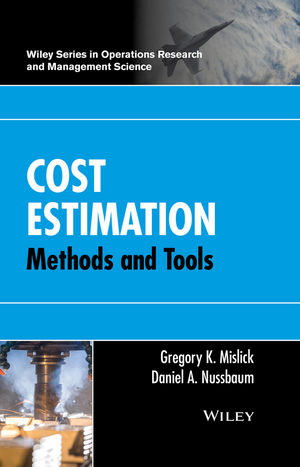
Cost Estimation (eBook)
John Wiley & Sons (Verlag)
978-1-118-53621-6 (ISBN)
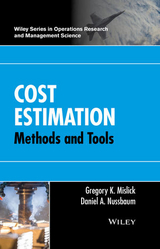
Presents an accessible approach to the cost estimation tools, concepts, and techniques needed to support analytical and cost decisions
Written with an easy-to-understand approach, Cost Estimation: Methods and Tools provides comprehensive coverage of the quantitative techniques needed by professional cost estimators and for those wanting to learn about this vibrant career field. Featuring the underlying mathematical and analytical principles of cost estimation, the book focuses on the tools and methods used to predict the research and development, production, and operating and support costs for successful cost estimation in industrial, business, and manufacturing processes.
The book begins with a detailed historical perspective and key terms of the cost estimating field in order to develop the necessary background prior to implementing the presented quantitative methods. The book proceeds to fundamental cost estimation methods utilized in the field of cost estimation, including working with inflation indices, regression analysis, learning curves, analogies, cost factors, and wrap rates. With a step-by-step introduction to the practicality of cost estimation and the available resources for obtaining relevant data, Cost Estimation: Methods and Tools also features:
- Various cost estimating tools, concepts, and techniques needed to support business decisions
- Multiple questions at the end of each chapter to help readers obtain a deeper understanding of the discussed methods and techniques
- An overview of the software used in cost estimation, as well as an introduction to the application of risk and uncertainty analysis
- A Foreword from Dr. Douglas A. Brook, a professor in the Graduate School of Business and Public Policy at the Naval Postgraduate School, who spent many years working in the Department of Defense acquisition environment
Cost Estimation: Methods and Tools is an excellent reference for academics and practitioners in decision science, operations research, operations management, business, and systems and industrial engineering, as well as a useful guide in support of professional cost estimation training and certification courses for practitioners. The book is also appropriate for graduate-level courses in operations research, operations management, engineering economics, and manufacturing and/or production processes.
Gregory K. Mislick is Senior Lecturer in the Department of Operations Research and Program Manager for the Masters Degree Program in Cost Estimating and Analysis at the Naval Postgraduate School (NPS). A retired U.S. Marine Corps Lieutenant Colonel aviator and past associate dean of the Graduate School of Operational and Information Sciences at NPS, his research interests includes life cycle cost estimating and modeling, probability and statistics, regression analysis, learning curves, and optimization.
Daniel A. Nussbaum, PhD, is Visiting Professor in the Department of Operations Research at the Naval Postgraduate School in Monterey, California. With over 30 years of professional experience providing financial estimating and analysis services to senior levels of the U.S. Federal government, Dr. Nussbaum's research interests includes cost/benefit analyses, life cycle cost estimating and modeling, and financial modeling.
Presents an accessible approach to the cost estimation tools, concepts, and techniques needed to support analytical and cost decisions Written with an easy-to-understand approach, Cost Estimation: Methods and Tools provides comprehensive coverage of the quantitative techniques needed by professional cost estimators and for those wanting to learn about this vibrant career field. Featuring the underlying mathematical and analytical principles of cost estimation, the book focuses on the tools and methods used to predict the research and development, production, and operating and support costs for successful cost estimation in industrial, business, and manufacturing processes. The book begins with a detailed historical perspective and key terms of the cost estimating field in order to develop the necessary background prior to implementing the presented quantitative methods. The book proceeds to fundamental cost estimation methods utilized in the field of cost estimation, including working with inflation indices, regression analysis, learning curves, analogies, cost factors, and wrap rates. With a step-by-step introduction to the practicality of cost estimation and the available resources for obtaining relevant data, Cost Estimation: Methods and Tools also features: Various cost estimating tools, concepts, and techniques needed to support business decisions Multiple questions at the end of each chapter to help readers obtain a deeper understanding of the discussed methods and techniques An overview of the software used in cost estimation, as well as an introduction to the application of risk and uncertainty analysis A Foreword from Dr. Douglas A. Brook, a professor in the Graduate School of Business and Public Policy at the Naval Postgraduate School, who spent many years working in the Department of Defense acquisition environment Cost Estimation: Methods and Tools is an excellent reference for academics and practitioners in decision science, operations research, operations management, business, and systems and industrial engineering, as well as a useful guide in support of professional cost estimation training and certification courses for practitioners. The book is also appropriate for graduate-level courses in operations research, operations management, engineering economics, and manufacturing and/or production processes.
Gregory K. Mislick is Senior Lecturer in the Department of Operations Research and Program Manager for the Masters Degree Program in Cost Estimating and Analysis at the Naval Postgraduate School (NPS). A retired U.S. Marine Corps Lieutenant Colonel aviator and past associate dean of the Graduate School of Operational and Information Sciences at NPS, his research interests includes life cycle cost estimating and modeling, probability and statistics, regression analysis, learning curves, and optimization. Daniel A. Nussbaum, PhD, is Visiting Professor in the Department of Operations Research at the Naval Postgraduate School in Monterey, California. With over 30 years of professional experience providing financial estimating and analysis services to senior levels of the U.S. Federal government, Dr. Nussbaum's research interests includes cost/benefit analyses, life cycle cost estimating and modeling, and financial modeling.
"This book is a manual of how to effectively internally manage a company, and maximise operational external efficiency of a contractor. On this basis it is essential reading for anyone in a decision-taking role, even if only a relatively minor role in bringing productions to market." (Chromatographia 2016)
Preface
How did this journey to write a textbook begin? After graduating from the US Naval Academy with a degree in Mathematics, I flew helicopters and served in the US Marine Corps for 26 years, piloting the mighty CH-46E Sea Knight (the “Battle Phrog”) during four overseas deployments. Along the way I earned my primary Masters Degree in Operations Research from the Naval Postgraduate School. One of my favorite classes while there was in cost estimation, and in particular I liked the usefulness and practicality of the subject matter. After graduation, I was fortunately assigned to the Marine Corps Research, Development and Acquisition Command (MCRDAC, now MARCORSYSCOM) in Quantico, Virginia for three years in Program Support Analysis (PSA), where I exclusively concentrated on Cost Estimation and Test and Evaluation. Those three years calculating costs, utilizing numerous quantitative methods, briefing seniors on the analysis and results found, very much stoked the fire in me for this area of study. I returned to the fleet and flew and deployed a few more times over the next nine years, and then returned to NPS as a military faculty member in the Operations Research Department in August 2000. When I arrived, the cost estimation class was being taught by Tim Anderson. Within a year, Tim retired from the US Navy and the course was seeking a new instructor. I eagerly volunteered to teach the class and have been doing so since 2001. At this time, approximately 250 students take the class each year, either as a resident student or as a distance learning, non-resident student.
While the cost estimation course had been taught with very detailed PowerPoint slides for many years before Dr. Daniel A. Nussbaum and I arrived, numerous students requested a textbook because they wanted either more detail or some “gaps” filled in and thus the idea for this textbook was born. Fortunately, publishers were very interested because little information like this existed on the market! The primary goal of this book is to help provide the tools that a cost estimator needs to predict the research and development, procurement, and/or operating and support costs or for any elements in a work breakdown structure in those phases.
While this textbook took 1.5 years to complete, many people have helped to provide information for it, either directly or indirectly. Anyone who has ever taught the cost estimation class here at NPS has had a hand in developing the slides that have been used for many years. The list of instructors at NPS includes Tim Anderson, Dan Boger, CDR Ron Brown (USN), CAPT Tom Hoivik (USN), CDR Steven E. Myers, (USN), and Mike Sovereign. In addition, a few others who provided significantly to the slides include: Major Tom Tracht (USAF), Dr Steve Vandrew of DAU (now NAVAIR), and the late Dr. Steven Book of the Aerospace Corporation. Thanks to all of these individuals and our apologies in advance if we have missed anyone! A few of the examples in the textbook are exactly from the original slides, while most others have been revamped or upgraded to align with the times.
Our goal when writing this textbook was to make it sound more like a “conversation” than a textbook, as if we were in the same room together and we were speaking to you about the topic. We hope that we have achieved that goal! We have also tried to make this textbook applicable to both DoD and non-DoD entities and organizations, to their cost estimators, and to those involved in Cost Engineering.
When I was a student, a pet peeve of mine was when an instructor would say something like “It is intuitively obvious that …..” and would then proceed from Step A to
Step D without explaining what was happening in Steps B and C! Well, of course, it is intuitively obvious if you have been working in the field for twenty-five years! But for those of us who are reading about a subject for the first time and are just being introduced to the subject matter, maybe it is not so intuitively obvious. Consequently, in the quantitative chapters in this textbook, you will see calculations provided to almost every problem. If the calculations are not provided, it is only because a previous example already went through the same steps.
It was also our intent to try to stay away from really technical math terms like “degrees of freedom” and describing a term as an “unbiased estimator for the variance.” Instead, our goal is to provide explanations in layman’s terms in easy-to-understand language that “just makes sense.” The book is organized as follows:
- Chapter 1: A historical perspective from Dr. Daniel A. Nussbaum on the past thirty years in cost estimation and changes he has observed along the way.
- Chapter 2: Background information on what cost estimation is and why it is important, the DoD acquisition process and the phases and acquisition categories of developmental programs and the key terminologies used in the acquisition environment.
- Chapter 3: The non-DoD acquisition process and the key terminologies, processes and methods used in the cost estimating field.
- Chapter 4: Once you are assigned a cost estimate, where do you get your data from? This chapter discusses many data bases, websites and the most significant cost reports used in cost estimating, as well as providing an introduction to Earned Value Management (EVM).
- Chapter 5: Once you have your data, how do you normalize it so you can accurately use it? You must normalize for content, quantity, and inflation, with normalizing for inflation being the most important of the three.
- Chapters 6–14: The “meat” of the book, involving the myriad quantitative methods utilized in the field of cost estimation, including regression analysis, learning curves, cost factors, wrap rates, and the analogy technique.
- Chapter 15: An overview of software cost estimation.
- Chapter 16: An overview of both Cost Benefit Analysis/Net Present Value, and Risk and Uncertainty.
- Chapter 17: Summary.
There are a number of people whom I would like to thank for their help in this textbook endeavor. First, I would like to thank Anne Ryan and Jae Marie Barnes for volunteering to review a number of the chapters in this text and offering ideas, suggestions, and recommendations on what to keep and what to change; Kory Fierstine for keeping me updated on DoD policy and always being there to listen and help when I had questions; Dr. Sam Buttrey for patient answers to my statistical questions; and I would like to thank many of my former students whom I have had in class along the way – your questions, suggestions, and ideas have helped me learn as much from you as I hope you learned from me. I would also like to thank my two sisters, Hope and Barbara, and my mom for their love and support over the years. I wish my dad were still alive to read the book. He may not have understood too much of this subject, but he still would have been one of my biggest supporters along the way!
I owe my biggest thanks to my co-author Dr. Daniel A. Nussbaum, for being such a great friend and mentor over the past ten years that we have worked together. Dan has never hesitated to answer a question, share his knowledge in any subject area that I perhaps needed help in, and provide sanity checks to ideas. We also started the Masters in Cost Estimating and Analysis (MCEA) degree program here at NPS in 2010. It has been a fun journey together.
Gregory K. Mislick
After completing a Ph.D. in theoretical mathematics and teaching mathematics to undergraduates, I was invited to attend a postdoctoral Fellowship in applied mathematics, and within one year I was tackling operations research projects for the US Army Concepts Analysis Agency (now Center for Army Analysis). A few years later, I transferred to the headquarters of US Army Europe, in Germany, in order to head a division called the Economic Analysis and Systems division. The issues facing a major command often required projections of the impact of budget cuts, cost estimates in the ever-changing multiple currency environment, and many other demands for cost estimation and analysis.
Shortly after returning to the US, I began working for the US Navy. Ever since, I have been specializing in cost estimation projects and problems inside the Department of Defense and outside the DoD with other US government agencies, other nations, and with private organizations. In 2004, I was invited to return to teaching at the Naval Postgraduate School, where, together with Greg Mislick and others, we developed the first dedicated Master’s degree program in cost estimating and analysis.
It has been clear to me for many years that a textbook would be helpful to students who are learning this discipline, along with its underlying mathematical and analytical principles and methods. I was delighted to join Greg Mislick in developing this text and I appreciate the hard work he has put into it. He and I have also teamed up successfully, with others, to be awarded the prestigious Cost Analysis and Management Sciences Community Award presented by the Assistant Secretary of the Navy for Financial Management and Comptroller in 2010, and the 2014 Military Operations Research Society’s Barchi prize, awarded to recognize the best paper given at their Symposium.
There are numerous professional heroes who provided me guidance and wisdom through the years and I would like to briefly recognize and thank them for all they have done while I have...
| Erscheint lt. Verlag | 4.5.2015 |
|---|---|
| Reihe/Serie | Wiley Series in Operations Research and Management Science |
| Wiley Series in Operations Research and Management Science | Wiley Series in Operations Research and Management Science |
| Sprache | englisch |
| Themenwelt | Mathematik / Informatik ► Mathematik ► Statistik |
| Mathematik / Informatik ► Mathematik ► Wahrscheinlichkeit / Kombinatorik | |
| Technik | |
| Wirtschaft ► Betriebswirtschaft / Management ► Finanzierung | |
| Wirtschaft ► Betriebswirtschaft / Management ► Unternehmensführung / Management | |
| Schlagworte | Analogies • analogy technique • Analysis • Betriebswirtschaft u. Operationsforschung • Business & Management • Business Decisions • Business Operations • Cost Analysis • cost engineering • cost estimating • cost estimation • cost estimation software • cost estimator • Cost Factors • data normalisation • decision science • Economics Engineering • Electrical & Electronics Engineering • Elektrotechnik u. Elektronik • financial modeling • Finanz- u. Wirtschaftsstatistik • government processes • Human Factors & Risk Assessment • Industrial Engineering • Industrial Processes • inflation indices • Learning Curves • Management Science/Operational Research • Manufacturing Processes • Menschliche Faktoren u. Risikobewertung • Operations Management • Operations Research • production processes • Regression Analysis • Statistics • Statistics for Finance, Business & Economics • Statistik • Systems Engineering • Wirtschaft u. Management • wrap rates |
| ISBN-10 | 1-118-53621-5 / 1118536215 |
| ISBN-13 | 978-1-118-53621-6 / 9781118536216 |
| Informationen gemäß Produktsicherheitsverordnung (GPSR) | |
| Haben Sie eine Frage zum Produkt? |
 EPUB (Adobe DRM)
Kopierschutz: Adobe-DRM
Adobe-DRM ist ein Kopierschutz, der das eBook vor Mißbrauch schützen soll. Dabei wird das eBook bereits beim Download auf Ihre persönliche Adobe-ID autorisiert. Lesen können Sie das eBook dann nur auf den Geräten, welche ebenfalls auf Ihre Adobe-ID registriert sind.
Details zum Adobe-DRM
Dateiformat: EPUB (Electronic Publication)
EPUB ist ein offener Standard für eBooks und eignet sich besonders zur Darstellung von Belletristik und Sachbüchern. Der Fließtext wird dynamisch an die Display- und Schriftgröße angepasst. Auch für mobile Lesegeräte ist EPUB daher gut geeignet.
Systemvoraussetzungen:
PC/Mac: Mit einem PC oder Mac können Sie dieses eBook lesen. Sie benötigen eine
eReader: Dieses eBook kann mit (fast) allen eBook-Readern gelesen werden. Mit dem amazon-Kindle ist es aber nicht kompatibel.
Smartphone/Tablet: Egal ob Apple oder Android, dieses eBook können Sie lesen. Sie benötigen eine
Geräteliste und zusätzliche Hinweise
Buying eBooks from abroad
For tax law reasons we can sell eBooks just within Germany and Switzerland. Regrettably we cannot fulfill eBook-orders from other countries.
aus dem Bereich