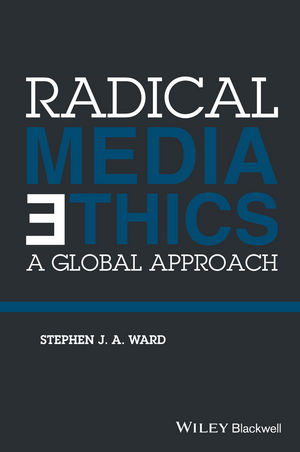
- Offers a comprehensive new way to think about media ethics in a new media era
- Provides guiding principles and values for practising responsible global media ethics
- Introduces one of the first codes of conduct for a journalism that is global in reach and impact
- Includes both philosophical considerations and practical elements in its establishment of new media ethics guidelines
Stephen J. A. Ward is an internationally recognized media ethicist whose writings and projects have influenced the development of the field in theory and practice. His publications include the award-winning The Invention of Journalism Ethics: The Path to Objectivity and Beyond (2005). In addition, he is the author of Global Journalism Ethics (2010) and co-editor of Media Ethics Beyond Borders: A Global Perspective (2009).
Stephen J. A. Ward is an internationally recognized media ethicist whose writings and projects have influenced the development of the field in theory and practice. His publications include the award-winning The Invention of Journalism Ethics: The Path to Objectivity and Beyond (2005). In addition, he is the author of Global Journalism Ethics (2010) and co-editor of Media Ethics Beyond Borders: A Global Perspective (2009).
Acknowledgments ix
Introduction x
Part I Theoretical Foundations 1
1 Ontology of Ethics 3
2 Ethics as Normative Interpretation 33
3 Implications for Radical Ethics 69
Part II The Shape of a Radical Integrated Ethics 91
4 Radical Media Ethics 93
5 Defining Journalism 119
6 Theory of Meaning for Integrated Ethics 143
Part III Principles of Global Integrated Ethics 171
7 Political Values for Integrated Ethics 173
8 Aims for Global Integrated Ethics 197
9 Realizing Global Integrated Ethics 215
Appendix: Ward Code for Global Integrated Ethics 223
Index 229
'...original and driven by a passion for ethics. It cannot be ignored.' - Digital Journalism
Chapter 1
Ontology of Ethics
Ethics today should be radical. In ethics proper, we need a radical global ethics of humanity. In media ethics, we need a radical global, integrated ethics of responsible practice.
But what is “radical”?
The first entry for “radical” in The New Shorter Oxford English Dictionary ( 1993) says the word means “going to the root or origin… affecting what is fundamental; far-reaching; thorough.”
This is the sense of radical that informs this book. My radicalness is philosophical.
My radicalness seeks reform of fundamental ideas. Reform requires intellectual boldness and moral imagination: boldness to challenge outdated, yet cherished, ideas and imagination to invent new ideas. To be philosophically radical is to alter the structure of our thinking.
In media ethics, fundamental ideas such as responsible publishing and impartiality are like reinforcing rods that run through the structure, providing support for more specific values. Reform of fundamental ideas has a far-reaching impact.
I start, therefore, with meta-ethics. Why? Because meta-ethical beliefs color how we approach ethical questions. If I believe that ethics is God’s absolute commandments for mankind, I may demand that society require all citizens to keep the commandments. Similarly, if I think ethics is a contemptuous attempt by the weak to restrain the strong, I feel justified in pursuing my interests at the expense of others. The need for meta-ethics is especially clear when we try to think in a new way about ethics. No radical media ethics is possible without radical meta-ethical thinking.
I proceed in this chapter as follows: In the first half of the chapter, I introduce my social ontology of ethics. That examines the mode of existence of ethics as a social activity for the regulation of conduct. I trace the origins of this activity to human nature, the intentional powers of the mind, and the evolution of human society and institutions. Ethics is not unique in this normative practice. Rather it is part of a distinctive human-dependent social reality whose objects, activities, and functions cannot be reduced to physical or biological properties.
In Chapter 2, I use this ontology to outline the psychology and epistemology of the practice of ethics – how it proceeds by way of holistic conceptual schemes and interpretations. In Chapter 3, I state the implications for ethics that flow from the two chapters. The result is a meta-ethical perspective on the nature of ethics as social, human-dependent, and interpretive.
Naturalist Ontology
What is ethics?
Ethics is the study and practice of what constitutes the best regulation of human conduct, individually and socially. Humans apply their notions of ethics by acting according to principles, norms, and aims. Ethics is the activity of constructing, critiquing, and enforcing norms, principles, and aims to guide individual and social conduct. The phrase “the best regulation” indicates a zone of critical and ever-evolving thought about the notions and norms of ethics. Existing norms may be inadequate, or even unethical.
Ethics takes all of life as its subject matter. Almost any form of conduct can fall under its critical gaze. Ethics applies to the conduct of individuals, groups, institutions, professions, and countries. Ethics asks how we, as persons and as a society (or species), ought to live. What are the primary goods that we should seek so people enjoy flourishing lives? How should we live together, so that our pursuit of those goods is just, dutiful, and respectful of others? How do we develop people of moral character who do what is right and serve the common good? The good, the right, and the virtuous: these are the three great, intertwined themes of ethics. Ethics, therefore, has three concerns: Appropriate ethical beliefs, correct application, and the disposition to act ethically. Ethics is about the most serious normative aspects of our existence: the most important goods in life, our basic rights and duties, our roles and how we carry out our responsibilities, and the pursuit of virtue. Ethics demands that we live in goodness and in right relation with each other. Ethics may require us to forgo personal benefits, to carry out duties, or to endure persecution.
Ethics is both individualistic and social. It is individualistic because individuals are asked to make certain norms and values part of their character. It is social because ethics is not about every person formulating their own rules of behavior. Correct conduct is honoring rules of fair social interaction – rules that apply to humans in general or to all members of a group. We experience ethics internally as the tug of conscience. We experience ethics externally as the demands placed upon us by codes of ethics, backed by social sanction. Psychologically, one learns ethics as a set of responses shaped by social enculturation and the ethical “climate” of society. My ethical capacities are nurtured and exercised within groups. Also, ethics requires that I adopt a social perspective that looks to the common good and transcends selfish individualism. Ethically speaking, “How ought I to live?” cannot be asked in isolation from the question, “How ought we to live?”
Ethics is practical. Ethics is an activity, a process, and a dynamic practice. It is something we do. We do ethics when we weigh values to make a decision. We do ethics when we modify practices in light of new technology. It may be convenient, but also potentially misleading, to talk about ethics as an object, the way we talk about our automobiles. Society and ethics is an evolving set of social interactions and processes, not a “thing.” Ethics is always situated in, yet transcendent of, a context. Reflection on ethics is carried out by fallible humans embedded in historical eras and in distinct cultures. Situated inquirers also scrutinize their beliefs. All societies, no matter how rigid or traditional, face the future. They cannot avoid struggling with new problems and new ethical questions. Both the cultures and their denizens are ever evolving, ever confronting new challenges. Ethics is not a static set of rules. Ethics is a natural and inescapable human activity. It is the attempt by individuals and societies to respond to quandaries created by changing conditions, unexpected issues, and new ways of thinking and acting.
Ethics at its best is reflective engagement with the urgent problems of the day, in light of where we have been and where we hope to be tomorrow. The questions are created by new technology and media, the progress of science, cultural and social trends, and the redefining of the planet’s geo-political and environmental climate. In today’s world there is no shortage of urgent normative questions. We live in a global world shaped by dramatic changes in technology and media, a world of vast inequalities in wealth and power, a world threatened by conflict and emerging technologies for war. Ethics is reflective engagement with questions that range from what developed nations ought to do to reduce global poverty to how media technology should be used to protect human rights. Engagement involves the reinterpretation of norms, the invention of principles, and the development of new and responsible practices.
Reflective engagement can occur in any area of society. For example, developments in genetic knowledge call for new ethical thinking in the sciences of life. Is it morally permissible to use genetic knowledge to “design” babies, or to force citizens to be tested for genes linked to debilitating diseases? In recent times, our concern about the impact of human activity on nature and on non-human forms of life has prompted the development of environmental ethics and the ethics of animal welfare.
Ethics starts from the lived experience of ethical doubt and plurality of values, and then seeks integration and theoretical understanding. Ethical theorizing can be divided into two types, meta-ethics (or philosophical ethics) and applied ethics (see Ward 2011, 7–51). Meta-ethics asks three big questions about the nature of ethics: What are we saying when we make an ethical claim? How do we know that what we say is justified? Why does ethics exist in the first place? There are plenty of ethical theories, from descriptivism and intuitionism to realism and relativism. Applied ethics, on the other hand, asks not what we mean by ethical concepts like good or right but what is good or right, and how to do what is good or right in certain situations. Examples of approaches to applied ethics are consequential theories of the good, deontological theories of the right, and theories of virtue.
In applied ethics, moral norms are often codified. Principles of ethics, such as “Help others in need” and “Live a life of non-violence and peace” are brought together to form moral systems, such as utilitarian ethics and Buddhist ethics. The Bible’s Ten Commandments is one such code. In addition, there are codes of increasing specificity for doctors, lawyers, and journalists. As a set of principles, “ethics” can refer to something singular or multiple. We can understand “ethics” as the proper name for a single ethical system. One may believe that there is only one set of correct principles and that is what ethics is. Or, we can think of...
| Erscheint lt. Verlag | 21.4.2015 |
|---|---|
| Sprache | englisch |
| Themenwelt | Geisteswissenschaften ► Philosophie ► Allgemeines / Lexika |
| Geisteswissenschaften ► Philosophie ► Ethik | |
| Geisteswissenschaften ► Sprach- / Literaturwissenschaft ► Literaturwissenschaft | |
| Geisteswissenschaften ► Sprach- / Literaturwissenschaft ► Sprachwissenschaft | |
| Sozialwissenschaften ► Kommunikation / Medien ► Journalistik | |
| Sozialwissenschaften ► Kommunikation / Medien ► Medienwissenschaft | |
| Sozialwissenschaften ► Politik / Verwaltung | |
| Sozialwissenschaften ► Soziologie | |
| Wirtschaft | |
| Schlagworte | Communication & Media Studies • Journalism • Journalismus • Kommunikation • Kommunikation u. Medienforschung • <p>Media ethics, journalistic ethics, global media, global media systems, social media, blogs, microblogs, tweets, online community</p> • Media Law & Ethics • Medienforschung • Medienrecht, Medienethik |
| ISBN-13 | 9781118477601 / 9781118477601 |
| Informationen gemäß Produktsicherheitsverordnung (GPSR) | |
| Haben Sie eine Frage zum Produkt? |
 EPUB (Adobe DRM)
Kopierschutz: Adobe-DRM
Adobe-DRM ist ein Kopierschutz, der das eBook vor Mißbrauch schützen soll. Dabei wird das eBook bereits beim Download auf Ihre persönliche Adobe-ID autorisiert. Lesen können Sie das eBook dann nur auf den Geräten, welche ebenfalls auf Ihre Adobe-ID registriert sind.
Details zum Adobe-DRM
Dateiformat: EPUB (Electronic Publication)
EPUB ist ein offener Standard für eBooks und eignet sich besonders zur Darstellung von Belletristik und Sachbüchern. Der Fließtext wird dynamisch an die Display- und Schriftgröße angepasst. Auch für mobile Lesegeräte ist EPUB daher gut geeignet.
Systemvoraussetzungen:
PC/Mac: Mit einem PC oder Mac können Sie dieses eBook lesen. Sie benötigen eine
eReader: Dieses eBook kann mit (fast) allen eBook-Readern gelesen werden. Mit dem amazon-Kindle ist es aber nicht kompatibel.
Smartphone/Tablet: Egal ob Apple oder Android, dieses eBook können Sie lesen. Sie benötigen eine
Geräteliste und zusätzliche Hinweise
Buying eBooks from abroad
For tax law reasons we can sell eBooks just within Germany and Switzerland. Regrettably we cannot fulfill eBook-orders from other countries.
aus dem Bereich