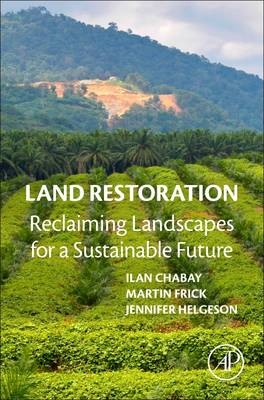
Land Restoration
Academic Press Inc (Verlag)
978-0-12-801231-4 (ISBN)
Land Restoration: Reclaiming Landscapes for a Sustainable Future brings together practitioners from NGOs, academia, governments, and the United Nations Convention to Combat Desertification (UNCCD) to exchange lessons to enrich the academic understanding of these issues and the solution sets available.
Ilan Chabay is Founder and Co-Director of the Knowledge, Learning, and Societal Change (KLASICA) international research alliance and a Research Professor at Arizona State University’s School for Global Futures in Washington, DC. His work focuses on how narratives and cultural identities shape sustainability and adaptive governance. He serves on the board of the International Disaster Risk Management Society and is an Honorary Fellow of the Research Institute for Humanity and Nature in Japan. His prior roles include leadership and research positions at the Helmholtz Centre Potsdam, the University of Gothenburg, and Chalmers University. Earlier in his career, he directed science communication initiatives, including designing museum exhibitions worldwide to promote curiosity and understanding of global change. Martin Frick is an international civil servant and former diplomat with over three decades of experience in human rights, climate change, food systems, and humanitarian affairs. He serves as Director of the World Food Programme’s Global Office Germany, managing WFP’s relationship with one of its largest donors. He is also a member of the Executive Committee of the Club of Rome. Previously, he was Deputy to the Special Envoy for the UN Secretary-General’s 2021 Food Systems Summit, leading its strategic and operational preparations. As Senior Director at the UN Framework Convention on Climate Change, he oversaw the implementation of the Paris Agreement and global Climate Action initiatives. He also directed the FAO’s work on climate change and served as Germany’s Ambassador to UN organizations in Bonn, helping establish the UN’s Sustainability Hub. Earlier in his career, he worked closely with Kofi Annan’s Global Humanitarian Forum on climate justice and advised Germany’s Foreign Minister on cabinet affairs. Dr. Frick holds a PhD in Law from Regensburg University and a diploma in International Relations from Sciences Po Strasbourg. Jennifer F. Helgeson is a behavioral economist whose research focuses on community resilience and sustainable development. She co-directs the Knowledge, Learning, and Societal Change (KLASICA) international research alliance and serves on the External Research Evaluation Committee of the Research Institute for Humanity and Nature in Kyoto, Japan. She holds adjunct positions at East Carolina University, the Institute at Brown for Environment and Society, and Virginia Polytechnic Institute. Previously, she was a Climate Change Adaptation Specialist at the Organisation for Economic Co-operation and Development and has worked on environmental economics projects with Friends of the Earth Middle East and the Grameen Foundation in Uganda. A former Fulbright scholar, she completed her doctorate at the Grantham Research Institute on Climate Change and the Environment at the London School of Economics, with prior studies in environmental economics at the University of Oxford and in economics at Brandeis University.
Foreword
Governing Land Restoration: Four Hypotheses
Introduction
Part 1 Social contexts of land restoration
Chapter 1.1 Land Degradation as a Security Threat Amplifier: The New Global Frontline
Chapter 1.2 Land Degradation and Its Impact on Security
Chapter 1.3 (Em)Powering People: Reconciling Energy Security and Land-Use Management in the Sudano-Sahelian Region
Chapter 1.4 Enabling Governance for Sustainable Land Management
Part 2 Concepts and Methodologies for restoration and maintenance
Chapter 2.1 Tenets of Soil and Landscape Restoration
Chapter 2.2 Stabilization of Sand Dunes: Do Ecology and Public Perception Go Hand in Hand?
Chapter 2.3 Trust Building and Mobile Pastoralism in Africa
Chapter 2.4 Land Degradation from Military Toxins: Public Health Considerations and Possible Solution Paths
Chapter 2.5 Flood and Drought Prevention and Disaster Mitigation: Combating Land Degradation with an Integrated Natural Systems Strategy
Chapter 2.6 Environmental Security, Land Restoration, and the Military: A Case Study of the Ecological Task Forces in India
Chapter 2.7 Releasing the Underground Forest
Part 3 Soil, Water, and Energy – The Relationship to Land Restoration
Chapter 3.1 Computational Policy Support Systems for Understanding Land Degradation Effects on Water and Food Security for and from Africa
Chapter 3.2 The Value of Land Restoration as a Response to Climate Change
Part 4 Economics, Policy, and Governance of Land Restoration
Chapter 4.1 The Importance of Land Restoration for Achieving a Land Degradation-Neutral World Chapter 4.2 Transforming Land Conflicts into Sustainable Development: A Case of the Taita Taveta of Kenya
Chapter 4.3 Case Study: Taranaki Farm Regenerative Agriculture. Pathways to Integrated Ecological Farming
Chapter 4.4 Regenerating Agriculture to Sustain Civilization
Chapter 4.5 Land Degradation: An Economic Perspective
Chapter 4.6 Four Returns, Three Zones, 20 years: A Systemic Approach to Scale Up Landscape Restoration by Business and Investors to Create a Restoration Industry
Chapter 4.7 Restoring Degraded Ecosystems by Unlocking Organic Market Potential: Case Study from Mashonaland East, Zimbabwe
Chapter 4.8 A Continuing Inquiry into Ecosystem Restoration: Examples from China’s Loess Plateau and Locations Worldwide and Their Emerging Implications
Part 5 The Community as a Resource for Land Restoration
Chapter 5.1 Poverties and Wealth: Perceptions, Empowerment, and Agency in Sustainable Land Management
Chapter 5.2 All Voices Heard: A Conflict Prevention Approach to Land and Natural Resources
Part 6 Gender in the Context of Land Restoration
Chapter 6.1 Land Restoration, Agriculture, and Climate Change: Enriching Gender Programming Through Strengthening Intersectional Perspectives
Chapter 6.2 Gender Roles and Land Use Preferences – Implications to Landscape Restoration in Southeast Asia
Part 7 Communities, Restoration, and Resilience
Chapter 7.1 Drought-Management Policies and Preparedness Plans: Changing the Paradigm from Crisis to Risk Management
Chapter 7.2 Not the Usual Suspects: Environmental Impacts of Migration in Ghana’s Forest-Savanna Transition Zone
Chapter 7.3 The Global Restoration Initiative
Part 8 Selected Case Studies
Chapter 8.1 Indigenuity: Reclaiming Our Relationship with the Land
Chapter 8.2 Land Restoration and Community Trust: Keys to Combating Poverty
Chapter 8.3 Shifting from Individual to Collective Action: Living Land’s Experience in the Baviaanskloof, South Africa
Chapter 8.4 Development and Success, For Whom and Where: The Central Anatolian Case
Chapter 8.5 Sharing Knowledge to Spread Sustainable Land Management (SLM)
Part 9 Suggestions for Ways to Use this Book
Chapter 9.1 Buffets, Cafes, or a Multicourse Meal: On the Many Possible Ways to Use this Book
Part 10 Concluding Remarks and a Way Forward
Chapter 10.1 Concluding Remarks
| Verlagsort | San Diego |
|---|---|
| Sprache | englisch |
| Maße | 191 x 235 mm |
| Gewicht | 1410 g |
| Themenwelt | Naturwissenschaften ► Biologie ► Ökologie / Naturschutz |
| Wirtschaft ► Volkswirtschaftslehre | |
| ISBN-10 | 0-12-801231-5 / 0128012315 |
| ISBN-13 | 978-0-12-801231-4 / 9780128012314 |
| Zustand | Neuware |
| Informationen gemäß Produktsicherheitsverordnung (GPSR) | |
| Haben Sie eine Frage zum Produkt? |
aus dem Bereich