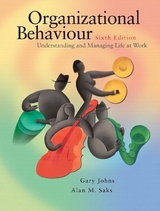
Organizational Behaviour
Addison Wesley (Verlag)
978-0-201-64381-7 (ISBN)
- Titel erscheint in neuer Auflage
- Artikel merken
(Note: Each Chapter Begins with a Vignette and Finishes with a Summary and Discussion Questions.) Preface. I. AN INTRODUCTION. 1. Organizational Behaviour and Management. What are Organizations? What is Organizational Behaviour? Why Study Organized Behaviour? How Much Do You Know about Organizational Behaviour? Goals of the Field. Early Prescriptions Concerning Management. Contemporary Management- The Contingency Approach. What Do Managers Do? Some Contemporary Management Concerns. II. INDIVIDUAL BEHAVIOR. 2. Personality and Learning. What Is Personality? Personality and Organization Behaviour. What Is Learning? Increasing the Probability of Behaviour. Reducing the Probability of Behaviour. Social Learning Theory. Organizational Learning Practices. 3. Perception, Attribution, and Judgment of Others. What Is Perception? Components of Perception. A Model of the Perceptual Process. Some Basic Biases in Person Perception. Attribution: Perceiving Causes and Motives. Person Perception and Workforce Diversity. Person Perception and Trust. Person Perception in the Selection Interview. Person Perception and Performance Appraisal. 4. Values, Attitudes, and Work Behaviour. What Are Values? What Are Attitudes? Attitude Formation. Changing Attitudes. What Is Job Satisfaction? What Determines Job Satisfaction? Consequences of Job Satisfaction. What Is Organizational Commitment? 5. Theories of Work Motivation. Why Study Motivation? What Is Motivation? Need Theories of Work Motivation. Process Theories of Work Motivation. Do Motivation Theories Translate Across Cultures? Putting It All Together: Integrating Theories of Work Motivation. 6. Motivation in Practice. Money as a Motivator. Job Design as a Motivator. Management by Objectives. Alternative Working Schedules as Motivators for a Diverse Workforce. Total Quality Management and Motivation. II. SOCIAL BEHAVIOUR AND ORGANIZATIONAL PROCESSES. 7. Groups and Teamwork. What Is a Group? Group Formation. Group Development. Group Structure and Its Consequences. Group Cohesiveness. Social Loafing. What Is a Team? Designing Effective Work Teams. 8. Social Influence, Socialization, and Culture. Social Influence in Organizations. Social Influence in Action. Socialization: Getting (Some) Conformity from Members. Methods of Socialization. Organizational Culture. 9. Leadership. What is Leadership? Lessons from Emergent Leadership. The Behaviour of Assigned Leaders. Situational Theories of Leadership. Participative Leadership: Involving Subordinates in Decisions. Transformational Leadership and Charisma. Developmental Leadership. Global and Strategic Leadership. Gender, Culture, and Leadership Style. Does Leadership Matter? 10. Communication. What Is Communication? Superior-Subordinate Communication. The Grapevine. The Verbal Language of Work. The Nonverbal Language of Work. Gender Differences in Communication. Cross-Cultural Communication. Personal Approaches to Improving Communication. Organizational Approaches to Improving Communication. 11. Decision Making. What Is Decision Making? The Complete Decision Maker- A Rational Decision-Making Model. Group Decision Making. Improving Decision Making in Organizations. Electronic Decision-Making Groups- Promise and Problems. 12. Power, Politics, and Ethics. What Is Power? The Bases of Individual Power. How Do People Obtain Power? Empowerment- Putting Power Where It Is Needed. Influence Tactics- Putting Power to Work. Who Wants Power? Controlling Strategic Contingencies- How Subunits Obtain Power. Organizational Politics- Using and Abusing Power. Ethics in Organizations. 13. Conflict and Stress. What Is Conflict? Types of Conflict. The Conflict Process. Modes of Managing Conflict. Managing Conflict with Negotiation. Is All Conflict Bad? A Model of Stress in Organizations. Stressors in Organizational Life. Reactions to Organizational Stress. Reducing or Coping with Stress. IV. THE TOTAL ORGANIZATION. 14. Organizational Structure. What Is Organizational Structure? The Division and Coordination of Labour. Traditional Structural Characteristics. Summarizing Structure- Organic versus Mechanistic. Network and Virtual Organizations. The Modular Organization. The Boundaryless Organization. The Impact of Size. A Footnote: Symptoms of Structural Problems. 15. Environment, Strategy, and Technology. The External Environment of Organizations. Strategic Responses to Uncertainty and Resource Dependence. The Technologies of Organizations. Implications of Advanced Information Technology. 16. Organizational Change, Development, and Innovation. The Concept of Organizational Change. Issues in the Change Process. Organizational Development: Planned Organizational Change. Some Specific Organizational Development Strategies. Does Organizational Development Work? The Innovation Process. Appendix: Research in Organizational Behaviour. The Basics of Organizational Behaviour Research. Observational Techniques. Correlational Techniques. Experimental Techniques. A Continuum of Research Techniques. Combining Research Techniques. Issues and Concerns in Organizational Research. References. Index. Photo Credits.
| Erscheint lt. Verlag | 25.9.2002 |
|---|---|
| Verlagsort | Harlow |
| Sprache | englisch |
| Maße | 285 x 284 mm |
| Gewicht | 1507 g |
| Themenwelt | Wirtschaft ► Betriebswirtschaft / Management ► Planung / Organisation |
| ISBN-10 | 0-201-64381-2 / 0201643812 |
| ISBN-13 | 978-0-201-64381-7 / 9780201643817 |
| Zustand | Neuware |
| Informationen gemäß Produktsicherheitsverordnung (GPSR) | |
| Haben Sie eine Frage zum Produkt? |
aus dem Bereich