Organization (eBook)
John Wiley & Sons (Verlag)
978-1-118-77987-3 (ISBN)
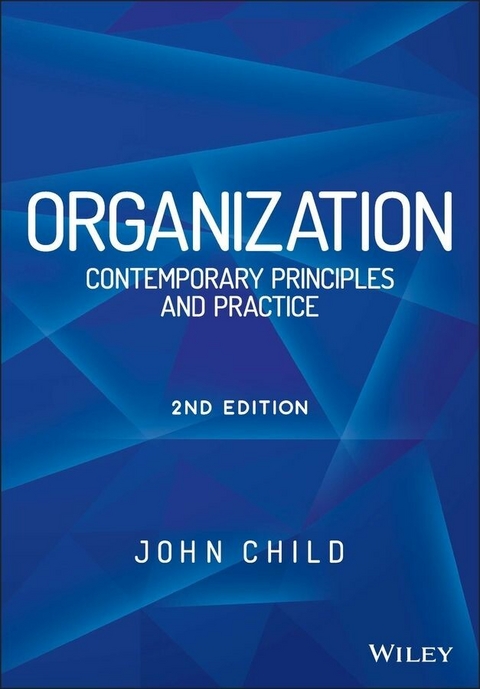
Organization: Contemporary Principles and Practices, SecondEdition is the completely updated and revised landmark guide to'macro' organization theory and design, fully grounded in currentinternational practice. International management expert John Childexplores the conditions facilitating the development of neworganizational forms and provides up-to-date coverage of the keydevelopments driving new organization structure and practice. Thisrevised Second Edition includes a new introductory section onOrganization Theory as well as a complete Instructor Manual updatedwith new material on the basic principles of organizationaldesign.
With detailed case studies and examples from throughout the UK,Europe, Asia and North America, Organization provides atruly international overview for advanced students and businessexecutives who want to be at the forefront of the evolution inOrganization Theory. 21st Century organizations will befaced with entirely new challenges and opportunities than thosefaced by previous generations, and emerging business leaders mustunderstand the new 'macro' realities in order to succeed.Organization will help readers:
- Understand the 'macro' organization, which is distinct fromorganizational behaviour
- Explore the way organizations fit into the internationalbusiness environment and global economy
- Analyze the way organizational structure and design affectmanagement performance
- Apply advanced organization theory and principles to day to daymanagement activities
Written by one of the foremost scholars, the fully updatedSecond Edition of this successful text provides executives andadvanced business students with a wide-ranging and trustworthyguide to organizations as the conditions for their survival in ourglobal business environment change.
JOHN CHILD is an internationally acknowledged expert onorganization and international business. He is particularly knownfor his grounded approach to the practice of management. AmongChild's 23 books, Corporate Co-evolution, co-authored withSuzana Rodrigues, won the 2009 Terry Book Award of the Academy ofManagement.
JOHN CHILD is an internationally acknowledged expert on organization and international business. He is particularly known for his grounded approach to the practice of management. Among Child's 23 books, Corporate Co-evolution, co-authored with Suzana Rodrigues, won the 2009 Terry Book Award of the Academy of Management.
Preface to Second Edition viii
Preface from the First Edition ix
Part I The Broad Picture 1
Chapter 1 Organization and Its Importance 3
Chapter 2 Perspectives on Organizational Design until Recent Times 27
Chapter 3 New Conditions, New Organization 53
Part II New Internal Forms 85
Chapter 4 Simpler Structures - Reducing Hierarchy 87
Chapter 5 Achieving Integration 109
Chapter 6 Control 143
Chapter 7 Questions of Reward 171
Chapter 8 Payment Systems 191
Part III New Network Forms 215
Chapter 9 Outsourcing and Offshoring 217
Chapter 10 Virtual Organization 241
Chapter 11 Strategic Alliances 269
Chapter 12 Organizing Across Borders 291
Part IV Achieving Effective Organizations 331
Chapter 13 Managing Organizational Change 333
Chapter 14 Organizing for Learning 371
Chapter 15 Generating and Utilizing Trust 405
Chapter 16 Corporate Governance in New Organizational Forms 427
Part V Designing Organizations for the 21st Century 451
Chapter 17 Meeting Strategic Business Needs 453
Chapter 18 Meeting Strategic Social Needs 477
Author Index 497
Subject Index 507
"John Child excels once again at connecting the past,
present and future of organizational thought and managerial
practice. By deepening its theoretical foundations and expanding
its discussion of 21st-century topics, this second edition is an
exciting and insightful journey for faculty and students
alike."
--Guido Möllering, Professor of
Organization and Management, Jacobs University Bremen
"This is an outstanding contribution to literature from a
world class academic. His contribution to the field of
organizational studies is without parallel and this work is a
monumental contribution to the global literature on organizational
behavior."
--Sir Cary Cooper, Lancaster University Management
School
"John Child has done it again. This accessible and
scholarly book brings the analysis of organizational forms where it
belongs at the very centre of the fields of organization and
strategy."
--Andrew Pettigrew, Saïd Business School, Oxford
University
"Conventional, sluggish bureaucracies are being introduced
to a new structural vocabulary as they attempt to respond to the
challenge of globalization. John Child provides a lucid and
engaging guide to this changing world of
organizations."
--W. Richard Scott, Department of Sociology, Stanford
University
Chapter 1
Organization and Its Importance
What This Chapter Covers
This book focuses on new trends and options in how we organize collective activity. The present chapter defines the key terms organizing, organization, and organizations. It then introduces the components of organization. Some of these are structural in nature, some are concerned with key processes, while others define boundaries. The components of organization are the parameters along which policy choices have to be made. Although there are limits to what the design of organization can achieve, these policy choices are highly consequential because serious problems can arise from inappropriate organization. The chapter closes with examples of such problems and a checklist to help identify their symptoms.
Purpose and Scope of This Book
In contemporary societies most work, and a good deal of leisure activity too, is carried out in cooperation with other people – it is collective. Often people are working with others in the same location, but increasingly it can involve collaboration across physical distances through Internet and satellite connections. The aim of this book is to provide you with useful insights into how good organization is a foundation for success in collective activity.
Although the book focuses on business companies, much of its content is also applicable to the many public and not-for-profit institutions that are also expected to organize themselves for delivering relevant services in an economic manner. The success of any company depends basically on two fundamental requirements: strategy and organization. The two are closely bound together. Strategy “establishes the criteria for choosing among alternative organizational forms.”1 Yet if its strategy is faulty a company's organization, however sound, cannot compensate for this deficiency. The failure of Kodak to recognize the strategic importance of digital photography is a case in point. On the other hand, an unsuitable organization will handicap a company from delivering sufficiently on its strategy, however well conceived this might be. For example, some business schools fail to capitalize on market opportunities because their faculty are organized in traditional supply-side departments rather than in customer-oriented program teams. Additionally, the formulation of a sound strategy in the contemporary business world relies on knowledge and insight being provided from all levels and units within a company. An inability to motivate and coordinate these inputs because of inadequate organization can prevent a good strategy from being formulated in the first place.
Superior organization offers one of the last sustainable sources of competitive advantage. The gains previously to be had from market entry barriers, proprietary technology, and scale economies have become steadily eroded by trade liberalization, technology transfer, and the development of flexible production technologies. Most resources and technologies can either be acquired from the market or imitated. Organization, on the other hand, is an asset that each company has to develop to suit its own needs and situation and it cannot be bought off-the-shelf. The globalization of markets and value chains, competitive pressures, and the ever-shortening cycles of innovation, place an increasing premium on the ability to organize a wide array of resources, especially human resources, so as to make speedy, intelligent, and coordinated moves in the competitive game.
We live in a challenging and dynamic time for organization. It is often said that the conventional ways in which companies and other collective endeavors have been organized in the past are inadequate for 21st century conditions. Also their two foundations – hierarchy and bureaucracy – today attract hostility because in the public mind they are associated respectively with exploitation and inefficiency. There has been a great deal of hype about an organizational revolution in which new forms are emerging that move away from the fundamental tenets of conventional organization. The gurus have had a field day and much of the discourse on the subject has left sober evaluation way behind.2 Actually despite the availability of some surveys and case studies3, it is difficult to gain an overall picture of the organizational innovations that are taking place. They appear to have progressed further in some parts of the world, such as the Nordic countries, than in others.4 It is therefore timely to review new organizational ideas and practices, compare them with conventional wisdom, and on this basis offer guidelines for practice.
Organization aims to present state-of-the-art principles and practice in the organizing of collective activities, primarily with reference to business companies. While there is much to criticize about the wider social costs of the way most organizations are structured and governed today – these are discussed in Chapters 16 and 18 – the main focus of this book is on how people and their work can be organized so as to achieve the objectives of the unit in which they are employed or to which they are contracted. I appreciate that this begs some absolutely fundamental questions as to the appropriateness of such objectives and who has the power to determine them, issues which ultimately determine whether organization is a force for social good or evil. Others have discussed these issues and the way that the failure to resolve them threatens a major crisis in contemporary societies.5 Without naively claiming that the design of organization can be treated as a purely technical matter, divorced from these wider issues, the main focus of this book will nevertheless be on the more practice-oriented question of the behavioral and performance consequences of organizational design. I return to the social evaluation of organization in the final chapter.
Organization consists of five main parts. Part I provides necessary background and looks at the broad picture rather than specifics. The present chapter introduces the nature of organization and the contributions it can make. Chapter 2 then outlines the main developments in organizational design over approximately the past hundred years. Its purpose is to provide an appreciation of what have become “conventional” ways of organizing, which continue to be widely found in practice and are engrained in the thinking of many administrators and managers who make decisions about organization. By contrast, Chapter 3 considers “new” organizational forms in the contexts that have encouraged them to be adopted. The chapter examines the relevance for organization of major developments in the business environment – globalization, new information and communications technologies, the rise of information-intensive and knowledge-based competition, the growing numbers of knowledge workers, and the increasing social expectations being placed on business. The overall message is that new developments in organization can only be appreciated by reference to the changed context in which business now operates.
Parts II and III turn to the specifics of organizational form. The chapters in Part II focus on the internal aspects of organization, while those in Part III examine various networked forms of organization spanning traditional boundaries. Chapter 4 is concerned chiefly with hierarchy, a fundamental structural feature of organization. It considers downsizing and delayering, which are moves toward smaller and slimmer management structures that have fewer hierarchical levels. The attempt to reduce hierarchy is often accompanied by the greater use of teams. Teams are an important means of improving the coordination and integration of activities, which is the subject of Chapter 5. That chapter discusses ways in which integration can be achieved, including the use of cross-functional teams and modern information and communication technologies. The management of projects is a particularly important capability today and the coordination of the specialized contributions required is usually achieved through teams. Control is the subject of Chapter 6, which is another fundamental aspect of organizing where new approaches have been developed to suit modern conditions. The next two chapters turn to reward policies and practices as further aspects of organizational design. Chapter 7 examines reward policies and the contribution they make within the employment relationship to reconciling managerial requirements with employee needs. Chapter 8 recognizes the importance of pay within the spectrum of rewards and it pays particular attention to the choice of alternative payment systems including the contentious issue of executive bonuses.
The four chapters in Part III turn outwards beyond the conventional boundaries of organizations. They discuss various arrangements that involve networking between firms and across national boundaries. Networking is a very general concept and it can take different forms in practice.6 The chapters in Part III consider some of these variations. One of the main features of new organization lies in how it opens up and crosses boundaries through outsourcing, virtual value chains, alliances, and internationalization. These developments have led some commentators to speak of the “boundaryless organization.” Chapter 9 examines the outsourcing of activities to external contractors. Chapter 10 looks at the special, but increasingly significant, case of “virtual” organization...
| Erscheint lt. Verlag | 11.2.2015 |
|---|---|
| Sprache | englisch |
| Themenwelt | Wirtschaft ► Betriebswirtschaft / Management ► Planung / Organisation |
| Schlagworte | Business & Management • graduate business text • Internationales Management • International Management • international organizational structures and designs • John Child • macro organization theory • Management • MBA Textbook • Organisation • Organisation (Betriebswirtsch.) • Organisations- u. Managementtheorie • organizational management practices • organizational processes • Organization & Management Theory • Organization: Contemporary Principles and Practices, Second Edition • organization management textbook • organization principles study guide • Organization studies • Organization Theory • Wirtschaft • Wirtschaft u. Management |
| ISBN-10 | 1-118-77987-8 / 1118779878 |
| ISBN-13 | 978-1-118-77987-3 / 9781118779873 |
| Informationen gemäß Produktsicherheitsverordnung (GPSR) | |
| Haben Sie eine Frage zum Produkt? |
 EPUB (Adobe DRM)
Kopierschutz: Adobe-DRM
Adobe-DRM ist ein Kopierschutz, der das eBook vor Mißbrauch schützen soll. Dabei wird das eBook bereits beim Download auf Ihre persönliche Adobe-ID autorisiert. Lesen können Sie das eBook dann nur auf den Geräten, welche ebenfalls auf Ihre Adobe-ID registriert sind.
Details zum Adobe-DRM
Dateiformat: EPUB (Electronic Publication)
EPUB ist ein offener Standard für eBooks und eignet sich besonders zur Darstellung von Belletristik und Sachbüchern. Der Fließtext wird dynamisch an die Display- und Schriftgröße angepasst. Auch für mobile Lesegeräte ist EPUB daher gut geeignet.
Systemvoraussetzungen:
PC/Mac: Mit einem PC oder Mac können Sie dieses eBook lesen. Sie benötigen eine
eReader: Dieses eBook kann mit (fast) allen eBook-Readern gelesen werden. Mit dem amazon-Kindle ist es aber nicht kompatibel.
Smartphone/Tablet: Egal ob Apple oder Android, dieses eBook können Sie lesen. Sie benötigen eine
Geräteliste und zusätzliche Hinweise
Buying eBooks from abroad
For tax law reasons we can sell eBooks just within Germany and Switzerland. Regrettably we cannot fulfill eBook-orders from other countries.
aus dem Bereich