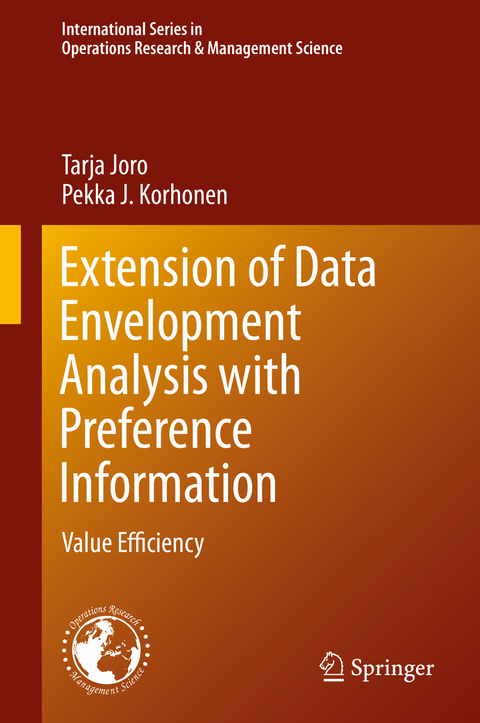
Extension of Data Envelopment Analysis with Preference Information (eBook)
XII, 191 Seiten
Springer US (Verlag)
978-1-4899-7528-7 (ISBN)
This book provides an introduction to incorporating preference information in Data Envelopment Analysis (DEA) with a special emphasis in Value Efficiency Analysis. In addition to theoretical considerations, numerous illustrative examples are included. Hence, the book can be used as a teaching text as well. Only a modest mathematical background is needed to understand the main principles. The only prerequisites are a) familiarity with linear algebra, especially matrix calculus; b) knowledge of the simplex method; and c) familiarity with the use of computer software.
The book is organized as follows. Chapter 1 provides motivation and introduces the basic concepts. Chapter 2 provides the basic ideas and models of Data Envelopment Analysis. The efficient frontier and production possibility set concepts play an important role in all considerations. That's why these concepts are considered more closely in Chapter 3. Since the approaches introduced in this study are inspired by Multiple Objective Linear Programming, the basic concepts of this field are reviewed in Chapter 4. Chapter 5 also compares and contrasts Data Envelopment Analysis and Multiple Objective Linear Programming, providing some cornerstones for approaches presented later in the book. Chapter 6 discusses the traditional approaches to take into account preference information in DEA. In Chapter 7, Value Efficiency is introduced, and Chapter 8 discusses practical aspects. Some extensions are presented in Chapter 9, and in Chapter 10 Value Efficiency is extended to cover the case when a production possibility set is not convex. Three implemented applications are reviewed in Chapter 11.
This book provides an introduction to incorporating preference information in Data Envelopment Analysis (DEA) with a special emphasis in Value Efficiency Analysis. In addition to theoretical considerations, numerous illustrative examples are included. Hence, the book can be used as a teaching text as well. Only a modest mathematical background is needed to understand the main principles. The only prerequisites are a) familiarity with linear algebra, especially matrix calculus; b) knowledge of the simplex method; and c) familiarity with the use of computer software.The book is organized as follows. Chapter 1 provides motivation and introduces the basic concepts. Chapter 2 provides the basic ideas and models of Data Envelopment Analysis. The efficient frontier and production possibility set concepts play an important role in all considerations. That's why these concepts are considered more closely in Chapter 3. Since the approaches introduced in this study are inspired by Multiple Objective Linear Programming, the basic concepts of this field are reviewed in Chapter 4. Chapter 5 also compares and contrasts Data Envelopment Analysis and Multiple Objective Linear Programming, providing some cornerstones for approaches presented later in the book. Chapter 6 discusses the traditional approaches to take into account preference information in DEA. In Chapter 7, Value Efficiency is introduced, and Chapter 8 discusses practical aspects. Some extensions are presented in Chapter 9, and in Chapter 10 Value Efficiency is extended to cover the case when a production possibility set is not convex. Three implemented applications are reviewed in Chapter 11.
Introduction.- Data Envelopment Analysis.- Production Possibility Set and Efficiency.- Multiple Objective Linear Programming.- Comparison of Data Envelopment Analysis and Multiple Objective Linear Programming.- Incorporating Preference Information to Data Envelopment Analysis.- Value Efficiency Analysis.- Value Efficiency Analysis in Practice.- Extensions to Value Efficiency Analysis.-Non-Convex Value Efficiency Analysis.- Applications of Value Efficiency Analysis.- Conclusion.
| Erscheint lt. Verlag | 2.1.2015 |
|---|---|
| Reihe/Serie | International Series in Operations Research & Management Science | International Series in Operations Research & Management Science |
| Zusatzinfo | XII, 191 p. 57 illus. in color. |
| Verlagsort | New York |
| Sprache | englisch |
| Themenwelt | Wirtschaft ► Allgemeines / Lexika |
| Wirtschaft ► Betriebswirtschaft / Management ► Logistik / Produktion | |
| Wirtschaft ► Betriebswirtschaft / Management ► Planung / Organisation | |
| Schlagworte | Data envelopment analysis • DEA • Non-Convex Value Efficiency • Preference Information • Production Possibility Set • Value Efficiency Analysis |
| ISBN-10 | 1-4899-7528-4 / 1489975284 |
| ISBN-13 | 978-1-4899-7528-7 / 9781489975287 |
| Informationen gemäß Produktsicherheitsverordnung (GPSR) | |
| Haben Sie eine Frage zum Produkt? |
 PDF (Wasserzeichen)
DRM: Digitales Wasserzeichen
Dieses eBook enthält ein digitales Wasserzeichen und ist damit für Sie personalisiert. Bei einer missbräuchlichen Weitergabe des eBooks an Dritte ist eine Rückverfolgung an die Quelle möglich.
Dateiformat: PDF (Portable Document Format)
Mit einem festen Seitenlayout eignet sich die PDF besonders für Fachbücher mit Spalten, Tabellen und Abbildungen. Eine PDF kann auf fast allen Geräten angezeigt werden, ist aber für kleine Displays (Smartphone, eReader) nur eingeschränkt geeignet.
Systemvoraussetzungen:
PC/Mac: Mit einem PC oder Mac können Sie dieses eBook lesen. Sie benötigen dafür einen PDF-Viewer - z.B. den Adobe Reader oder Adobe Digital Editions.
eReader: Dieses eBook kann mit (fast) allen eBook-Readern gelesen werden. Mit dem amazon-Kindle ist es aber nicht kompatibel.
Smartphone/Tablet: Egal ob Apple oder Android, dieses eBook können Sie lesen. Sie benötigen dafür einen PDF-Viewer - z.B. die kostenlose Adobe Digital Editions-App.
Buying eBooks from abroad
For tax law reasons we can sell eBooks just within Germany and Switzerland. Regrettably we cannot fulfill eBook-orders from other countries.
aus dem Bereich