


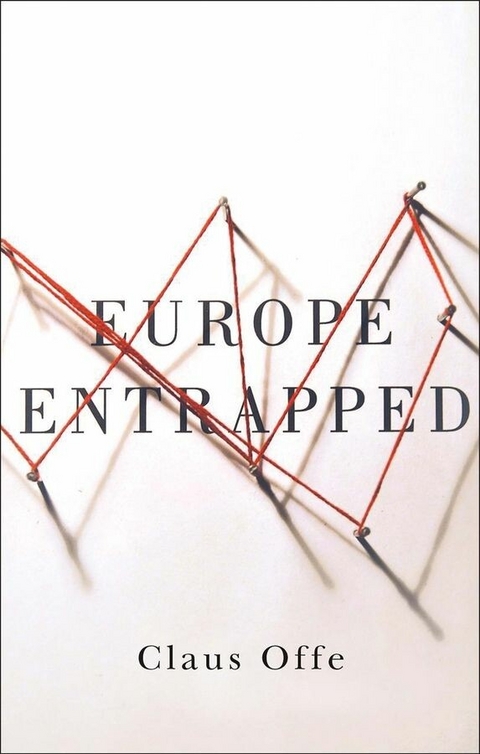
Europe Entrapped (eBook)
John Wiley & Sons (Verlag)
978-0-7456-8755-1 (ISBN)
Today Europe finds itself in a crisis that casts a dark shadowover an entire generation. The seriousness of the crisis stems fromone core political contradiction at the heart of the Europeanproject: namely, that what urgently needs to be done is alsoextremely unpopular and therefore virtually impossible to dodemocratically. What must be done - and almost everyone agrees inprinciple on the measures that would be needed to deal with thefinancial crisis - cannot be sold to the voting public of the coremember states, which so far have been less affected by the crisisthan those on the periphery, nor can the conditions that coremembers try to impose be easily sold to voters in the deficitcountries.
The European Union is therefore becoming increasingly disunited,with deepening divides between the German-dominated‘core’ and the southern ‘periphery’,between the winners and the losers of the common currency, betweenthe advocates of greater integration and the anti-Europeans,between the technocrats and the populists. Europe finds itselftrapped by the deepening divisions that are opening up across theContinent, obstructing its ability to deal with a crisis that hasalready caused massive social suffering in the countries of theEuropean periphery and is threatening to derail the very project ofthe European Union.
In this short book, Claus Offe brings into sharp focus thecentral political problem that lies at the heart of the EU andshackles its ability to deal with the most serious crisis of itsshort history.
Claus Offe is Professor of Political Sociology at the Hertie School of Governance in Berlin. He is author of numerous books, including Contradictions of the Welfare State, Disorganized Capitalism, Modernity and the State, and Reflections on America: Tocqueville, Weber and Adorno in the United States.
Today Europe finds itself in a crisis that casts a dark shadow over an entire generation. The seriousness of the crisis stems from one core political contradiction at the heart of the European project: namely, that what urgently needs to be done is also extremely unpopular and therefore virtually impossible to do democratically. What must be done - and almost everyone agrees in principle on the measures that would be needed to deal with the financial crisis - cannot be sold to the voting public of the core member states, which so far have been less affected by the crisis than those on the periphery, nor can the conditions that core members try to impose be easily sold to voters in the deficit countries. The European Union is therefore becoming increasingly disunited, with deepening divides between the German-dominated core and the southern periphery , between the winners and the losers of the common currency, between the advocates of greater integration and the anti-Europeans, between the technocrats and the populists. Europe finds itself trapped by the deepening divisions that are opening up across the Continent, obstructing its ability to deal with a crisis that has already caused massive social suffering in the countries of the European periphery and is threatening to derail the very project of the European Union. In this short book, Claus Offe brings into sharp focus the central political problem that lies at the heart of the EU and shackles its ability to deal with the most serious crisis of its short history.
Claus Offe is Professor of Political Sociology at the Hertie School of Governance in Berlin. He is author of numerous books, including Contradictions of the Welfare State, Disorganized Capitalism, Modernity and the State, and Reflections on America: Tocqueville, Weber and Adorno in the United States.
* List of Abbreviations
* Preface
* (1) Democratic capitalism and the European Union
* (2) The nature of the crisis
* (3) Growth, debt and doom loops
* (4) No return to square one
* (5) In search of political agency
* (6) Finalitées: Bases of identification with European integration as a political project
* (7) The configuration of political forces and preferences
* (8) Germany's leadership role for Europe: a non-starter - Framing the crisis
* (9) "Thin" citizenship: The ugly face of the EU system of rule
* (10) Redistribution across state borders and social divides
* Afterword
"The title of his book says it all: Europe finds itself in a trap of its own making. Offe has no easy answers as to how the continent might escape. But his 130-page essay is a model of analytical clarity and should be required reading for anyone who wants to grasp the core issues of the crisis--and eschew simple slogans and facile apportionment of blame to single nations (whether Germany or Greece)."
Current History
"This is a strangely heart-warming book. While Claus Offe analyses the weaknesses and failures of European integration with ruthless precision, he also reminds us powerfully of the values of the European ideal, and shows how we could come closer to realising them - if only political leaders had the will and tenacity to do so. In the current climate of Europhobia, this is the nearest thing to realistic optimism that we are likely to get."
Colin Crouch, University of Warwick
"Claus Offe has written a passionate, probing, and deeply perturbing book that both excoriates the European Union and provides a glimpse of hope in the struggle for a social Europe."
Gary Marks, UNC-Chapel Hill and RVU Amsterdam
"After so many years without a resolution, it is hard to feel hopeful about the euro crisis. If there are grounds for hope they lie in this volume. In it Claus Offe describes how the citizens of Europe, and of Germany in particular, frame the crisis. He explains how that framing defines the range of feasible policy options. Offe shows how it is in the capacity of those citizens and their leaders -- of European society, in other words -- to modify that framing in ways that open the door to a more constructive policy response. Offe's careful analysis deserves a wide audience. If it receives one, Europe will be a better place."
Barry Eichengreen, University of California, Berkeley
"At the core of this book is the proposition that, though the Euro was a mistake, its undoing would be a greater mistake. Around this insight, Offe describes the logic of the economic, institutional, political and cultural traps that have been sprung on European polities. The great merit of this book is that it poses the fundamental question implicit in any attempt to escape such traps: who is to be the agent of change? No one reading this book will think that this question has an easy answer; they will realise that an answer is desperately called for."
Albert Weale, University College London
1
Democratic Capitalism and the European Union
Twenty-five years after the end of state socialism, the history of EU enlargement and integration, coupled with the deepest crisis it has so far faced, have posed the challenge to rethink one classical question of social and political theory: How does the democratic state interact with the capitalist market economy? How has the putative institutional equilibrium of the post-Second-World-War “social” market economy been disrupted and how can it (if at all) be restored at the European level of the EU, i.e., an unprecedented type of supranational political entity?
Following the demise of state socialism, the EU underwent a (still unfinished) process of Eastern Enlargement after which no less than thirteen new member states (all of them, except for one-and-a-half small Mediterranean islands, post-Communist) came under the umbrella of the Treaties and the acquis of European law. So far, four of the latter have joined the Euro zone; other post-Communist transformation countries are committed to following suit in the short- to medium-term future. The economic transition they have undergone is an historically novel one, the transition from the “command economy” of state socialism to the market economy of democratic capitalism. Yet the binary conceptual code of “state” vs “market” has helped to obscure the (I would claim) universally valid condition that applies both to the post-Communist transformation and European integration: The market as the mode of operation of a capitalist economy is, on the one hand, the opposite of the state and its practices; on the other, markets are themselves creatures of state policies and continuously recreated by the latter. In Hayek's famous distinction, the “command economy” is based on táxis, the discretionary establishment and coercive implementation of some man-made positive order. Kósmos, in contrast, is conceptualized as a kind of social order, namely the market that emerges from evolutionary forces beyond human design, intention, and even potential understanding.
No doubt, the binary codes of opposing táxis to kósmos, state to market, the “artificial” to the “natural,” discretionary coercion to freedom has become a hegemonic intellectual frame since the dominance of neoliberal doctrines in economic and political thought began, on both sides of the North Atlantic, in the late 1970s. Yet the two cases just mentioned – economic transformation after state socialism and EU integration – can serve as perfect empirical illustrations of the fact that markets are themselves coercively implemented artefacts of political design and decisions, not outcomes of some alleged “natural” evolution or simply “normal” conditions. Markets, as well as other institutions of capitalist societies, are made and allowed to operate by identifiable actors at specific times and locations; at any rate, they are not “given” nor do they just “happen” naturally. If that premise is accepted, what follows is the need to re-arrange the Hayekian conceptual architecture and to complicate the picture by adding a few items. Let me briefly do so in four points.
First, the difference between the two types of political economy must be rephrased so that the state–socialist type of regime (for Hayek the quintessential case of táxis) operates the economy through the means of collectivized property, plan, command, control, and by reference to some notion of “social justice” embodied in prescriptive rules1 establishing positive duties. In contrast, capitalist states run their economies through setting the stage for spontaneous self-coordination of rational interest-driven proprietors, i.e., by granting market participants, by merely prohibiting rules establishing negative legal duties, the freedom to dispose over their lawfully owned resources according to interests they choose to pursue in competitive interaction with others who do likewise. In opposition to this conceptual foundation of libertarian doctrine, it comes closer to the truth if we understand capitalist market economies as emanating from the victorious political project of a (“capitalist”) state and social forces supporting it to steer its economy by the organizational device of private property, market freedom, and the pursuit of interests.2 Market “spontaneity,” we might say, is itself instituted, licensed, regulated, and politically set in motion, just as the planning apparatus of some dictatorial party and its coercive disposition over society's resources. The constitutive role of state authorities for capitalism becomes evident if we realize that before even the first market transaction between a buyer and a seller can take place and become a matter of routine, a state must be in place already that has institutionalized (at least) three things: property rights, contract rights with enforcement mechanisms attached, and the currency that allows market participants to enter into commercial transactions – none of which can be established by “negative” or prohibitive rules alone.
Generally speaking, virtually every move “free” market participants make in pursuing their interests is licensed, mandated, regulated, promoted, guaranteed, subsidized, protected, legally formalized etc. by political programs and legal provisions, as are the opportunities for such moves provided for by market-related state action, e.g. by trade policies, the provision of infrastructure, zoning laws, schools, research institutions, the courts, and many others.3 Again, we want to keep in mind that the capitalist market society is a political economy, or a state-instituted arrangement of economic interaction. In short, as Polanyi4 has demonstrated, kósmos (in the Hayekian sense of unplanned spontaneous market coordination of the action of interested actors) is not the opposite, but a peculiar sub-case of táxis – an arrangement for which some political authority has unleashed the freedom of owners in contrast to the discretionary power of planning authorities.
My second point here is that markets and market competition are, as already Adam Smith knew well, essentially self-subversive. As market competition always creates losers and constrains the leeway even of winners to profit, there is an ubiquitous interest of market participants to limit the intensity and adverse impact of competition through the formation of cartels and monopolies, to deny market access to potential competitors, to resort to modes of “competition” (such as violent rivalry ranging from individual violence to piracy to international war) other than the two supposedly only legitimate ones, namely competition through lower prices or better quality (including novelty) of products. These two solely “civilized” modes of competition can also be bypassed through lobbying for protectionist concessions and other privileges granted by state policies. Also, once finding themselves in competition, market participants may try to acquire (supposedly) “free” goods (provided for free of charge or below cost from state authorities, e.g. infrastructure or outright subsidies) and to externalize costs (e.g. environmental damages, employment risks of workers) without compensating those negatively affected. Market transactions are well known to generate all kinds of negative externalities that are then dumped on (uncompensated) others. In all three of these directions (hindering market access of potential competitors, absorbing productive inputs without bearing the costs, generating negative externalities without compensation) markets do not only depend on pre-existing non-market relations (the legal and monetary preconditions addressed in the previous point) but they also lead rational market participants to generate and profit from shaping the structure of markets, extracting “free” resources, and coping with competitive pressures by economizing at the expense of third parties.
All of this is to say that “fair” market competition, even once it is installed, is far from self-enforcing and self-sustaining. If a market is to stay competitive, it needs to be permanently supervised and policed. It is an on-going concern for all levels of public policy to decide and adjudicate on market participants' strategies to evade and obstruct competition, appropriate “free” inputs and externalize social costs – a never-ending task of policing and enforcing competition for which, at the EU level, the Competition Commissioner is responsible. Far from being self-sustaining, markets are utterly fragile arrangements in need of being cultivated and governed by the state's economic policies. These policies tend to be torn between two objectives. On the one hand, and within the confines of a national economy and state, they pursue the objective of facilitating profitable business for investors because doing so is expected to promote prosperity of the country, create employment, resolve social conflict through positive-sum pay-offs and provide a tax base on which the making of any policy and its implementation depend. On...
| Erscheint lt. Verlag | 30.1.2015 |
|---|---|
| Sprache | englisch |
| Themenwelt | Sozialwissenschaften ► Politik / Verwaltung ► Europäische / Internationale Politik |
| Sozialwissenschaften ► Politik / Verwaltung ► Vergleichende Politikwissenschaften | |
| Wirtschaft ► Volkswirtschaftslehre ► Wirtschaftspolitik | |
| Schlagworte | Economics • euro crisis • Europa /Politische Theorie, Geschichtsschreibung • Europe • European politics • European Union • political economics • Political Science • Politics • Politik / Europa • Politikwissenschaft • Politische Ãkonomie • Politische Ökonomie • Sociology • Volkswirtschaftslehre |
| ISBN-10 | 0-7456-8755-5 / 0745687555 |
| ISBN-13 | 978-0-7456-8755-1 / 9780745687551 |
| Informationen gemäß Produktsicherheitsverordnung (GPSR) | |
| Haben Sie eine Frage zum Produkt? |
 EPUB (Adobe DRM)
Kopierschutz: Adobe-DRM
Adobe-DRM ist ein Kopierschutz, der das eBook vor Mißbrauch schützen soll. Dabei wird das eBook bereits beim Download auf Ihre persönliche Adobe-ID autorisiert. Lesen können Sie das eBook dann nur auf den Geräten, welche ebenfalls auf Ihre Adobe-ID registriert sind.
Details zum Adobe-DRM
Dateiformat: EPUB (Electronic Publication)
EPUB ist ein offener Standard für eBooks und eignet sich besonders zur Darstellung von Belletristik und Sachbüchern. Der Fließtext wird dynamisch an die Display- und Schriftgröße angepasst. Auch für mobile Lesegeräte ist EPUB daher gut geeignet.
Systemvoraussetzungen:
PC/Mac: Mit einem PC oder Mac können Sie dieses eBook lesen. Sie benötigen eine
eReader: Dieses eBook kann mit (fast) allen eBook-Readern gelesen werden. Mit dem amazon-Kindle ist es aber nicht kompatibel.
Smartphone/Tablet: Egal ob Apple oder Android, dieses eBook können Sie lesen. Sie benötigen eine
Geräteliste und zusätzliche Hinweise
Buying eBooks from abroad
For tax law reasons we can sell eBooks just within Germany and Switzerland. Regrettably we cannot fulfill eBook-orders from other countries.


