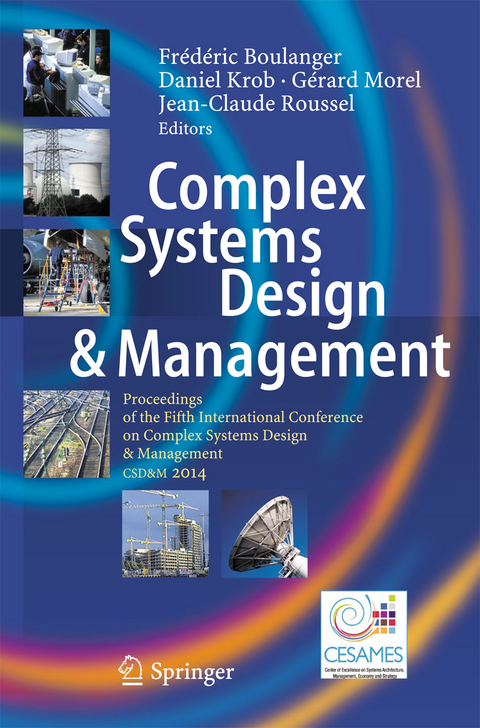
Complex Systems Design & Management (eBook)
XXVI, 372 Seiten
Springer International Publishing (Verlag)
978-3-319-11617-4 (ISBN)
This book contains all refereed papers that were accepted to the fifth edition of the « Complex Systems Design & Management » (CSD&M 2014) international conference which took place in Paris (France) on the November 12-14, 2014.
These proceedings cover the most recent trends in the emerging field of complex systems sciences & practices from an industrial and academic perspective, including the main industrial domains (aeronautic & aerospace, transportation & systems, defense & security, electronics & robotics, energy & environment, health & welfare services, software & e-services), scientific & technical topics (systems fundamentals, systems architecture & engineering, systems metrics & quality, systemic tools) and system types (transportation systems, embedded systems, software & information systems, systems of systems, artificial ecosystems).
The CSD&M 2014 conference is organized under the guidance of the CESAMES non-profit organization, address: CESAMES, 8 rue de Hanovre, 75002 Paris, France.
Preface 5
Conference Organization 10
Contents 14
When Systems Engineering Meets Software Language Engineering 26
1 A Language-Oriented Vision for Systems Engineering 26
2 Challenges for SLE from Language Designers’ Point of View 29
3 Challenges for SLE from the Language Users’ Point of View 35
4 Conclusion and Perspectives 37
References 37
Dependency Analysis as a Heat Map for Architecture Standardization 39
1 Initial Situation and Outline of Paper 40
2 Objective 42
3 Approach 42
4 Use Case 48
5 Conclusion and Future Work 51
References 52
User-Based Solutions for Increasing Level of Service in Bike-Sharing Transportation Systems 54
1 Introduction 55
2 Presentation of the Model 56
3 Results 59
4 Discussion 64
5 Conclusion 66
References 66
A New Framework for the Simulation of Offshore Oil Facilities at the System Level 68
1 Introduction 69
2 Acausal and Hybrid Modeling 70
3 Physics Modeling 72
4 Risk Modeling 75
5 Framework 78
6 Conclusion and Perspectives 79
References 80
Towards an Extended Interoperability Systemic Approach for Dynamic Manufacturing Networks: Role and Assessment of PLM1Standards 81
1 Introduction 82
2 SIP Related Work 84
3 Systemic and Its Limitations for a Global Interoperable PLM Approach 88
4 Illustration through ISA95 Case Study 89
5 Conclusion and Way Forward 92
References 93
Flexible Queries over Engineering Data 95
1 Introduction 95
2 Queries and Rules on Engineering Data 98
3 Requirements from Flexible Queries 100
4 A Visual Query Formalism 103
5 Semantics 104
6 Implementation 106
7 Conclusion 107
References 107
Leveraging Domain Expertise 1in ArchitecturalExploration 109
1 Introduction 110
2 Engineering Complex Systems with Architecture Patterns 111
3 Architecture Patterns – Example Use Case 113
4 Integration Framework 117
5 Architecture Optimization 121
6 Summary and Future Directions 123
References 124
Seven Issues on Distributed Situation Awareness Measurement in Complex Socio-technical Systems 126
1 Introduction 126
2 Previous Work 129
3 Why It Is Not Worthy to Combine the Existing SA Measurement Techniques 132
4 Issues on DSA Measurement 133
5 Conclusion 136
References 137
The Hidden Perils of Addressing Complexity with Formal Process – A Philosophical and Empirical Analysis 139
1 Introduction 139
2 Complexity and the Rise of Formal Quality Control Processes 140
3 Formal Process as Technology 142
4 Formal Process and Labor Study Literature 143
5 Research Question 144
6 Research Method 144
7 Analysis 145
8 Conclusion 148
References 150
A Formal Foundation of Systems Engineering 152
1 Introduction 152
2 What Is Necessary for an Adequate Formalization of Systems Engineering? 153
3 Formal Introduction of the Framework 159
4 Concluding Remarks 165
References 165
Ontology-Assisted Systems Engineering Process with Focus in the Requirements Engineering Process 168
1 Introduction 168
2 How Is Nowadays the Requirements Engineering Process 170
3 Ontology-Assisted Requirements Engineering Process in the Systems Engineering Process 173
4 Applied In 177
5 Conclusions 179
References 180
How Can Usage Monitoring Improve Resilience?* 181
1 Introduction 181
2 State of the Art 182
3 Design Pattern Fit to Resilient Systems 185
4 Case Study: Railway Accident 189
5 Conclusion 191
References 192
Executable Architectures Using Cuckoo Search Optimization Coupled with OPM and CPN-A Module: A New Meta-Architecture Model for FILA SoS 193
1 Introduction 193
2 Literature Review on Current and Past SoS Projects 195
3 Flexible Intelli igent & Learning Architecture for System of Systems-FIL LA-SoS
4 Methodology of Generating Executable Architectures 200
5 Conclusion 208
References 209
User-Centered Design for Emotion. A Case Study in Wellness Products 211
1 Introduction 211
2 Research Methodology and Data Collection 212
3 Weak Design Points Detected 217
4 Generalizing Results to Improve Current and Future Designs 219
5 Results and Discussion 223
References 224
A Fuzzy Approach for Assessing Transportation Infrastructure1 Security 225
1 Introduction 225
2 A Review of Past Work 228
3 Methodology 231
4 Case Study 237
5 Conclusion and Discussion 240
References 241
A Verification Approach from MDE Applied to Model Based Systems Engineering: xeFFBD Dynamic Semantics 243
1 Introduction 243
2 Towards Execution and Validation of DSMLs 245
3 Application in the Field of SE 246
4 Application Discussion and Expected Contributions 253
5 Conclusion and Perspectives 255
References 255
How to Boost Product Line Engineering with MBSE – A Case Study of a Rolling Stock Product Line 257
1 Introduction 257
2 PLE for the Railway Rolling Stock Sector: Origins, Motivations and Generations 260
3 Defining a Reuse Strategy 261
4 Looking Back, Looking Forward 263
5 Model Based Framework for MBSE and PLE 266
6 Application of a 2nd Generation Reuse Strategy to a Metro Platform 269
7 Conclusions and Way Forward 273
References 273
An Overview of Multimodal Transport Design and Challenges Underlined by a Carsharing Case Study 275
1 Introduction 276
2 Multimodal Transportation Design 276
3 Challenges 278
4 Carsharing, a New Transportation Mode at the Crossroads of All Challenges 280
5 Conclusion 284
References 285
Timed Symbolic Testing Framework for Executable Models Using High-Level Scenarios 287
1 Introduction 287
2 Approach Overview 289
3 Interaction Scenarios and Symbolic Simulation 290
4 Activity Diagrams and Numeric Simulation 293
5 ConformanceTesting 295
6 Experiments 297
7 Related Works 298
8 Conclusion 299
References 299
MoSaRT Framework: A Collaborative Tool for Modeling and Analyzing Embedded Real-Time Systems 301
1 Introduction 301
2 Background and Related Work 303
3 Objectives of MoSaRT Framework 304
4 MoSaRT Design Language 305
5 MoSaRT Analysis Repository 307
6 MoSaRT Usage Scenarios 309
7 Conclusion 311
References 312
Preliminary Hazard Analysis Generation Integrated with Operational Architecture – Application to Automobile 314
1 Introduction 315
2 Background on Links between Safety and Systems Engineering 315
3 Conceptual Model of Safe Systems Engineering – Requirement Analysis View 316
4 Our Proposal Concerning the Integration of PHA and MBSE 319
5 Application to an Example 321
6 Conclusion and Outlook 325
References 325
Author Index 358
| Erscheint lt. Verlag | 24.10.2014 |
|---|---|
| Zusatzinfo | XXVI, 372 p. 126 illus., 10 illus. in color. |
| Verlagsort | Cham |
| Sprache | englisch |
| Themenwelt | Technik |
| Wirtschaft ► Betriebswirtschaft / Management ► Logistik / Produktion | |
| Schlagworte | Complexity • Complex Systems Design • Complex Systems Design & Management • Complex Systems Management • Complex Systems Sciences • CSD&M 2014 |
| ISBN-10 | 3-319-11617-7 / 3319116177 |
| ISBN-13 | 978-3-319-11617-4 / 9783319116174 |
| Informationen gemäß Produktsicherheitsverordnung (GPSR) | |
| Haben Sie eine Frage zum Produkt? |
 PDF (Wasserzeichen)
DRM: Digitales Wasserzeichen
Dieses eBook enthält ein digitales Wasserzeichen und ist damit für Sie personalisiert. Bei einer missbräuchlichen Weitergabe des eBooks an Dritte ist eine Rückverfolgung an die Quelle möglich.
Dateiformat: PDF (Portable Document Format)
Mit einem festen Seitenlayout eignet sich die PDF besonders für Fachbücher mit Spalten, Tabellen und Abbildungen. Eine PDF kann auf fast allen Geräten angezeigt werden, ist aber für kleine Displays (Smartphone, eReader) nur eingeschränkt geeignet.
Systemvoraussetzungen:
PC/Mac: Mit einem PC oder Mac können Sie dieses eBook lesen. Sie benötigen dafür einen PDF-Viewer - z.B. den Adobe Reader oder Adobe Digital Editions.
eReader: Dieses eBook kann mit (fast) allen eBook-Readern gelesen werden. Mit dem amazon-Kindle ist es aber nicht kompatibel.
Smartphone/Tablet: Egal ob Apple oder Android, dieses eBook können Sie lesen. Sie benötigen dafür einen PDF-Viewer - z.B. die kostenlose Adobe Digital Editions-App.
Buying eBooks from abroad
For tax law reasons we can sell eBooks just within Germany and Switzerland. Regrettably we cannot fulfill eBook-orders from other countries.
aus dem Bereich