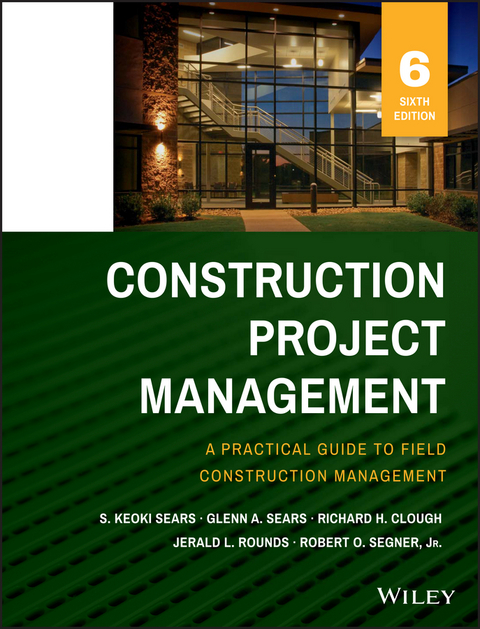
Construction Project Management (eBook)
John Wiley & Sons (Verlag)
978-1-118-74526-7 (ISBN)
For more than thirty years, Construction Project Management has been considered the preeminent guide to all aspects of the construction project management process, including the Critical Path Method (CPM) of project scheduling, and much more. Now in its Sixth Edition, it continues to provide a solid foundation of the principles and fundamentals of project management, with a particular emphasis on project planning, demonstrated through an example project, along with new pedagogical elements such as end-of-chapter problems and questions and a full suite of instructor's resources.
Also new to this edition is information on the Earned Value Analysis (EVA) system and introductory coverage of Building Information Modeling (BIM) and Lean Construction in the context of project scheduling. Readers will also benefit from building construction examples, which illustrate each of the principles of project management. This information, combined with the case studies provided in the appendix, gives readers access to hands-on project management experience in the context of real-world project management problems.
- Features two integrated example projects-one civil and one commercial-fully developed through the text
- Includes end-of-chapter questions and problems
- Details BIM in scheduling procedures, Lean Construction, and Earned Value Analysis, EVA
- Provides teaching resources, including PowerPoint slides, interactive diagrams, and an Instructor's Manual with solutions for the end-of-chapter questions
Construction Management and Civil Engineering students and professionals alike will find everything they need, to understand and to master construction project management in this classic guide.
S. KEOKI SEARS is a Project Manager and owner of Project Catalyst Corporation, based in Durango, Colorado.
GLENN A. SEARS is an active consultant in construction technology and management.
RICHARD H. CLOUGH was Dean of the College of Engineering, University of New Mexico.
JERALD L. ROUNDS is professor emeritus of Construction Management and Construction Engineering at the University of New Mexico.
ROBERT O. SEGNER, JR. is professor of Construction Science in the College of Architecture at Texas A&M University.
A thoroughly updated edition of the classic guide to project management of construction projects For more than thirty years, Construction Project Management has been considered the preeminent guide to all aspects of the construction project management process, including the Critical Path Method (CPM) of project scheduling, and much more. Now in its Sixth Edition, it continues to provide a solid foundation of the principles and fundamentals of project management, with a particular emphasis on project planning, demonstrated through an example project, along with new pedagogical elements such as end-of-chapter problems and questions and a full suite of instructor's resources. Also new to this edition is information on the Earned Value Analysis (EVA) system and introductory coverage of Building Information Modeling (BIM) and Lean Construction in the context of project scheduling. Readers will also benefit from building construction examples, which illustrate each of the principles of project management. This information, combined with the case studies provided in the appendix, gives readers access to hands-on project management experience in the context of real-world project management problems. Features two integrated example projects one civil and one commercial fully developed through the text Includes end-of-chapter questions and problems Details BIM in scheduling procedures, Lean Construction, and Earned Value Analysis, EVA Provides teaching resources, including PowerPoint slides, interactive diagrams, and an Instructor's Manual with solutions for the end-of-chapter questions Construction Management and Civil Engineering students and professionals alike will find everything they need, to understand and to master construction project management in this classic guide.
S. KEOKI SEARS is a Project Manager and owner of Project Catalyst Corporation, based in Durango, Colorado. GLENN A. SEARS is an active consultant in construction technology and management. RICHARD H. CLOUGH was Dean of the College of Engineering, University of New Mexico. JERALD L. ROUNDS is professor emeritus of Construction Management and Construction Engineering at the University of New Mexico. ROBERT O. SEGNER, JR. is professor of Construction Science in the College of Architecture at Texas A&M University.
Preface vii
1 Construction Practices 1
2 Systematic Project Management 19
3 Project Estimating 35
4 Project Planning 71
5 Project Scheduling Concepts 97
6 Production Planning 143
7 Managing Time 161
8 Resource Management 191
9 Project Scheduling Applications 213
10 Project Coordination 241
11 Project Cost System 275
12 Project Financial Management 309
Index 335
1
Construction Practices
1.1 Introduction
The objective of this book is to present and discuss the management of field construction projects. These projects involve a great deal of time and expense, so close management control is required if they are to be completed within the established time and cost constraints. The text also develops and discusses management techniques directed toward the control of cost, time, resources, and project finance during the construction process. Emphasis is placed on practical and applied procedures of proven efficacy. Examples relate to field construction practices.
Effective management of a project also requires a considerable background of general knowledge about the construction industry. The purpose of this chapter is to familiarize the reader with certain fundamentals of construction practice that will be useful for a complete understanding of the discussions presented in later chapters. Learning objectives for this chapter include:
- Recognize the size and impact of the construction industry.
- Understand how a construction project moves from concept to reality.
- Identify entities involved in a construction project and various project delivery systems that link the participating entities.
- Introduce the role of the project manager.
1.2 The Construction Industry
In terms of the dollar value of output produced, the construction industry is one of the largest single production activities of the US economy. As of December of 2013, the seasonally adjusted value of construction put in place for 2013 was estimated to be $0.930 trillion. This figure is updated monthly by the US Census Bureau. The current value can be found on the US Census Bureau website under Construction Spending, www.census.gov/construction/c30/c30index.html. The current dollar gross domestic product (GDP) in the fourth quarter of 2013 was $17.103 trillion. This figure is regularly updated by the US Department of Commerce, Bureau of Economic Analysis, and can be found at www.bea.gov/newsreleases/ national/gdp/gdpnewsrelease.htm.
Though construction was severely impacted by the economic downturn at the end of the first decade of this century, the annual expenditure for construction still accounts for almost 5.44 percent of the GDP. More than 1 of every 20 dollars spent for goods and services in the United States is spent on construction. The construction industry is also one of the nation’s largest employers, so its impact in terms of both dollars and jobs remains considerable.
Not only does the construction industry touch the lives of virtually every human being on a daily basis; it also occupies a fundamental position in many national economies. This large and pervasive industry is regarded as the bellwether of economic growth in the United States. Periods of national prosperity usually are associated with high levels of construction activity. One is the natural result of the other.
The construction industry is heterogeneous and enormously complex. There are several major classifications of construction that differ markedly from one another: housing, nonresidential building, heavy civil, utility, and industrial. In addition, these construction types are further divided into many specialties, such as electrical, concrete, excavation, piping, and roofing.
Construction work is accomplished by contractors who vary widely in terms of size and specialty. Some contractors choose to concentrate on a particular task or aspect of the construction project and are therefore referred to as specialty contractors. Others assume broader responsibility for a comprehensive work package and are referred to as general contractors. Commonly, general contractors will subcontract specific aspects of a project to specialty contractors, forming a contractual web of general contractors and specialty contractors. Within the industry, very large contractors handle annual volumes in excess of $15 billion; their annual budgets rival the gross national products of many small countries. However, the construction industry is typified by small businesses.
1.3 The Construction Project
Construction projects are intricate, time-consuming undertakings. The total development of a project normally consists of several phases requiring a diverse range of specialized services. In progressing from initial planning to project completion, the typical job passes through successive and distinct stages that demand input from such disparate areas as financial organizations, governmental agencies, engineers, architects, lawyers, insurance and surety companies, contractors, material and equipment manufacturers and suppliers, and construction craft workers.
During the construction process itself, even a project of modest proportions involves many skills, materials, and literally hundreds of different operations. The assembly process must follow a natural order of events that constitutes a complicated pattern of individual time requirements and restrictive sequential relationships among the project’s many segments.
To a great extent, each construction project is unique—no two jobs are ever exactly the same. In its specifics, each structure is tailored to suit its environment, arranged to perform its own particular function, and designed to reflect personal tastes and preferences. The vagaries of the construction site and the possibilities for creative and utilitarian variation of even the most standardized building product combine to make each construction project a new and different experience. The contractor sets up its “factory” on the site and, to a large extent, custom builds each structure.
Construction is subject to the influence of highly variable and sometimes unpredictable factors. The construction team, which includes architects, engineers, craft workers, specialty contractors, material suppliers, and others, changes from one job to the next. All the complexities inherent in different construction sites—such as subsoil conditions, surface topography, weather, transportation, material supply, utilities and services, local specialty contractors, labor conditions, and available technologies—are an innate part of construction.
However, though construction projects are subject to infinite variety, construction processes tend to be consistent from job to job. Each job goes through mobilization and closeout processes. All materials and installed equipment are subject to a procurement process that includes submittals, approvals, purchase, and shipment to the job site. Contracts are negotiated. Costs are estimated and billed out when a component is completed. Changes happen regularly, but even changes are handled through a consistent change order process. Hence, much of the current focus in construction management is on understanding and managing construction processes more effectively.
The character of construction projects, typified by their complexity and diversity and by the nonstandardized nature of their production, is a result of variable inputs operated on by standard processes yielding a unique product. The use of prefabricated modular units is somewhat limiting this variability, but it is unlikely that field construction will ever be able to adapt completely to the standardized methods and product uniformity of assembly-line production. To the contrary, many manufacturing processes are moving toward mass customization, or “one-off” production and adopting many of the project management tools originating in the construction industry.
1.4 Project Stages
A construction project proceeds in a rather definite order; the stages of development that follow are typical.
A. Planning and Definition
Once an owner has identified the need for a new facility, he or she must define the requirements and delineate the budgetary constraints. Project definition involves establishing broad project characteristics, such as location, performance criteria, size, configuration, layout, equipment, services, and other owner requirements needed to establish the general aspects of the project. Conceptual planning stops short of detailed design, although a considerable amount of preliminary architectural or engineering work may be required. The definition of the work is basically the responsibility of the owner, although a design professional may be called in to provide technical assistance and advice.
B. Design
The design phase involves the architectural and engineering design of the entire project. It culminates in the preparation of final working drawings and specifications for the total construction program. In practice, design, procurement, and construction often overlap, with procurement and construction beginning on certain segments as soon as the design is completed and drawings and specifications become available for those segments.
With the advent of high-speed computing and massive data management capabilities, the various design components can now be incorporated into a single database producing integrated design in a digital format. Production information is being added to the database, resulting in a Building Information Modeling (BIM) model of the project that contains all information on the project in a unique digital format. The use of BIM is still in the early stages, but its use is evolving rapidly throughout the construction industry.
C. Procurement and Construction
Procurement refers to the ordering, expediting, and delivering of key project equipment and materials, especially...
| Erscheint lt. Verlag | 9.1.2015 |
|---|---|
| Sprache | englisch |
| Themenwelt | Technik ► Bauwesen |
| Wirtschaft ► Betriebswirtschaft / Management ► Projektmanagement | |
| Schlagworte | Bauausführung • Bauausführung • Baubetrieb • Bauingenieur- u. Bauwesen • Baukonstruktion • BIM • building construction examples • Building Information Modeling • Civil Engineering & Construction • Construction • Construction Management • Construction Project Management • CPM • Critical path • Earned Value Analysis • engineered construction examples • EVA • fundamentals of critical path scheduling • Glenn A. Sears • Industrial Engineering • Industrial Engineering / Project Management • Industrielle Verfahrenstechnik • Jerald L. Rounds • Lean Construction • master construction project management • planning and scheduling construction projects • principles and fundamentals of CPM • principles of project management • Project Management • Project Scheduling • Projektmanagement • Projektmanagement i. d. Industriellen Verfahrenstechnik • Richard H. Clough • Robert O. Segner • Scheduling Construction Projects • S. Keoki Sears |
| ISBN-10 | 1-118-74526-4 / 1118745264 |
| ISBN-13 | 978-1-118-74526-7 / 9781118745267 |
| Informationen gemäß Produktsicherheitsverordnung (GPSR) | |
| Haben Sie eine Frage zum Produkt? |
 EPUB (Adobe DRM)
Kopierschutz: Adobe-DRM
Adobe-DRM ist ein Kopierschutz, der das eBook vor Mißbrauch schützen soll. Dabei wird das eBook bereits beim Download auf Ihre persönliche Adobe-ID autorisiert. Lesen können Sie das eBook dann nur auf den Geräten, welche ebenfalls auf Ihre Adobe-ID registriert sind.
Details zum Adobe-DRM
Dateiformat: EPUB (Electronic Publication)
EPUB ist ein offener Standard für eBooks und eignet sich besonders zur Darstellung von Belletristik und Sachbüchern. Der Fließtext wird dynamisch an die Display- und Schriftgröße angepasst. Auch für mobile Lesegeräte ist EPUB daher gut geeignet.
Systemvoraussetzungen:
PC/Mac: Mit einem PC oder Mac können Sie dieses eBook lesen. Sie benötigen eine
eReader: Dieses eBook kann mit (fast) allen eBook-Readern gelesen werden. Mit dem amazon-Kindle ist es aber nicht kompatibel.
Smartphone/Tablet: Egal ob Apple oder Android, dieses eBook können Sie lesen. Sie benötigen eine
Geräteliste und zusätzliche Hinweise
Buying eBooks from abroad
For tax law reasons we can sell eBooks just within Germany and Switzerland. Regrettably we cannot fulfill eBook-orders from other countries.
aus dem Bereich