


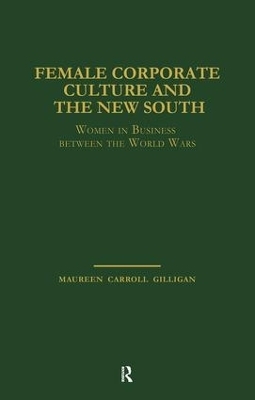
Female Corporate Culture and the New South
Women in Business Between the World Wars
Seiten
2019
Routledge (Verlag)
978-1-138-86387-3 (ISBN)
Routledge (Verlag)
978-1-138-86387-3 (ISBN)
Before World War I, Southern women's participation in the workforce consisted of black women's domestic labor and white working-class women's industrial or manufacturing work, but after the war, Southern women flooded business offices as stenographers, typists, clerks, and bookkeepers. This book examines their experiences in the clerical workforce, using both traditional labor sources and exploring the cultural institutions that evolved from these women's work-related milieu.
Businessmen throughout the South molded this workforce to meet their needs using both labor-saving management techniques and exploiting social mores to enforce gender boundaries that limited women's workplace opportunities. This study traces the social and economic implications of Southern women's increased participation in clerical labor after World War I. While it increased the civic activities of white middle-class southern women, it also confined them to a routinized days work and limited venues of occupational achievement. Through a varied network of business women's clubs and organizations, women struggled with their new identities as workers and attempted to integrate their work lives with their community and family obligations.
(Ph.D. dissertation, Emory University, 1995; revised with new Introduction and Preface)
Businessmen throughout the South molded this workforce to meet their needs using both labor-saving management techniques and exploiting social mores to enforce gender boundaries that limited women's workplace opportunities. This study traces the social and economic implications of Southern women's increased participation in clerical labor after World War I. While it increased the civic activities of white middle-class southern women, it also confined them to a routinized days work and limited venues of occupational achievement. Through a varied network of business women's clubs and organizations, women struggled with their new identities as workers and attempted to integrate their work lives with their community and family obligations.
(Ph.D. dissertation, Emory University, 1995; revised with new Introduction and Preface)
Maureen Carroll Gilligan
Chapter One, Urbanization, Clerical Work, and the Modem Southern Woman, Chapter Two A Manageable Workforce: Scientific Management and Women Workers, Chapter Three What An Office Should Be, Chapter Four Building Civic Bridges: Building Business Consensus, Chapter Five Businesswomen’s Idealism: Civicism and the Clerical Worker, Chapter Six Losing Ground, Conclusion
| Erscheint lt. Verlag | 4.2.2019 |
|---|---|
| Verlagsort | London |
| Sprache | englisch |
| Maße | 138 x 216 mm |
| Gewicht | 453 g |
| Themenwelt | Geschichte ► Allgemeine Geschichte ► 1918 bis 1945 |
| Geisteswissenschaften ► Geschichte ► Regional- / Ländergeschichte | |
| Geschichte ► Teilgebiete der Geschichte ► Kulturgeschichte | |
| Sozialwissenschaften ► Soziologie ► Gender Studies | |
| Wirtschaft ► Betriebswirtschaft / Management | |
| ISBN-10 | 1-138-86387-4 / 1138863874 |
| ISBN-13 | 978-1-138-86387-3 / 9781138863873 |
| Zustand | Neuware |
| Informationen gemäß Produktsicherheitsverordnung (GPSR) | |
| Haben Sie eine Frage zum Produkt? |
Mehr entdecken
aus dem Bereich



aus dem Bereich
Deutschland 1933 bis 1945
Buch | Hardcover (2025)
S. Fischer (Verlag)
CHF 47,60
der deutsche Vernichtungskrieg gegen die Sowjetunion. Eine Revision
Buch | Hardcover (2025)
S. Fischer (Verlag)
CHF 49,95


