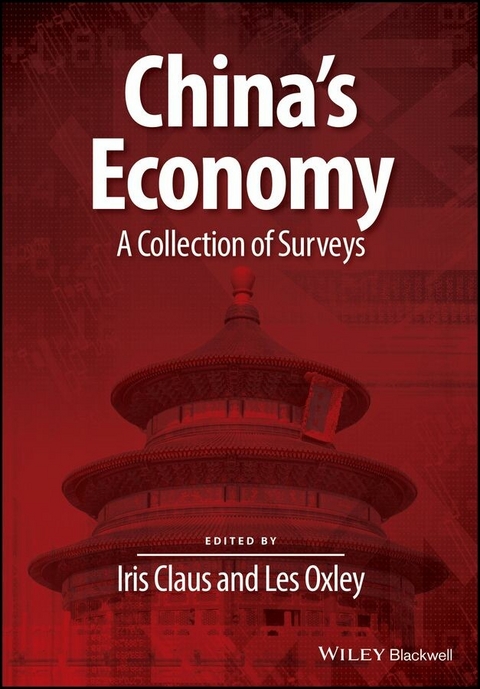
China's Economy (eBook)
208 Seiten
Wiley-Blackwell (Verlag)
978-1-118-98244-0 (ISBN)
This collection of critical surveys provides readers with a range of up-to-date work from leading scholars in the area, writing on some of the key issues facing China, as they survey the present and future challenges of the Chinese economy
- Nine papers provide detailed discussion on key aspects of the past, present and future of the Chinese economy
- Leaders in their relevant fields of scholarship tackle some of the critical issues facing China
- Contributors identify common themes, including the household registration system, urbanization, demographic transition, inequality and the sustainability of economic growth
- Articles provide a critical review of the literature and discuss policy implications and areas for future research
Iris Claus is a Senior Fellow, Department of Economics, Waikato University, New Zealand. Her current research interests are in unconventional monetary policy, taxation, financial intermediation, open economy macroeconomics and general equilibrium modeling. She is the Managing Editor for Journal Economic Surveys and Associate Editor of Asian Economic Papers.
Les Oxley is Professor in Economics, University of Waikato, New Zealand, and Adjunct Professor, School of Economics and Finance, Curtin University of Technology, Australia. He is the editor of, amongst others, Innovation, Entrepreneurship, Geography and Growth (with P. McCann, Wiley-Blackwell, 2012), Economics and History: Surveys in Cliometrics (with D. Greasley, Wiley-Blackwell, 2011), and the author of China’s Energy Economy: Reforms, Market Development, Factor Substitution and the Determinants of Energy Intensity (with Hengyun Ma, 2012).
Iris Claus is a Senior Fellow, Department of Economics, Waikato University, New Zealand. Her current research interests are in unconventional monetary policy, taxation, financial intermediation, open economy macroeconomics and general equilibrium modeling. She is the Managing Editor for Journal Economic Surveys and Associate Editor of Asian Economic Papers. Les Oxley is Professor in Economics, University of Waikato, New Zealand, and Adjunct Professor, School of Economics and Finance, Curtin University of Technology, Australia. He is the editor of, amongst others, Innovation, Entrepreneurship, Geography and Growth (with P. McCann, Wiley-Blackwell, 2012), Economics and History: Surveys in Cliometrics (with D. Greasley, Wiley-Blackwell, 2011), and the author of China's Energy Economy: Reforms, Market Development, Factor Substitution and the Determinants of Energy Intensity (with Hengyun Ma, 2012).
1. The Chinese Economy, Past, Present and Future 1
Iris Claus and Les Oxley
2. A Survey of Recent Research in Chinese Economic History
7
Kent Deng
3. Demographic Transition and Labour Market Changes:
Implications for Economic Development in China 25
Yang Du and Cuifen Yang
4. Pension Reform in China: Challenges and Opportunities
45
Yong Cai and Yuan Cheng
5. The Evolution of the Housing Market and Its Socioeconomic
Impacts in the Post-Reform People's Republic of China: A
Survey of the Literature 63
Jie Chen and Xuehui Han
6. Urbanization and Urban Systems in the People's Republic
of China: Research Findings and Policy Recommendations 83
Ming Lu and Guanghua Wan
7. Income Inequality in the People's Republic of China:
Trends, Determinants, and Proposed Remedies 99
Chen Wang, GuanghuaWan and Dan Yang
8. The Evolving Geography of China's Industrial
Production: Implications for Pollution Dynamics and Urban Quality
of Life 125
Siqi Zheng, Cong Sun, Ye Qi and Matthew E. Kahn
9. Innovation in China 143
Peilei Fan
10. China's Service Trade 165
Hejing Chen and John Whalley
Index 197
1
THE CHINESE ECONOMY, PAST, PRESENT AND FUTURE
Iris Claus and Les Oxley
University of Waikato
Since initiating reforms in 1978 China has experienced an unprecedented rate of economic growth and development to become the second largest economy in the world after the United States. Yet there is so much that we do not know about the internal workings and operations of the Chinese economy, in part, because the available English-language literature is but a fraction of the scholarly work on China. English-speaking scholars, business people, analysts and policy makers are typically excluded from Chinese-language scholarship, analysis and commentary, or are often limited to ‘executive summary-type’ articles from ‘business-literature’ outlets. We hope to fill at least part of the gap in the story of China, past, present and future with nine up-to-date surveys on some of the critical issues facing China, which have been written by leaders in the relevant fields of scholarship.
China's rapid economic growth and development was reinforced by industrialization, mainly driven by export-oriented and labor-intensive industries in Eastern China's coastal cities, and urbanization. Between 1990 and 2011, urban areas expanded 3.4 times and the urban population increased 2.3 times (CSY, 2012).1 This fast urbanization proceeded despite stringent constraints imposed by a household registration system, the Hukou system. A survey by Wang (2009) and PTSPLT (2011) discovered that approximately 220 million people of the urban population are rural migrants living in cities without having obtained the formal status of urban household registration. Migrants without urban registration only have limited access to most welfare entitlements and basic public services, like education for their children, and are excluded from many urban jobs. This differentiation between migrants and native urbanites is creating serious social problems and contributing to China's rising inequality. Many argue (e.g. Xia and Liu, 2012) that China's current urbanization exhibits a relatively low quality of life, fails to fully play its role in creating market demand and supply and, due in part to the effects of the Hukou system, creates an environment that is not well integrated with national social and economic goals and responsibilities (Ba, 2013). Moreover, industrialization and urbanization have proceeded without agricultural modernization, which is contributing to a large and growing urban–rural income gap (Wang, 2011). For example, by a comprehensive evaluation based on eight indicators (e.g. labor productivity, land output and mechanization), Yin (2011) finds that China's agricultural modernization ranks 51st in the world.
China's industrialization has also occurred in an economy with a relatively low level and growth rate of informatization and the extent to which China is becoming information based lags behind other countries. Since 2003, China's industrial value added has accounted for over 45% of total gross domestic product (GDP), which by Chenery's (1979) criterion suggests that China has entered the middle and late industrialization phases. China's course of industrialization exhibits quantitative expansion with excess productive capacity (Xu and Zheng, 2011), while informatization is still in its growth phase, mainly limited to investment, and its effective integration with industrialization is impeded by technological bottlenecks and interregional barriers (Guo, 2013). Furthermore, according to a survey by Akamai Technologies US, in the fourth quarter of 2011, the world average Internet speed was 2.7 Mbps, while in China it was 1.4 Mbps, leaving China ranked 90th in the world.
The nine papers presented here discuss in detail some key aspects of the Chinese economy, past, present and future. They survey the present and future challenges of the Chinese economy, based upon a rich (ancient) past, yet contested (recent) history, and identify some common themes, such as the household registration system, urbanization, demographic transition, inequality and the sustainability of economic growth.
In terms of China's past, the first article by Deng (2014) presents A Survey of Recent Research in Chinese Economic History, which argues that differing views on China's more ancient economic history have started to converge to a consensus view. However, parts of China's economic history, in particular the more recent history, remain unknown or unresolved to some extent due, in some cases, to taboos. As a consequence, we do not have clear statements to make or analysis to cite relating to the effect that China's more recent history has had on current outcomes. Knowing more about what conditions were important for China's modernizations is important, not only for China, but as potential lessons for other countries and Deng appeals for more work on China's economic history.
For China's present and future, the central government has proposed a goal of ‘economic and social development’. In October 2010, the 5th Plenum of the 17th Central Committee of the Communist Party of China (CPC) outlined China's 12th five-year plan and proposed Three Modernizations Coordination, targeted at agricultural modernization synchronized with industrialization and urbanization (Xu, Duan and Liu, 2012). Two years later, in November 2012, the Report of the 18th CPC National Congress explicitly announced a new, grand policy orientation of Four Modernizations Synchronous Development (FMSD), which is aimed at synchronously developing industrialization, informatization, urbanization and agricultural modernization – all with Chinese characteristics. As previously the CPC indicated the need for a significant transition to achieve the goal of economic and social development (Ren, 2012). Secretary General Xi Jinping stated that, within a century of the establishment of the People's Republic of China the goal of economic and social development is to build a modernized socialist China that is prosperous, strong, democratic, culturally advanced and harmonious. A central driver to achieve this goal is the Four Modernizations Synchronous Development. Secretary General Xi Jinping acknowledges that the FMSD will be a long process with contributions over several generations, a ‘two-century’ timeline, divided into several stages based on the developing speed and complexity of the problems to be resolved.
Some of the critical issues facing modern day China are addressed in the papers presented here. In the second article Demographic Transition and Labour Market Changes: Implications for Economic Development in China, Du and Yang (2014) discuss China's demographic transition, which has been influenced by strict population control policy and coincided with rapid economic growth. However, China's changing age structure, i.e. a declining fertility rate and an ageing population, is occurring at a much faster pace than was projected by the government and has led to labor market shortages and rising wages. Population control policy is not the only influence in families’ decisions to have children but other factors, such as income growth, increased educational attainment and urbanization, also have been important and the impact of these effects likely has been underestimated in government population projections. A further challenge facing China is that its population has started ageing while China remains a middle-income country without a comprehensive social protection system to support the elderly.
Pension reform, which became a prerequisite for restructuring state-owned enterprises and labor market reform because of the lack of portability of pension benefits, has been on-going since the late 1980s and, as Cai and Cheng (2014) discuss in Pension Reform in China: Challenges and Opportunities, a three-part pension system was introduced in 1997. The first part of the pension system is a basic pension plan, which provides employees with a defined benefit. The second part consists of a defined contribution system under which employees and their employers contribute to individual accounts and the third part is voluntary pensions. However, despite three decades of reform China's pension system remains incomplete. Critical issues that need to be addressed are that the current system is only available to urban workers and local government employees in rural areas, its operation is fragmented by decentralized financial and administrative management, it is fiscally unsustainable in part because of low compliance and faster than expected population ageing, and individual accounts earn low rates of return mainly due to investment restrictions and underdeveloped capital markets in China.
Another cornerstone of China's reforms was housing. Housing reform was launched in 1978 and centered on rent reform, the privatization of public housing and the build-up of a housing market. The Evolution of the Housing Market and its Socio-economic Impacts in the Post-reform People's Republic of China: A Survey of the Literature is the focus of the fourth article by Chen and Han (2014). As one might expect, the housing sector has been growing rapidly coinciding with sustained high economic growth, internal migration and expanding urban centers. News coming from many local and international sources suggest that...
| Erscheint lt. Verlag | 23.12.2014 |
|---|---|
| Reihe/Serie | Surveys of Recent Research in Economics |
| Surveys of Recent Research in Economics | Surveys of Recent Research in Economics |
| Sprache | englisch |
| Themenwelt | Wirtschaft ► Volkswirtschaftslehre |
| Schlagworte | China, economy, Chinese economy, China’s economic growth, China’s economic history, industrialization, export orientated, labor intensive industries, services trade, urbanization, household registration system, urbanization, demographic transition, population ageing, sustainability of economic growth, Hukou system, rural migrants, inequality, regional disparity, China’s pension reform, China’s pension system, China’s industrialization policy, housing sector, housing bubble, innovation, R&D, industrial produ • China /Wirtschaft, Volkswirtschaft • Economics • Economic Theory • Macroeconomics • Makroökonomie • Makroökonomie • Microeconomics • Mikroökonomie • Mikroökonomie • Volkswirtschaftslehre • Wirtschaftstheorie |
| ISBN-10 | 1-118-98244-4 / 1118982444 |
| ISBN-13 | 978-1-118-98244-0 / 9781118982440 |
| Informationen gemäß Produktsicherheitsverordnung (GPSR) | |
| Haben Sie eine Frage zum Produkt? |
 EPUB (Adobe DRM)
Kopierschutz: Adobe-DRM
Adobe-DRM ist ein Kopierschutz, der das eBook vor Mißbrauch schützen soll. Dabei wird das eBook bereits beim Download auf Ihre persönliche Adobe-ID autorisiert. Lesen können Sie das eBook dann nur auf den Geräten, welche ebenfalls auf Ihre Adobe-ID registriert sind.
Details zum Adobe-DRM
Dateiformat: EPUB (Electronic Publication)
EPUB ist ein offener Standard für eBooks und eignet sich besonders zur Darstellung von Belletristik und Sachbüchern. Der Fließtext wird dynamisch an die Display- und Schriftgröße angepasst. Auch für mobile Lesegeräte ist EPUB daher gut geeignet.
Systemvoraussetzungen:
PC/Mac: Mit einem PC oder Mac können Sie dieses eBook lesen. Sie benötigen eine
eReader: Dieses eBook kann mit (fast) allen eBook-Readern gelesen werden. Mit dem amazon-Kindle ist es aber nicht kompatibel.
Smartphone/Tablet: Egal ob Apple oder Android, dieses eBook können Sie lesen. Sie benötigen eine
Geräteliste und zusätzliche Hinweise
Buying eBooks from abroad
For tax law reasons we can sell eBooks just within Germany and Switzerland. Regrettably we cannot fulfill eBook-orders from other countries.
aus dem Bereich