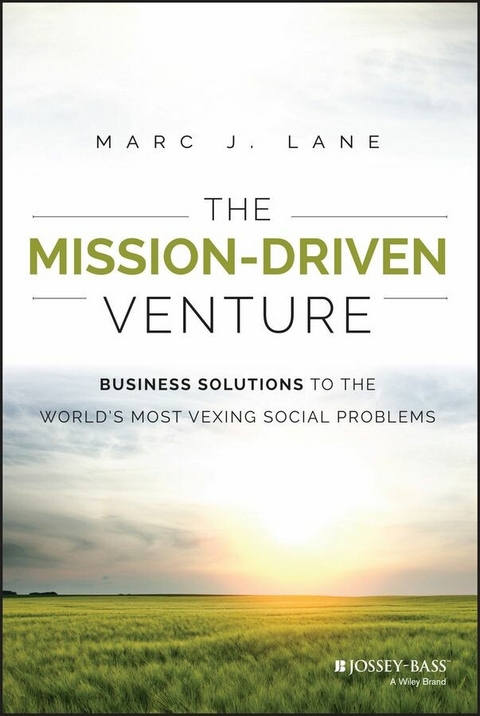
The Mission-Driven Venture (eBook)
John Wiley & Sons (Verlag)
978-1-118-41679-2 (ISBN)
The Mission-Driven Venture provides actionable guidance for leveraging the power of the marketplace to solve the world's most vexing social problems. Written by attorney and financial advisor Marc J. Lane, a renowned thought leader and expert on entrepreneurship, social enterprises, impact investing and entrepreneurial finance, this book reaches the full spectrum of interests represented at the intersection of business and social change. Whether a social entrepreneur, impact investor, socially conscious individual, or a nonprofit or foundation leader, any reader committed to social innovation can benefit from this practical roadmap to the rapidly developing arena of social enterprise.
Through real-world accounts of the journeys and successes of mission-driven ventures, Lane effectively illustrates the transformative potential of social enterprise, inspiring the reader to be an agent of change. Among the many tools offered through The Mission-Driven Venture, readers will:
- Find functional guidance to move from idea to reality with a step-by-step guide to designing and implementing a successful mission-driven venture
- Assess the benefits and challenges of the business models and entity choices available to the social entrepreneur
- Examine the entrepreneurial linkages between nonprofits and for-profits
- Recognize governance issues that can arise when mission and profit objectives clash, and discover tools for managing them
- Explore evolving trends and developments in financing social enterprise
- Discover methods and tools for measuring and reporting social impact
- Develop an effective strategy for achieving both financial success and meaningful social impact
Practical guidance to maximize financial results while driving positive social change The Mission-Driven Venture provides actionable guidance for leveraging the power of the marketplace to solve the world's most vexing social problems. Written by attorney and financial advisor Marc J. Lane, a renowned thought leader and expert on entrepreneurship, social enterprises, impact investing and entrepreneurial finance, this book reaches the full spectrum of interests represented at the intersection of business and social change. Whether a social entrepreneur, impact investor, socially conscious individual, or a nonprofit or foundation leader, any reader committed to social innovation can benefit from this practical roadmap to the rapidly developing arena of social enterprise. Through real-world accounts of the journeys and successes of mission-driven ventures, Lane effectively illustrates the transformative potential of social enterprise, inspiring the reader to be an agent of change. Among the many tools offered through The Mission-Driven Venture, readers will: Find functional guidance to move from idea to reality with a step-by-step guide to designing and implementing a successful mission-driven venture Assess the benefits and challenges of the business models and entity choices available to the social entrepreneur Examine the entrepreneurial linkages between nonprofits and for-profits Recognize governance issues that can arise when mission and profit objectives clash, and discover tools for managing them Explore evolving trends and developments in financing social enterprise Discover methods and tools for measuring and reporting social impact Develop an effective strategy for achieving both financial success and meaningful social impact
Marc J. Lane, a nationally recognized business and tax attorney and financial adviser, practices law at The Law Offices of Marc J. Lane, P.C. in Chicago (www.MarcJLane.com) and serves as the President of Social Enterprise Alliance's Chicago chapter. Marc is an expert on entrepreneurship and entrepreneurial finance, and an influential advocate of best corporate governance practices. Twice a recipient of the Illinois State Bar Association's Lincoln Award, Marc, a "Leading Illinois Attorney" and "Illinois Super Lawyer," has consistently earned an "AV¯® Preeminent¯(TM)" rating in the Martindale-Hubbell Legal Directory, the highest ranking awarded. Martindale-Hubbell also includes him in its Bar Registry of Preeminent Attorneys. By appointment of Illinois Gov. Pat Quinn, he chaired the state's Task Force on Social Innovation, Entrepreneurship, and Enterprise. An innovator in helping social enterprises, foundations, investors, lenders and philanthropists leverage capital to maximize financial results while driving positive social change, Marc has taught Social Enterprise at Northwestern University School of Law. He is also the pioneer behind the Advocacy Investing® approach to socially responsible and mission-related investing (www.AdvocacyInvesting.com). Marc drafted Illinois' and other states' Low-profit Limited Liability Company (L³C) legislation, which authorizes the new hybrid business form which can leverage foundations' program-related investments to access trillions of dollars of market-driven capital for ventures with modest financial prospects, but the possibility of major social impact. He continues to champion innovative social enterprise business forms and models throughout the nation. Marc is the author of 35 books, including Social Enterprise: Empowering Mission-Driven Entrepreneurs, published by the American Bar Association, and The Mission-Driven Venture: Business Solutions to the World's Most Vexing Social Problems, published by John Wiley and Sons. Marc is also an in-demand speaker. His latest keynote focuses on cutting-edge ways to solve some of our most intractable social problems--thanks to new funding and partnership models among impact investors, philanthropies, non-profits, and corporations.
Chapter 1
Nothing Stops a Bullet Like a Job
In the aftermath of the Great Recession, too many of us are living on the outskirts of hope. As public companies boast about record profits and the Dow sets all-time highs, the U.S. Census Bureau reports that more than one out of seven Americans lives in poverty. More than seventeen million American children—23.5 percent of all the nation's children—live in families with incomes below the federal poverty line, $23,550 a year for a family of four. The National Center for Children in Poverty reports that, on average, families need an income of about twice that amount just to cover the necessities of life.
No less alarming, a survey commissioned by the Associated Press in 2013 found that four out of five American adults struggle with joblessness, near-poverty, or reliance on welfare for at least some of their lives. They are collateral damage in any increasingly global economy that rewards the rich at the expense of the poor and no longer supports a robust manufacturing sector.
The tragedy of impoverished “sacrifice zones”—the post-industrial cities of Detroit, Michigan, and Camden, New Jersey, southern West Virginia's coal fields, and those native American reservations where the twin evils of unfettered expansion and unchecked exploitation keep old wounds unhealed—is spreading at an alarming pace throughout the nation.
But those who are born poor or fall into poverty needn't stay poor.
Breaking the cycle of poverty was once the exclusive domain of governments and charities. But, in recent years, “mission-driven ventures,” those organized specifically to do good work, have taken it upon themselves to rescue the poor, the sick, and the undereducated. Occupying the intersection of money and meaning, they use the power of the marketplace to advance their agendas without forcing their managers to make decisions solely to maximize profits, opting instead to be transparently accountable to all the ventures' stakeholders, society first among them. On an ever-greater scale, mission-driven ventures are helping to restore our fraying social fabric and to repair the world.
Take Juma Ventures, a model for entrepreneurial non-profits everywhere, whose visionary CEO, Dr. Marc Spencer, was selected in 2012 by the San Francisco Business Times as the Bay Area's most admired non-profit chief executive.
Juma's approach is elegant in its simplicity. The organization provides life-changing employment and educational opportunities to local youth who might otherwise remain forever disadvantaged. They grew up in the inner city, surrounded by violence, drugs, and dysfunction, and they see little reason for optimism. Eighteen percent of Juma's students have been arrested, 30 percent have a family member in jail, 20 percent are foster youth, and 61 percent are from single-parent households. The deck is heavily stacked against them in a society in which competition is everything and birthright too often dictates destiny.
Juma runs for-profit enterprises, not only to help fund its activities but also to improve the lives of the young people it serves. They are on the front lines of Juma's businesses. They work concessions selling hot dogs and ice cream at major sports arenas and ball parks in San Francisco, Oakland, San Diego, New Orleans, and Seattle. And, along the way, they gain a work ethic and see that all things are possible.
Juma's mission is to empower those they serve and to encourage their pursuit of a college education and the ticket it represents. In 2013, according to Juma, 685 young people who participated in Juma's programs worked shifts at 464 events, collectively earning $1,000,000 in wages and saving $238,000 for college, while learning money management, sales techniques, and communications skills. Through its Individual Development Account program, the first of its kind in the nation, Juma multiplies every dollar its beneficiaries save for college by a factor of two, three, or four, using funds from government grants and private donations. Those funds can be used only for college-related costs and are usually paid directly to colleges. Since the program was established in 1999, its participants have saved more than $783,000 in their Individual Development Accounts and earned nearly $960,000 in matching funds. What's more, Juma gives them critical financial literacy training, including budgeting and credit building. Without this knowledge, knowledge they might never have gained without Juma, they might never escape the cycle of poverty into which they were born.
Beyond helping young people earn money, learn how to manage it, and save for college, Juma helps them get into college and succeed once they're enrolled. The organization leads campus tours and helps its beneficiaries define their career paths, study for college entrance exams like the ACT and SAT, and complete applications for financial aid to cover expenses beyond the funds they receive from scholarships and their Individual Development Accounts. Juma also continues to support its students throughout the first two years of their college education by helping them navigate the student financial-aid system, meet their budgeting goals for college expenses, secure the academic advice they need, and, perhaps most important, know they have gained the support of an entire community of people who want nothing more than for them to succeed.
As Juma grad Cruz Ramirez, class of 2008, recounts, “Not only did I get into the university of my dreams, but I was also able to get it all together financially and emotionally and finally go. Juma staff was with me every step of the way.” Cruz's story is not unique, or even unusual. In 2011, every one of Juma's young people in the Bay Area graduated from high school. Ninety percent of those high school graduates went on to enroll in college, almost twice the national average of low-income high school graduates who move on to college. As this book goes to press, 83 percent of Juma graduates who started college three years ago are on track to graduate in four years. These numbers are a cause for celebration and a reason for emulation.
We begin with the story of Juma Ventures, not just because it is a mission-driven venture that has achieved enviable—and measurable—success, but also because Juma is a striking example for anyone who sees a problem—whether in his or her own community or in a community across the globe—and wants to take action to help solve it by attacking the problem at its source.
Since it began in 1993 by opening a single Ben and Jerry's Scoop Shop in San Francisco and hiring low-income young people to run it, Juma Ventures has been gnawing away at the root of poverty in America by helping young people from low-income families get a financial and college education and develop transferable job skills by running a profitable small business. All of these things will help them make better life decisions, keep them employed in good-paying jobs, and prevent them from slipping back into poverty. If they don't slip back into poverty, they won't depend for survival on government subsidy or private philanthropy.
This is not to suggest that traditional non-profit organizations—or social enterprises—should attack the source of the world's most challenging social problems, but ignore their symptoms. One million American children go to bed hungry, and fifty million Americans are unable to buy the food they need to stay healthy. So, clearly, traditional non-profits that focus on alleviating the symptoms of social problems (for example, by running soup kitchens or pay-what-you-can restaurants) are more important than ever.
What's so exciting about mission-driven ventures is that their potential is transformational. Organizations like Juma Ventures are game-changers. They do not make the condition of the disadvantaged more tolerable, but innovate and disrupt in ways that governments, philanthropies, and traditional non-profits simply cannot, given the challenges of public budget austerity and declining charitable giving. Juma's approach to combat the scourge of poverty is irresistible: give young people the tools they need to succeed in life and, when they do, encourage them to support Juma's programs by paying forward the life-changing kindness Juma showed them at a critical juncture in their development.
Now, for the first time, a Juma graduate sits on the organization's board of directors, and several other graduates help run Juma. The organization's goal is to have a graduate serve as its CEO within the next twenty years. If Juma and mission-driven ventures like it are able to continue to grow and replicate their tremendous success, they will significantly contribute to solving the world's most intractable social problems.
Juma's experience is a reflection of social and commercial enterprises' growing commitment to social accountability, environmental stewardship, and financial performance, the elusive new social compact that has been dubbed the “triple bottom line.”
“Father G” and Homeboy
Drive 350 miles south of Juma's headquarters, and you'll find Father Greg Boyle—“Father G” to some of the high-risk former gang members his Homeboy Industries employs, “G-Dog” to...
| Erscheint lt. Verlag | 17.12.2014 |
|---|---|
| Reihe/Serie | Wiley Nonprofit Authority |
| Wiley Nonprofit Authority | Wiley Nonprofit Authority |
| Sprache | englisch |
| Themenwelt | Wirtschaft ► Betriebswirtschaft / Management ► Planung / Organisation |
| Schlagworte | Advocacy Investing • Business & Management • Gemeinnützige Organisation • Gemeinnützige Organisationen / Management u. Führung • Gemeinnützige Organisation • Gemeinnützige Organisationen / Management u. Führung • Marc J. Lane • mission-based venture • nonprofit challenges • nonprofit earned revenue • nonprofit earned revenue case studies nonprofit funding tools • nonprofit enterprise • nonprofit enterprise examples • nonprofit funding • Nonprofit Governance • nonprofit income strategies • Non-Profit Organizations / Management Leadership • Social Enterprise Alliance • social enterprise strategy • Social Entrepreneurship • social outcome metrics • social value creation • The Mission-Driven Venture: Business Solutions and Earned Revenue Strategies for Nonprofits • Wirtschaft u. Management |
| ISBN-10 | 1-118-41679-1 / 1118416791 |
| ISBN-13 | 978-1-118-41679-2 / 9781118416792 |
| Informationen gemäß Produktsicherheitsverordnung (GPSR) | |
| Haben Sie eine Frage zum Produkt? |
 EPUB (Adobe DRM)
Kopierschutz: Adobe-DRM
Adobe-DRM ist ein Kopierschutz, der das eBook vor Mißbrauch schützen soll. Dabei wird das eBook bereits beim Download auf Ihre persönliche Adobe-ID autorisiert. Lesen können Sie das eBook dann nur auf den Geräten, welche ebenfalls auf Ihre Adobe-ID registriert sind.
Details zum Adobe-DRM
Dateiformat: EPUB (Electronic Publication)
EPUB ist ein offener Standard für eBooks und eignet sich besonders zur Darstellung von Belletristik und Sachbüchern. Der Fließtext wird dynamisch an die Display- und Schriftgröße angepasst. Auch für mobile Lesegeräte ist EPUB daher gut geeignet.
Systemvoraussetzungen:
PC/Mac: Mit einem PC oder Mac können Sie dieses eBook lesen. Sie benötigen eine
eReader: Dieses eBook kann mit (fast) allen eBook-Readern gelesen werden. Mit dem amazon-Kindle ist es aber nicht kompatibel.
Smartphone/Tablet: Egal ob Apple oder Android, dieses eBook können Sie lesen. Sie benötigen eine
Geräteliste und zusätzliche Hinweise
Buying eBooks from abroad
For tax law reasons we can sell eBooks just within Germany and Switzerland. Regrettably we cannot fulfill eBook-orders from other countries.
aus dem Bereich