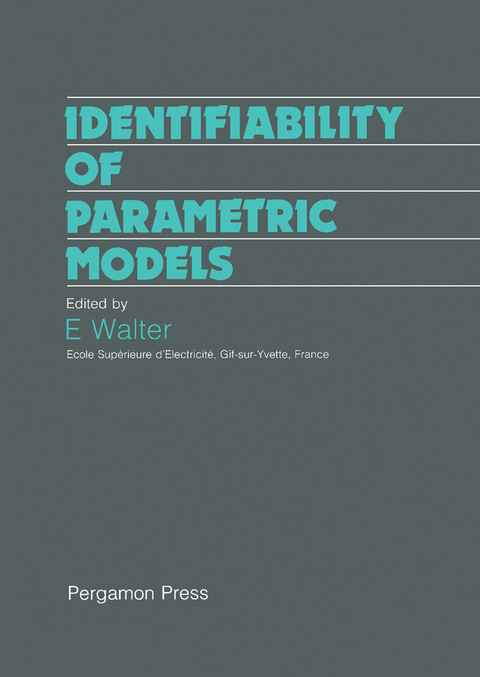
Identifiability of Parametric Models (eBook)
132 Seiten
Elsevier Science (Verlag)
978-1-4831-5595-1 (ISBN)
Identifiability of Parametric Models provides a comprehensive presentation of identifiability. This book is divided into 11 chapters. Chapter 1 reviews the basic methods for structural identifiability testing. The methods that deal with large-scale models and propose conjectures on global identifiability are considered in Chapter 2, while the problems of initial model selection and generating the set of models that have the exact same input-output behavior are evaluated in Chapter 3. Chapters 4 and 5 cover nonlinear models. The relations between identifiability and the well-posedness of the estimation problem are analyzed in Chapter 6, followed by a description of the algebraic manipulations required for testing a model for structural controllability, observability, identifiability, or distinguishability in chapter 7. The rest of the chapters are devoted to the relations between identifiability and parameter uncertainty. This publication is beneficial to students and researchers aiming to acquire knowledge of the identifiability of parametric models.
Front Cover 1
Identifiability of Parametric Models 4
Copyright Page 5
Table of Contents 8
FOREWORD 6
Part 1: Tutorial 14
CHAPTER 1. IDENTlFlABlLlTY OF MODEL PARAMETERS 14
1. Introduction 14
2 Basic concepts and identifiability analysis for noise-free linear time-invariant models 15
3 Complete models, general definitions and nonlinear systems 23
4 Parameter bounds for unidentifiable linear models 28
5 Numerical identifiability: is this really a new problem? 32
6 Concluding remarks 32
References 32
Part 2: Linear Models 34
CHAPTER 2: RESULTS AND CONJECTURESON THE IDENTlFlABlLlTY OF LINEAR SYSTEMS 34
1 Introduction 34
2 Equations derived from experimental data 34
3 Results on local identifiability 36
4 A particular result on global identifiability 39
5 Examples of the application of Conjecture 1 42
6 Examples of the application of Conjecture 2 43
7 Conclusion 43
References 44
CHAPTER 3: ON STRUCTURAL EQUIVALENCEAND IDENTIFIABILITY CONSTRAINT ORDERING 45
1 Introduction 45
2 Mathematical background 45
3 Structural equivalence 46
4 Exhaustive modelling 48
References 51
Appendix 52
Part 3: Nonlinear and Time-Varying Models 55
CHAPTER 4: IDENTIFIABILITY OF POLYNOMIAL SYSTEMS:STRUCTURAL AND NUMERICAL ASPECTS 55
1 Introduction 55
2 Deterministic identifiability: problem statement 55
3 Algebraic invariants for homogeneous polynomial models 56
4 Analysis of deterministic identifiability 57
5 Practical identifiability: problem statement 58
6 Principal component analysis of practical identifiability 59
7 A case study on methane pyrolysis 60
8 Conclusions 61
References 61
CHAPTER 5: VOLTERRA AND GENERATING POWER SERIES APPROACHESTO IDENTIFIABILITY TESTING 63
1 Introduction 63
2 Problem statement 63
3 Generating series approach 64
4 Volterra series approach 72
5 Conclusions 78
References 78
Part 5: Infinite-Dimensional Models 80
CHAPTER 6: IDENTIFIABILITY OF PARAMETERSIN THE OUTPUT LEAST SQUARE FORMULATION 80
1 Introduction 80
2 A sufficient condition for OLSI 84
3 Finite dimensional parameters 85
4 A weaker condition on the derivative 85
5 OLS-identifiability by regularization 87
References 87
Part 6: Computer Algebra 88
CHAPTER 7: THE TESTING OF STRUCTURAL PROPERTIESTHROUGH SYMBOLIC COMPUTATION 88
1 Introduction 88
2 Definitions and problem statement 88
3 Jacobian matrix and global injectivity 90
4 Methods for testing structural controllability and structural observability 90
5 Methods for testing structural identifiability 91
6 Methods for testing structural distinguishability 92
7 Solution of a set of polynomial equations 93
Conclusion 95
Appendix 1: Proof of reducing to zero 95
Appendix 2: Using REDUCE 96
References 97
Part 7: Identifiability and Parameter Uncertainty 98
CHAPTER 8: THEORETICAL ASPECTS AND PRACTICAL STRATEGIESFOR THE IDENTIFICATION OF UNIDENTIFIABLE COMPARTMENTAL SYSTEMS 98
1 Introduction 98
2 An unidentifiable model of glucose kinetics 98
3 Identifiability from parameter bounds 99
4 Identifiability using additional a priori knowledge 103
5 Conclusions 103
References 103
CHAPTER 9: IDENTIFIABILITY OF SYSTEMS WITH MODELING ERRORA NEW FORMULATION 105
1 Introduction 105
2 Statement of the problem 105
3 Bounds on the solution error 106
4 Identifiability of nearly-equivalent models 107
5 Conclusion 109
References 109
CHAPTER 10: APPLICATION TO HETEROGENEOUS CATALYSIS 110
1 Introduction 110
2 Listing of possible mechanisms 111
3 Compartmental models 111
4 Identifiability 112
5 Distinguishability 113
6 Membership set estimation 113
7 Discussion 115
8 Conclusions 115
References 115
CHAPTER 11 : ROBUST EXPERIMENT DESIGN:BETWEEN QUALITATIVE AND QUANTITATIVE IDENTIFIABILITIES 117
1 Introduction 117
2 Classical non-robust design 118
3 Classical robust approaches 118
4 Robust optimal design in the average sense 119
5 Robust optimal design in the min-max sense 124
6 Conclusions 125
References 125
Author Index 128
Subject Index 130
| Erscheint lt. Verlag | 23.5.2014 |
|---|---|
| Sprache | englisch |
| Themenwelt | Mathematik / Informatik ► Informatik ► Theorie / Studium |
| Naturwissenschaften | |
| Technik ► Maschinenbau | |
| Wirtschaft ► Betriebswirtschaft / Management ► Planung / Organisation | |
| ISBN-10 | 1-4831-5595-1 / 1483155951 |
| ISBN-13 | 978-1-4831-5595-1 / 9781483155951 |
| Informationen gemäß Produktsicherheitsverordnung (GPSR) | |
| Haben Sie eine Frage zum Produkt? |
 PDF (Adobe DRM)
Kopierschutz: Adobe-DRM
Adobe-DRM ist ein Kopierschutz, der das eBook vor Mißbrauch schützen soll. Dabei wird das eBook bereits beim Download auf Ihre persönliche Adobe-ID autorisiert. Lesen können Sie das eBook dann nur auf den Geräten, welche ebenfalls auf Ihre Adobe-ID registriert sind.
Details zum Adobe-DRM
Dateiformat: PDF (Portable Document Format)
Mit einem festen Seitenlayout eignet sich die PDF besonders für Fachbücher mit Spalten, Tabellen und Abbildungen. Eine PDF kann auf fast allen Geräten angezeigt werden, ist aber für kleine Displays (Smartphone, eReader) nur eingeschränkt geeignet.
Systemvoraussetzungen:
PC/Mac: Mit einem PC oder Mac können Sie dieses eBook lesen. Sie benötigen eine
eReader: Dieses eBook kann mit (fast) allen eBook-Readern gelesen werden. Mit dem amazon-Kindle ist es aber nicht kompatibel.
Smartphone/Tablet: Egal ob Apple oder Android, dieses eBook können Sie lesen. Sie benötigen eine
Geräteliste und zusätzliche Hinweise
Buying eBooks from abroad
For tax law reasons we can sell eBooks just within Germany and Switzerland. Regrettably we cannot fulfill eBook-orders from other countries.
aus dem Bereich