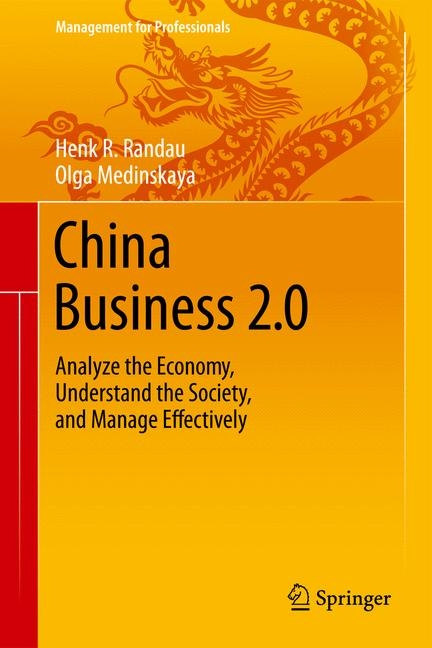
China Business 2.0 (eBook)
XXII, 237 Seiten
Springer International Publishing (Verlag)
978-3-319-07677-5 (ISBN)

Dr. Henk R. Randau has held various management positions such as General Manager and Chief Financial Officer, in subsidiaries of large multinational industrial companies. He lived and worked in Mainland China for several years. Dr. Randau studied business administration in Germany and the United States. He received his Ph.D. in economics from the Wissenschaftliche Hochschule fuer Unternehmensfuehrung (WHU), Germany and published papers in well-known business journals. He is also a business founder and supports entrepreneurs as a business angel.
Olga Medinskaya is a culture specialist who lived and worked for several years in Suzhou, China. She is the founder of an organization specializing in cultural training and experiences. Mrs. Medinskaya has been educated as an economist at the University of Mainz, Germany, where she earned her master's degree and at the University of Rostov, Russia, where she earned her bachelor's degree.
Dr. Henk R. Randau has held various management positions such as General Manager and Chief Financial Officer, in subsidiaries of large multinational industrial companies. He lived and worked in Mainland China for several years. Dr. Randau studied business administration in Germany and the United States. He received his Ph.D. in economics from the Wissenschaftliche Hochschule fuer Unternehmensfuehrung (WHU), Germany and published papers in well-known business journals. He is also a business founder and supports entrepreneurs as a business angel. Olga Medinskaya is a culture specialist who lived and worked for several years in Suzhou, China. She is the founder of an organization specializing in cultural training and experiences. Mrs. Medinskaya has been educated as an economist at the University of Mainz, Germany, where she earned her master’s degree and at the University of Rostov, Russia, where she earned her bachelor’s degree.
Acknowledgements 6
Abbreviations 8
Contents 12
List of Figures 14
List of Tables 16
List of Graphs 18
List of Contributors 20
Introduction 22
Part I: China 2.0: The New Stage 24
1: China 2.0 25
1.1 Reform Via a Step-by-Step Approach 25
1.2 The New Stage 27
Reference 31
2: China´s Maturing Economy 32
2.1 GDP by Sector 32
2.2 GDP by Origin 33
2.3 Productivity 33
2.4 Inward Foreign Direct Investment 37
2.5 Outward Foreign Direct Investment 38
References 40
3: The Economic Landscape 41
3.1 Significant Economic Differences Between Regions 41
3.2 Geographical Areas 41
3.3 Northeastern China 43
3.4 The Yangtze River Delta 43
3.5 The Pearl River Delta 44
3.6 Central and Western China 45
3.7 Special Administrative Regions 45
4: Domination of State-Owned Enterprises 47
5: Rebalancing the Economy: The 12th Five-Year Plan 50
5.1 Economic Restructuring 50
5.2 Strategic Industries and Innovation 52
5.3 Social Equity 52
5.4 Environmental Initiatives 53
6: Moving Forward: China´s Plan to Innovation 56
7: The Rising Middle Class 61
References 68
8: The Banking Sector 69
Reference 71
9: A Regulatory Challenge: The Chinese Stock Market 72
9.1 Share Classification 73
9.2 Reputation and Volatility 73
Reference 74
10: Internationalizing the RMB 75
11: China´s Infrastructure: An Overview 77
11.1 Railways 78
11.2 Roads and Expressways 79
11.3 Air Traffic 79
Part II: Challenges 80
12: Energy: Growth, Supplies, and Dependencies 81
Reference 82
13: Securing Resources: China´s Diminishing Supply 83
References 84
14: Intense Growth: The Environmental Impact 85
References 87
15: Demographic Dilemmas 88
15.1 One-Child Policy 88
15.2 Gender Imbalance 88
15.3 Aging Society 89
15.4 Workforce 89
Reference 90
16: Social Concerns 91
16.1 Abuse of Power and Status 91
16.2 Egoistic Culture 92
16.3 Food Concerns 93
16.4 Pollution 93
17: High Risk: China´s Real Estate 95
17.1 Land Use Rights 95
17.2 Economic Relevance 96
18: Urbanization: A Transforming Country 98
Reference 100
19: Unequal Wealth Distribution 101
20: China´s Evolving Social Welfare System 103
20.1 Pension 103
20.2 Healthcare 104
References 105
21: Corruption: Skating on Thin Ice 106
21.1 Bribery 106
22: Be Aware: Fraud Risks 111
References 116
23: A Snapshot on Mass Media 117
23.1 Print Media 117
23.2 TV and Radio 117
23.3 Internet and Social Networking 118
23.4 Control and Censorship 119
Part III: Doing Business 122
24: Understanding Entry Modes 123
25: China´s Tax Structure 127
25.1 Tax Legislation and Administration 127
25.2 Execution and Interpretation 127
25.3 Tax Treaties 128
26: Types of Taxes 130
26.1 Registration 130
26.2 Tax Incentives 130
26.3 Enterprise Income Tax 132
26.4 Withholding Tax (WHT) 133
26.5 Value Added Tax 134
26.5.1 The Golden Tax System 134
26.6 Business Tax 135
26.7 Consumption Tax (CT) (Table26.6) 136
26.8 Other Applicable Corporate Taxes 137
26.9 Individual Income Tax 139
26.10 Method of Calculating IIT 140
26.11 Foreign Individual Taxpayers 140
27: Passing Audits and Annual Examinations 143
27.1 Financial Statements Under the New CAS 144
28: Protecting Intellectual Property 149
28.1 Patents 151
28.2 Trademarks 151
28.3 Enforcement 152
29: Chinese Migrants: The Hukou System 158
30: Work Culture and Effective Management Style 160
31: Human Resource Challenges: Retention and Skills 166
31.1 Retention 166
31.2 Skills 167
32: Playing by the Rules: Employment Regulations 173
32.1 Recruitment 173
32.2 Labor Agreements 174
32.3 Wages, Benefits and Social Security 174
33: The Education System: The Big Picture 181
33.1 School Education 181
33.2 Higher Education 183
33.3 Learning and Pressure on Children 184
Reference 186
34: Chops: The Chinese Form of Signature 187
35: Negotiation: How to Make Deals in China 189
Part IV: The Chinese Way 193
36: China and the West 194
36.1 The First Emperor 194
36.2 Imperial China 194
36.3 Modern China 195
36.4 The People´s Republic of China 195
36.5 The New China 196
36.6 The Attitude Towards the West 196
37: Administrative Structure and Ethnic Groups 199
37.1 Administrative Structure 199
37.2 Ethnic Groups and Language 200
38: Political System: The One-Party Nation 201
38.1 Chinese Communist Party 201
38.2 State Government 202
38.3 National People´s Congress 203
38.4 People´s Liberation Army 203
39: Philosophy and Religion 205
39.1 Confucianism 205
39.2 Taoism 206
39.3 Legalism 206
40: The Importance of Family 207
40.1 Chinese Names 207
40.2 The Extended Family 208
41: From Collectivism to Individualism 209
References 212
42: Generations of Change 213
42.1 1950s and Older 213
42.2 1960s and 1970s 213
42.3 1980s and Younger 214
References 215
43: Etiquette: Dos and Don´ts 216
43.1 Meeting and Greeting 216
43.2 Body Language 217
43.3 Gift Giving 217
44: Chinese Festivals: Knowing the Roots 219
44.1 Moon Calendar 219
44.2 Chinese New Year (Chinese Spring Festival) 219
44.3 Moon Festival 221
45: Business Banquets 222
45.1 Timing 222
45.2 Seating 222
45.3 Structure 223
45.4 Toasting 224
45.5 Alcohol 224
45.6 Conversation 224
45.7 Payment 224
45.8 Table Manners in China 225
46: Social Concepts: Mianzi and Guanxi 227
46.1 Face (Mianzi) 227
46.2 Connection (Guanxi) 228
Index 229
| Erscheint lt. Verlag | 10.11.2014 |
|---|---|
| Reihe/Serie | Management for Professionals | Management for Professionals |
| Zusatzinfo | XXII, 237 p. 49 illus., 48 illus. in color. |
| Verlagsort | Cham |
| Sprache | englisch |
| Themenwelt | Wirtschaft ► Betriebswirtschaft / Management ► Personalwesen |
| Wirtschaft ► Betriebswirtschaft / Management ► Unternehmensführung / Management | |
| Schlagworte | Chinese Infrastructure • Corruption • Emerging Market Risk • International Management • Middle-Class • urbanization |
| ISBN-10 | 3-319-07677-9 / 3319076779 |
| ISBN-13 | 978-3-319-07677-5 / 9783319076775 |
| Informationen gemäß Produktsicherheitsverordnung (GPSR) | |
| Haben Sie eine Frage zum Produkt? |
 PDF (Wasserzeichen)
DRM: Digitales Wasserzeichen
Dieses eBook enthält ein digitales Wasserzeichen und ist damit für Sie personalisiert. Bei einer missbräuchlichen Weitergabe des eBooks an Dritte ist eine Rückverfolgung an die Quelle möglich.
Dateiformat: PDF (Portable Document Format)
Mit einem festen Seitenlayout eignet sich die PDF besonders für Fachbücher mit Spalten, Tabellen und Abbildungen. Eine PDF kann auf fast allen Geräten angezeigt werden, ist aber für kleine Displays (Smartphone, eReader) nur eingeschränkt geeignet.
Systemvoraussetzungen:
PC/Mac: Mit einem PC oder Mac können Sie dieses eBook lesen. Sie benötigen dafür einen PDF-Viewer - z.B. den Adobe Reader oder Adobe Digital Editions.
eReader: Dieses eBook kann mit (fast) allen eBook-Readern gelesen werden. Mit dem amazon-Kindle ist es aber nicht kompatibel.
Smartphone/Tablet: Egal ob Apple oder Android, dieses eBook können Sie lesen. Sie benötigen dafür einen PDF-Viewer - z.B. die kostenlose Adobe Digital Editions-App.
Buying eBooks from abroad
For tax law reasons we can sell eBooks just within Germany and Switzerland. Regrettably we cannot fulfill eBook-orders from other countries.
aus dem Bereich