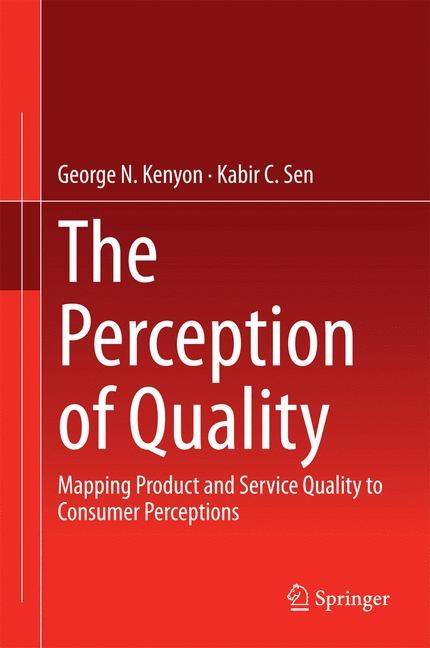
The Perception of Quality (eBook)
IX, 265 Seiten
Springer London (Verlag)
978-1-4471-6627-6 (ISBN)
Exploring the concept of quality management from a new point of view, this book presents a holistic model of how consumers judge the quality of products. It links consumer perceptions of quality to the design and delivery of the final product, and presents models and methods for improving the quality of these products and services. It offers readers an improved understanding of how and why the design process must consider how the consumer will perceive a product or service. In order to facilitate the presentation and understanding of these concepts, illustrations and case examples are also provided throughout the book.
This book provides an invaluable resource for managers, designers, manufacturers, professional practitioners and academics interested in quality management. It also offers a useful supplementary text for marketing and quality management courses.
Dr. George Kenyon is an Associate Professor of Operations and Supply Chain Management at Lamar University. He received his B.S. in Technology from the University of Houston in 1982, his M.S. in Management Science from Florida Institute of Technology in 1993, and his Ph.D. in Business Administration from Texas Tech University in 1997. His research and teaching interests are in the fields of supply chain management, quality management, project management and operations management. He has published in the International Journal of Production Economics, Journal of Manufacturing Technology Management, Journal of Marketing Channels, Quality Management Journal, International Journal of Information Systems and Supply Chain Management, and Journal of Case Studies in Accreditation and Assessment, as well as, several book chapters.
Prior to joining Lamar University's faculty, Dr. Kenyon spent eighteen years in industry with companies such as Texas Instruments, Rockwell International, The Boeing Company, Aspen Technologies, and Hewlett Packard. He has held positions in systems testing engineering, systems design, manufacturing engineering, manufacturing management, process improvement, and business planning. As a consultant, he has worked with Gulf States Steel, the Westlake Corporation, Miller Brewing, and Phillips Chemical designing and installing advanced planning and scheduling systems.
Dr. Kabir C. Sen is a Professor of Marketing and currently Chair of the Management and Marketing Department at Lamar University. He received his B.Tech. (Hons) degree in Metallurgical Engineering from the Indian Institute of Technology, Khargpur (India). He also has a MBA from the Cranfield School of Management (UK). In 1991, he received his Ph.D. in marketing from Washington University in St. Louis. His research interests include franchising, service design, health care marketing and sports economics. He has published in some of these areas in academic journals such as the Journal of Advertising Research, Journal of Consumer Marketing, Journal of Quantitative Analysis in Sports, International Journal of Pharmaceutical and Healthcare Marketing and Managerial and Decision Economics. He has also contributed chapters for academic books on a variety of topics.
Before joining academics, Dr. Sen worked as a senior metallurgist and later as the corporate planning officer for the former Indian subsidiary of GKN plc (UK).
Exploring the concept of quality management from a new point of view, this book presents a holistic model of how consumers judge the quality of products. It links consumer perceptions of quality to the design and delivery of the final product, and presents models and methods for improving the quality of these products and services. It offers readers an improved understanding of how and why the design process must consider how the consumer will perceive a product or service. In order to facilitate the presentation and understanding of these concepts, illustrations and case examples are also provided throughout the book.This book provides an invaluable resource for managers, designers, manufacturers, professional practitioners and academics interested in quality management. It also offers a useful supplementary text for marketing and quality management courses.
Dr. George Kenyon is an Associate Professor of Operations and Supply Chain Management at Lamar University. He received his B.S. in Technology from the University of Houston in 1982, his M.S. in Management Science from Florida Institute of Technology in 1993, and his Ph.D. in Business Administration from Texas Tech University in 1997. His research and teaching interests are in the fields of supply chain management, quality management, project management and operations management. He has published in the International Journal of Production Economics, Journal of Manufacturing Technology Management, Journal of Marketing Channels, Quality Management Journal, International Journal of Information Systems and Supply Chain Management, and Journal of Case Studies in Accreditation and Assessment, as well as, several book chapters.Prior to joining Lamar University’s faculty, Dr. Kenyon spent eighteen years in industry with companies such as Texas Instruments, Rockwell International, The Boeing Company, Aspen Technologies, and Hewlett Packard. He has held positions in systems testing engineering, systems design, manufacturing engineering, manufacturing management, process improvement, and business planning. As a consultant, he has worked with Gulf States Steel, the Westlake Corporation, Miller Brewing, and Phillips Chemical designing and installing advanced planning and scheduling systems.Dr. Kabir C. Sen is a Professor of Marketing and currently Chair of the Management and Marketing Department at Lamar University. He received his B.Tech. (Hons) degree in Metallurgical Engineering from the Indian Institute of Technology, Khargpur (India). He also has a MBA from the Cranfield School of Management (UK). In 1991, he received his Ph.D. in marketing from Washington University in St. Louis. His research interests include franchising, service design, health care marketing and sports economics. He has published in some of these areas in academic journals such as the Journal of Advertising Research, Journal of Consumer Marketing, Journal of Quantitative Analysis in Sports, International Journal of Pharmaceutical and Healthcare Marketing and Managerial and Decision Economics. He has also contributed chapters for academic books on a variety of topics.Before joining academics, Dr. Sen worked as a senior metallurgist and later as the corporate planning officer for the former Indian subsidiary of GKN plc (UK).
Contents 5
1 What is Quality? 10
References 13
2 Creating a Competitive Advantage 14
2.1 Understanding the Demand Landscape 15
2.2 Choosing the Competitive Space 16
2.3 Defining Competitive Advantage 17
2.4 Creating Competitive Advantage 18
2.4.1 Competitive Strategies 19
2.4.2 The Competitive Dilemma 21
3 The Value Proposition 22
3.1 Benefits and Sacrifices 22
3.2 Value and Motivation 23
3.2.1 Motivational Theories 23
3.2.1.1 The Drive Theory 23
3.2.1.2 The Field Theory 24
3.2.1.3 The Expectancy Theory 25
3.2.2 Types of Motivational Goals 26
3.2.3 The Dimensions of Value 29
3.2.4 Types of Value 30
3.3 Value-Creating Strategies 34
3.3.1 Creating Value in Manufacturing 35
3.3.2 Creating Value in Services 36
Reference 37
4 The Philosophy of Quality 38
4.1 Foundational Theories of Total Quality Management 39
4.1.1 W. Edward Deming 39
4.1.1.1 Deming’s Chain Reaction Theory 39
4.1.1.2 Deming’s Fourteen Points of Total Quality Management 41
4.1.1.3 Deming’s System of Profound Knowledge 43
4.1.2 Joseph Juran 44
4.1.3 Phillip Crosby 45
4.1.3.1 Crosby’s Cost of Quality 45
4.1.4 Armand Feigenbaum 47
4.1.5 Kaoru Ishikawa 48
4.2 Evolving the Philosophy of Quality 49
Reference 49
5 The Perception Process 50
5.1 The Psychology of Perception 50
5.1.1 The Features of Perception 51
5.1.1.1 Constancy 51
5.1.1.2 Grouping 51
5.1.1.3 Contrast Effects 52
5.1.1.4 Perceptual Learning 52
5.2 The Effects of Culture on Perception 52
5.3 Making Inferential Judgments 54
5.3.1 Inferential Biases 54
5.4 The Expectation Theory 55
5.4.1 The Trichotomy of Perception 56
5.4.1.1 Credence Properties 56
5.4.1.2 Search Properties 57
5.4.1.3 Experience Properties 59
6 The Aspects of Quality 60
6.1 The Five Aspects of Quality 61
6.2 Quality Management and the Customer 66
6.3 Quality Results and the Customer 68
6.4 A Framework for Quality 68
Reference 69
7 Organizational Dimensions of Quality 70
7.1 The Leadership Dimension 71
7.2 The Strategic Planning Dimension 73
7.3 The Information and Analysis Dimension 74
7.4 The Human Resource Management Dimension 77
7.5 The Process Management Dimension 78
7.6 The Innovation Dimension 79
7.6.1 Developing Organizational Creativity 81
7.6.2 The Work Environment 82
7.6.2.1 The Effects of Downsizing on Creativity 82
7.7 The Supplier Relationship Management Dimension 83
7.7.1 The Supplier Relationship Management Process 83
7.8 The Customer Relationship Management Dimension 84
7.8.1 Customer Relationship Management Process 84
7.9 The Organizational Culture Dimension 86
7.10 Implications for the Customer 87
References 89
8 Implementing Organizational Change 90
8.1 Organizational Improvement Methodologies 91
8.1.1 Organizational Climate 92
8.1.2 Organizational Culture 92
8.1.3 Organizational Structure 92
8.1.3.1 The Pre-bureaucratic Structure 93
8.1.3.2 The Bureaucratic Structure 93
8.1.3.3 The Post-bureaucratic Structure 93
8.1.3.4 The Functional Structure 94
8.1.3.5 The Divisional Structure 94
8.1.3.6 The Matrix Structure 94
8.1.3.7 The Flat Structure 95
8.1.3.8 Structural Characteristics 95
Formalization 95
Centralization 95
Specialization 96
8.1.4 Organizational Strategies 96
8.1.4.1 The Entrepreneurial Problem 96
8.1.4.2 The Engineering Problem 97
8.1.4.3 The Administrative Problem 97
8.1.4.4 Strategic Topologies 98
The Prospector Strategy 98
The Analyzer Strategy 98
The Low-cost Defender Strategy 99
The Differentiated Defender Strategy 99
8.2 Essential Elements for Change 99
8.2.1 Motivational Leadership 99
8.2.2 Intrinsic Motivation 100
8.2.2.1 Challenges 100
8.2.2.2 Curiosity 100
8.2.2.3 Control 100
8.2.2.4 Fantasy 101
8.2.2.5 Competition 101
8.2.2.6 Cooperation 101
8.2.2.7 Recognition 101
8.2.3 Extrinsic Motivation 102
8.2.3.1 Employee Motivation 102
8.2.3.2 Figuring Out What Motivates Others 102
8.2.4 Action Planning 103
8.2.4.1 Diagnosis 103
8.2.4.2 Action planning 103
8.2.4.3 Intervention 104
8.2.4.4 Evaluation 104
8.2.5 Performance Management 104
8.3 Driving the Change 104
8.3.1 Tools for Managing Organizational Change 105
8.3.1.1 FlowCharts 105
8.3.1.2 Process Mapping 106
8.3.1.3 Deployment Flow Charts 106
8.3.1.4 Critical Pathway Charts 107
Reference 108
9 Dimensions of Transformational Process Quality 109
9.1 The Capability Dimension 110
9.1.1 Process Capability Indices 110
9.2 The Capacity Dimension 113
9.2.1 Supply Issues in Capacity Management 113
9.2.2 Inventory Issues in Capacity Management 115
9.2.3 Reliability Issues in Capacity Management 116
9.3 The Flexibility Dimension 117
9.3.1 Flexibility Issues in Supply Chains 119
9.4 The Efficiency Dimension 120
9.5 The Conformance Dimension 121
9.6 The Inventory Management Dimension 122
9.7 The Cost Dimension 124
9.8 The Order-Handling Dimension 124
9.9 The Input Dimension 125
9.10 Implications to the Customer 125
References 126
10 Process Improvement Methods and Tools 127
10.1 Continuous Improvement 128
10.1.1 Reducing Variability 128
10.2 Improving Production Effectiveness 129
10.2.1 Measurement Problems 129
10.3 Improving Production Efficiency 131
10.4 Improving Productivity 132
10.5 Balancing Effectiveness, Efficiency, and Productivity 133
10.5.1 Using OEE to Drive Improvements 136
10.6 Process Improvement Methodologies 137
10.6.1 LeanJust-In-Time Management 137
10.6.1.1 Lean Thinking 137
10.6.1.2 Just-In-Time 141
10.6.2 Business Process Re-engineering 142
10.6.3 Agile Management 142
10.6.4 Six Sigma 142
10.6.4.1 The Define Phase 143
Define the Problem 143
Define the Business Case for the Project 143
Selecting the Project 144
Charter the Project 144
10.6.4.2 The Measure Phase 144
10.6.4.3 The Analyze Phase 145
10.6.4.4 The Improve Phase 145
10.6.4.5 The Control Phase 146
10.6.4.6 What Makes Six Sigma Work? 146
10.6.5 Quality Circles 146
10.6.6 Kaizen 147
10.6.7 Design of Experiments 147
References 148
11 The Dimensions of Supply Chain Quality 149
11.1 The Integration Dimension 151
11.1.1 Relationship Management (RM) 152
11.1.1.1 Customer Relationship Management (CRM) 152
11.1.1.2 Supplier Relationship Management (SRM) 152
11.1.1.3 Concurrent Engineering (CE) 152
11.1.1.4 Synchronization 153
11.1.1.5 Collaboration 154
11.1.1.6 Technology Management 154
11.2 The Process Management Dimension 155
11.3 The Product Life Cycle Management (PLM) Dimension 157
11.3.1 Stages of the Product Life cycle 157
11.3.1.1 Introduction Stage 157
11.3.1.2 Growth Stage 158
11.3.1.3 Maturity Stage 158
11.3.1.4 Decline Stage 158
11.3.2 The Logistics Dimension 158
11.3.3 The Timeliness Attribute 160
11.3.4 The Completeness Attribute 160
11.3.5 The Information Attribute 160
11.3.6 The Availability Attribute 161
11.3.7 The Flexibility Attribute 161
11.3.8 The Service Experience Attribute 161
11.3.9 The Warranties and Returns Attribute 162
11.3.10 The Cost Attribute 163
11.3.11 The Process Attribute 164
11.3.11.1 Outsourcing 164
11.4 Implications for the Customer 165
References 167
12 Implementing Change in the Supply Chain 168
12.1 Issues and Opportunities 169
12.2 Alignment of Product Types with Supply Chain Structure 171
12.3 Alignment of Supply with Demand 174
12.4 The Bullwhip Effect and Inventory Variance 175
12.4.1 Primary Causes of the Bullwhip Effect 175
12.4.2 Consequences of the Bullwhip Effect 177
12.4.2.1 Excessive Inventory 177
12.4.2.2 Inefficient Production 177
12.4.2.3 Increases of Cost 178
12.5 Counter Measures for the Bullwhip Effect 178
12.6 Implications 179
13 The Dimensions of Product Quality 180
13.1 The Performance Dimension 180
13.2 The Features Dimension 181
13.3 The Reliability Dimension 181
13.4 The Conformance Dimension 182
13.5 The Durability Dimension 182
13.6 The Serviceability Dimension 183
13.7 The Aesthetics Dimension 183
13.8 The Creativity Dimension 184
References 185
14 Product Design and Commercialization 186
14.1 The Perception of Product Quality 187
14.2 The Product Development Process 191
14.2.1 Generating Ideas 191
14.2.2 The Market Evaluation Stage 194
14.2.2.1 Identifying Customer Needs 194
14.2.2.2 Establishing Target Specifications 195
Quality Functional Deployment Framework 196
The House of Quality 197
Identifying Competitive Products 201
14.2.2.3 Generating the Product Concept 201
14.2.2.4 Refining Product Specifications 201
14.2.2.5 Performing the Economic Analysis 202
14.2.2.6 Finalizing the Development Plan 202
14.2.3 The Design Stage 202
14.2.3.1 Functional Design 203
14.2.3.2 Prototyping 205
14.2.3.3 Detailed Design 205
14.2.3.4 Design Verification and Testing 207
14.2.3.5 Packaging Design 207
14.3 Commercialization 207
14.4 Implications to the Customer 208
14.5 Product Improvement Methodologies 208
14.5.1 Function-Based Reviews 209
14.5.2 Value-Based Reviews 210
14.5.2.1 A Basic Approach to Value Analysis 211
14.5.2.2 Cost Versus Value 211
14.5.2.3 Issues Driving the Value Analysis Process 212
Design-Related Issues 212
Internal, Non-design-Related Issues 212
Market Sources 212
Best Practices 213
14.5.2.4 Implementing a Value Analysis Review 213
PHASE 1: Start–up Phase 213
Team Building 214
ProductService Selection 215
PHASE 2: Information Phase 216
PHASE 3: Function Analysis Phase 217
Describe the Functions 217
Rank the Functions Using Pairwise Comparison 217
PHASE 4: Creativity Phase 217
PHASE 5: Evaluation Phase 218
PHASE 6: Development Phase 218
PHASE 7: Presentation Phase 219
14.6 CASE: The Antler Shed 220
15 The Dimensions of Service Quality 222
15.1 The Reliability Dimension 222
15.1.1 Attributes of Reliability 223
15.2 The Responsiveness Dimension 223
15.2.1 Attributes of Responsiveness 224
15.3 The Assurance Dimension 224
15.3.1 Attributes of Assurance 225
15.4 The Empathy Dimension 225
15.4.1 Attributes of Empathy 226
15.5 The Tangibles Dimension 226
15.5.1 Attributes of Tangibility 226
15.6 The Ease-of-Use Dimension 227
15.6.1 Attributes of Ease of Use 228
16 Service System Design and Commercialization 229
16.1 The Perception of Service Quality 230
16.2 Moments of Truth 231
16.2.1 Precontact Awareness Phase 232
16.2.2 Customer Contact Phase 235
16.2.2.1 Initial Contact 235
16.2.2.2 Subsequent Contacts 237
16.3 A Framework for Service Design 243
16.3.1 Getting Information from the Consumer 243
16.3.2 Formulating Policies 244
16.3.3 Implementing Policies 246
16.3.4 Monitoring Consumer Perceptions 247
16.3.4.1 Striving for the “Sweet Spot” in Service Design 247
Reference 251
17 Integrating All the Components of Quality 252
17.1 The Product Offering as a Bundle of Attributes 252
17.2 Ascertaining Consumer Views 254
17.3 Bringing Ideas to Fruition 255
17.4 Quality as a Dynamic Concept 256
17.5 The Price–Quality Relationship 257
Bibliography 259
| Erscheint lt. Verlag | 25.11.2014 |
|---|---|
| Zusatzinfo | IX, 265 p. 53 illus. |
| Verlagsort | London |
| Sprache | englisch |
| Themenwelt | Technik ► Maschinenbau |
| Wirtschaft ► Betriebswirtschaft / Management ► Logistik / Produktion | |
| Wirtschaft ► Betriebswirtschaft / Management ► Marketing / Vertrieb | |
| Schlagworte | Customer Driven Design of Products and Services • Customer Perceptions • Dimensions of Quality • Quality Control, Reliability, Safety and Risk • Quality management • The Perception of Quality |
| ISBN-10 | 1-4471-6627-2 / 1447166272 |
| ISBN-13 | 978-1-4471-6627-6 / 9781447166276 |
| Informationen gemäß Produktsicherheitsverordnung (GPSR) | |
| Haben Sie eine Frage zum Produkt? |
 PDF (Wasserzeichen)
DRM: Digitales Wasserzeichen
Dieses eBook enthält ein digitales Wasserzeichen und ist damit für Sie personalisiert. Bei einer missbräuchlichen Weitergabe des eBooks an Dritte ist eine Rückverfolgung an die Quelle möglich.
Dateiformat: PDF (Portable Document Format)
Mit einem festen Seitenlayout eignet sich die PDF besonders für Fachbücher mit Spalten, Tabellen und Abbildungen. Eine PDF kann auf fast allen Geräten angezeigt werden, ist aber für kleine Displays (Smartphone, eReader) nur eingeschränkt geeignet.
Systemvoraussetzungen:
PC/Mac: Mit einem PC oder Mac können Sie dieses eBook lesen. Sie benötigen dafür einen PDF-Viewer - z.B. den Adobe Reader oder Adobe Digital Editions.
eReader: Dieses eBook kann mit (fast) allen eBook-Readern gelesen werden. Mit dem amazon-Kindle ist es aber nicht kompatibel.
Smartphone/Tablet: Egal ob Apple oder Android, dieses eBook können Sie lesen. Sie benötigen dafür einen PDF-Viewer - z.B. die kostenlose Adobe Digital Editions-App.
Buying eBooks from abroad
For tax law reasons we can sell eBooks just within Germany and Switzerland. Regrettably we cannot fulfill eBook-orders from other countries.
aus dem Bereich