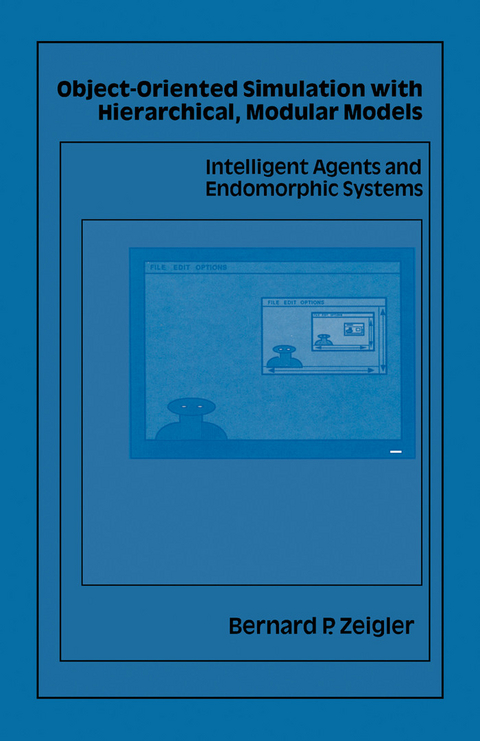
Object-Oriented Simulation with Hierarchical, Modular Models (eBook)
414 Seiten
Elsevier Science (Verlag)
978-1-4832-6491-2 (ISBN)
Bernard P. Zeigler, is a Professor of Electrical & Computer Engineering at the University of Arizona and co-director of the Arizona Center for Integrative Modeling and Simulation. He is the author of numerous books and publications, a Fellow of the IEEE, and of the Society for Modeling and Simulation International. Zeigler is currently heading a project for the Joint Interoperability Test Command (JITC) where he is leading the design of the future architecture for large distributed simulation events for the Joint Distributed Engineering Plant (JDEP). He is also developing DEVS-methodology approaches for testing mission thread end-to-end interoperability and combat effectiveness of Defense Department acquisitions and transitions to the Global Information Grid with its Service Oriented Architecture (GIG/SOA).
Object-Oriented Simulation with Hierarchical, Modular Models: Intelligent Agents and Endomorphic Systems describes an approach to object-oriented discrete event simulation and the concepts of hierarchical, modular model construction, The implementation of the concepts of multifaceted modeling methodology in the DEVS-Scheme modeling and simulation environment is discussed. The use of the DEVS-Scheme environment in modeling artificial intelligent agents is also considered, along with the concept of endomorphism to characterize the application of self-embedded models, including models of self. Comprised of 15 chapters, this book begins with an overview of the dimensions of knowledge representation in simulation environments, followed by a discussion on object-oriented programming as well as the concepts of modular, hierarchical models and the system entity structure. Subsequent chapters focus on digraph-models and experimental frames; DEVS formalism and DEVS-Scheme simulation environment; a model base for simple multi-computer architectures; and rule-based specification of atomic models. Model bases in endomorphic systems and intelligent agents are also examined. This monograph will be of interest to simulation theorists as well as practitioners and researchers in the fields of artificial intelligence, systems engineering, computer science and engineering, and operations research.
Front Cover 1
Object-Oriented Simulation with Hierarchical, Modular Models: Intelligent Agents and Endomorphic Systems 4
Copyright Page 5
Table of Contents 6
PREFACE 14
Chapter 1. DIMENSIONS OF KNOWLEDGE REPRESENTATION IN SIMULATION ENVIRONMENTS 22
1.1 Introduction 22
1.2 Knowledge Representation Schemes and Formalisms 23
1.3 Simulation Model Specification Formalisms 24
1.4 AI Knowledge Representation Schemes 24
1.5 Representation and Knowledge 26
1.6 System-theoretic Representation 28
1.7 Modular, Hierarchical Models and Object-Oriented Paradigms Contrasted 29
1.8 Framework for Knowledge Representation in Simulation 31
1.9 What Kinds of Modelling and Simulation Knowledge Are There? 32
1.10 Endomorphic Models, Simulations, and Agents 36
Chapter 2. BASICS 38
2.1 Object-Oriented Programming Concepts 38
2.2 The System Entity Structure/Model Base 47
2.3 Independent Testability 48
2.4 Artificial Worlds Example 53
2.5 SES Pruning and Model Synthesis 58
Chapter 3. DEVS FORMALISM AND DEVS-SCHEME 62
3.1 Discrete Event Dynamic Systems 62
3.2 Brief Review of the DEVS Formalism 65
3.3 Basic Models 69
3.4 Coupled Models 76
3.5 DEVS-Scheme Simulation Environment 79
Chapter 4. ATOMIC-MODELS: SIMPLE PROCESSOR EXAMPLE 90
4.1 Performance of Simple Architectures 91
4.2 A Simple Processor Model 93
4.3 Normal Form Atomic Model Specification 96
4.4 DEVS-Scheme Atomic Model Implementation of Simple Processor 98
4.5 Simulation of Atomic-Models 100
4.6 Stand-alone Testing of an Atomic Model 103
4.7 Simple Processor with Buffering and Random Processing Times 109
Chapter 5. DIGRAPH-MODELS AND EXPERIMENTAL FRAMES 110
5.1 Experimental Frame for Simple Computer Architectures 111
5.2 Development of Digraph-Models 115
5.3 Co-ordinator of Coupled-Models 126
5.4 Applicability of Frames to Models: Model Instrumentation 133
Chapter 6. A MODEL BASE FOR SIMPLE MULTI-COMPUTER ARCHITECTURES 138
6.1 Co-ordinators and Architectures 139
6.2 Testing the Architectures 162
Chapter 7. SYSTEM ENTITY STRUCTURES 166
7.1 System Entity Structure Definitions and Axioms 167
7.2 Using the System Entity Structure in DEVS-Scheme 170
7.3 System Entity Structure Organization of Model Bases 176
7.4 Operations on Hierarchical Model Structures: Flatting and Deepening 186
Chapter 8. ADVANCED DEVS CONCEPTS AND KERNEL-MODELS 190
8.1 More Advanced Processor Models 190
8.2 Kernel-Models: Homogeneous Structures 200
8.3 Example: Parallel Processor Broadcast Architecture 204
8.4 Methods Make-new and Make-class 211
8.5 System Entity Structure Representation of Kernel Models 213
8.6 Multilayered Models and Distributed Experimental Frames 221
Chapter 9. RULE-BASED SPECIFICATION OF ATOMIC-MODELS 226
9.1 Activities as Rules 226
9.2 Class Forward-Models 231
9.3 Inheritance and Specialization 237
9.4 Specialization and Multiple Entities 250
9.5 DEVS-Scheme Methodology Reviewed 252
Chapter 10. A ROBOT-MANAGED LABORATORY OF THE FUTURE 254
10.1 Multilevel Hierarchical Robot Model 256
10.2 Space Management for Mobile Components 259
10.3 Robot Cognition System 260
10.4 Robot-Managed Laboratory Model 268
Chapter 11. ENDOMORPHY: MODELS WITHIN INTELLIGENT AGENTS 270
11.1 Approach to Endomorphy: Multifacetted Modelling Methodology 273
11.2 Process Laboratory Model 275
11.3 Robot Models: Designing Model-Plan Units 277
11.4 DEVS Representation of Dynamic Systems 279
11.5 Obtaining the Characteristic Functions of the DEVS Model 283
11.6 Robot Fluid Handling MPUs 285
11.7 Table-Models: Deriving Internal Models from External Models 288
11.8 Windows in Table-Models: Parameter Sensitivity Analysis 293
Chapter 12. ENDOMORPHY: MODEL USAGE WITHIN INTELLIGENT AGENTS 296
12.1 Event-Based Control 296
12.2 Using DEVS Models of Processes to Construct Event-Based Control Models 300
12.3 Introspection and Super-Simulation 306
12.4 Table-Models: Command Sequence Planning 308
12.5 Breakdown Diagnosis 311
12.6 Testing MPU Designs 313
12.7 Summary: Methodology for Event-Based Control 313
Chapter 13. MODEL BASE MANAGEMENT AND ENDOMORPHIC SYSTEMS 320
13.1 Reuse of Pruned Entity Structures 321
13.2 Hierarchical Reuse of PES Versions 324
13.3 Partitioned System Entity Structures 325
13.4 Context Sensitive Pruning 326
13.5 Model Coherence and Context Sensitive Constraint Rules 328
13.6 Model Bases in Endomorphic Systems and Intelligent Agents 332
13.7 Minsky's Views on Models and Knowledge 337
Chapter 14. DEVS-SCHEME IN THE LARGER SCHEME OF THINGS 346
14.1 Layers of DEVS-Scheme 347
14.2 Other Properties, Other Views 355
Chapter 15. EPILOGUE: THE CHALLENGE OF HIGH AUTONOMY SYSTEMS 368
Appendix A: ADVANCED CONCEPTS AND FACILITIES 372
A.1 Continuous Model Extensions to DEVS-Scheme 372
A.2 Simulation of Multi-formalism Non-homogeneous Networks 374
A.3 Distributed Simulation of DEVS Models 375
A.4 Automated Hierarchical Model Simplification 377
..5 Variable Structure Models 379
A.6 Using Object-Oriented Concepts to Support Extensibility of Layer 1 with Respect to Layer 2 381
A.7 Converting Non-modular to Modular Form 382
Appendix B: DEVS AND GSMP: SOME RELATIONS 384
..1 Some Simple Behaviors of DEVS 385
B.2 Proof that the DEVS Behaviors Require Uncountable State Sets 386
B.3 Expressing GSMP within DEVS 387
Bibliography 390
Index 408
| Erscheint lt. Verlag | 10.5.2014 |
|---|---|
| Sprache | englisch |
| Themenwelt | Mathematik / Informatik ► Informatik ► Theorie / Studium |
| Naturwissenschaften | |
| Technik ► Maschinenbau | |
| Wirtschaft ► Betriebswirtschaft / Management ► Planung / Organisation | |
| ISBN-10 | 1-4832-6491-2 / 1483264912 |
| ISBN-13 | 978-1-4832-6491-2 / 9781483264912 |
| Informationen gemäß Produktsicherheitsverordnung (GPSR) | |
| Haben Sie eine Frage zum Produkt? |
 PDF (Adobe DRM)
Kopierschutz: Adobe-DRM
Adobe-DRM ist ein Kopierschutz, der das eBook vor Mißbrauch schützen soll. Dabei wird das eBook bereits beim Download auf Ihre persönliche Adobe-ID autorisiert. Lesen können Sie das eBook dann nur auf den Geräten, welche ebenfalls auf Ihre Adobe-ID registriert sind.
Details zum Adobe-DRM
Dateiformat: PDF (Portable Document Format)
Mit einem festen Seitenlayout eignet sich die PDF besonders für Fachbücher mit Spalten, Tabellen und Abbildungen. Eine PDF kann auf fast allen Geräten angezeigt werden, ist aber für kleine Displays (Smartphone, eReader) nur eingeschränkt geeignet.
Systemvoraussetzungen:
PC/Mac: Mit einem PC oder Mac können Sie dieses eBook lesen. Sie benötigen eine
eReader: Dieses eBook kann mit (fast) allen eBook-Readern gelesen werden. Mit dem amazon-Kindle ist es aber nicht kompatibel.
Smartphone/Tablet: Egal ob Apple oder Android, dieses eBook können Sie lesen. Sie benötigen eine
Geräteliste und zusätzliche Hinweise
Buying eBooks from abroad
For tax law reasons we can sell eBooks just within Germany and Switzerland. Regrettably we cannot fulfill eBook-orders from other countries.
aus dem Bereich