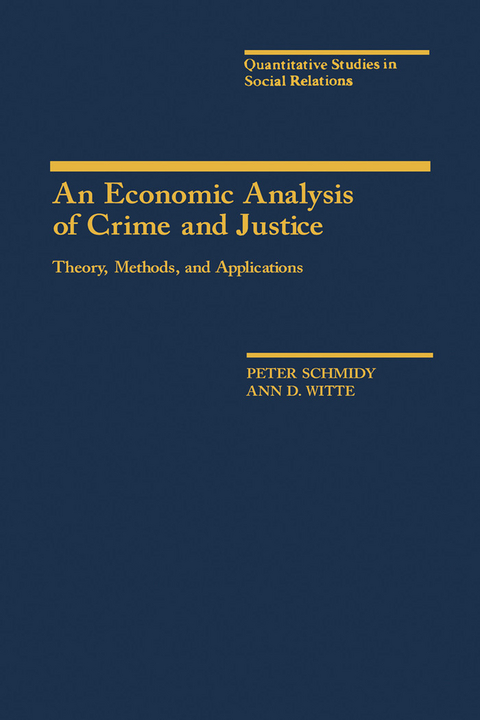
Economic Analysis of Crime and Justice (eBook)
430 Seiten
Elsevier Science (Verlag)
9781483272214 (ISBN)
An Economic Analysis of Crime and Justice: Theory, Methods, and Applications presents the applications of economic theory and econometric methods to various problems in criminology. The book is divided into three parts. Part I discusses models of criminal recidivism. The second part tackles the economic model of crime. Part III estimates cost functions for prisons. Specific chapters in the book cover topics on statistical analysis of qualitative outcomes; analysis of two measures of criminal activity: the arrest rate and the conviction rate; and long-run estimate of cost function for a group of Federal Correctional Institutions. Economists, correctional administrators, and criminal justice professionals will find the book a great source of information and insight.
Front Cover 1
An Economic Analysis of Crime and Justice: Theory, Methods, and Applications 4
Copyright Page 5
Table of Contents 6
Preface 12
Acknowledgments 14
Chapter 1. Introduction 16
Text 16
Parr I: Statistical Analyses of Recidivism 20
Text 20
Chapter 2. Statistical Analysis of Qualitative Outcomes 25
2.1. Introduction 25
2.2. Least Squares with Dummy Variables 26
2.3. The Logit Model 29
2.4. The Polytomous Logit Model 31
2.5. Logit Models with Only Qualitative Regressors 35
2.6. Probit Models 36
2.7. Discriminant Analysis versus Logit Analysis 38
Notes 40
Chapter 3. Logit Analysis of the Nature of Criminal Activity 41
3.1. Introduction 41
3.2. Data 42
3.3. Analysis of Seriousness of Criminal Activity 43
3.4. Further Results on Seriousness of Criminal Activity 50
3.5. Analysis of Type of Criminal Activity 52
3.6. Further Results on Type of Criminal Activity 58
3.7. Summary and Conclusions 59
Notes 61
Chapter 4. Statistical Analysis of Censored or Truncated Outcomes 63
4.1. Introduction 63
4.2. The Truncated Normal Model 65
4.3. The Censored Normal (Tobit) Model 68
4.4. A Two-Part Tobit Model 71
4.5. Sample Selection Model 73
4.6. The Simultaneous Tobit Model 75
4.7. Summary 76
Chapter 5. Tobit Analysis of the Total Length of Time Sentenced for Recidivist Offenses 78
5.1. Introduction 78
5.2. Analysis of the 1969 and 1971 Data 79
5.3. Analysis of the 1975 Data 85
5.4. Analysis of Subsamples of the 1975 Data 90
5.5. Summary and Conclusions 97
Notes 98
Chapter 6. Statistical Analysis of Survival Times 100
6.1. Introduction 100
6.2. The Exponential Case 104
6.3. The Lognormal Case 105
6.4. Split Population Models 107
6.5. The Hazard Rate 109
6.6. Heterogenity versus State Dependence 111
6.7. The Proportional Hazards Model 112
6.8. Summary and Conclusions 114
Notes 115
Chapter 7. Analysis of the Length of Time until Recidivism 116
7.1. Introduction 116
7.2. Analysis of the 1969 and 1971 Data 117
7.3. Analysis of the 1975 Data 125
7.4. Analysis of Subsamples of the 1975 Data 130
7.5. Summary and Conclusions 137
Notes 139
Chapter 8. Use of Models of Recidivism for Program Evaluation 140
8.1. Introduction 140
8.2. Techniques for Program Evaluation 141
8.3. The Program and the Data 143
8.4. Evaluation Based on Length of Time Sentenced 145
8.5. Evaluation Based on Length of Time until Recidivism 148
8.6. Summary and Conclusions 152
Notes 153
Part II: Testing the Economie Model of Crime 154
Text 154
Chapter 9. Economic Models of Criminal Behavior 157
9.1. Introduction 157
9.2. The Theory of Consumer Demand and Labor Supply 158
9.3. Behavior toward Risk 163
9.4. A Simple Economic Model of Crime 166
9.5. A Simple Model of the Allocation of Time to Crime 169
9.6. Another Time Allocation Model 172
9.7. A More Complex Model of the Allocation of Time 178
9.8. A Survey of Economic Models of Crime 180
9.9. Summary and Conclusions 197
Appendix 9.1. Derivation of Comparative Static Results for the Model of Section 9.5 199
Appendix 9.2. Analysis of a Model in Which Time Enters the Utility Function 204
Notes 208
Chapter 10. Estimating a Simple Economic Model of Criminal Behavior 209
10.1. Introduction 209
10.2. An Empirical Model of Criminal Activity 210
10.3. Estimates of a Model for All Criminal Behavior 216
10.4. Results for Specific Types of Offenses 221
10.5. Summary and Conclusions 226
Notes 230
Chapter 11. Labor Markets for Prison Releasees 232
11.1. Introduction 232
11.2. An Empirical Model of Postrelease Labor Market Performance 233
11.3. Empirical Results for Wages after Release 238
11.4. Empirical Results for Work Stability 242
11.5. An Assessment of the Evidence on Postrelease Labor Market Performance 246
11.6. Summary and Conclusions 251
Appendix 11.1. Comparison of Studies of Labor Market Performance of Prison Releases 253
Notes 263
Chapter 12. An Estimate of a Simultaneous Model of Criminal Behavior and Labor Market Success 264
12.1. Introduction 264
12.2. The Empirical Model 265
12.3. The Empirical Results 267
12.4. Summary and Conclusions 274
Notes 275
Part III: The Use of Production and Cost Theory in Criminal Justice Research 276
Text 276
Chapter 13. Modern Production and Cost Theory and Its Use in the Study of Production in Public Organizations 278
13.1. Introduction 278
13.2. The Basic Theory of Cost and Production 279
13.3. Some Extension of Cost and Production Theory 287
13.4. Adaptations of Simple Production and Cost Theory 292
13.5. Summary and Conclusions 294
Notes 295
Chapter 14. A Model of Costs for Large-Scale Prisons 296
14.1. Introduction 296
14.2. The Relationship of the Prison System to Other Organizations 297
14.3. The Goals of Prison Systems 299
14.4. What Is the Productive Unit and What Does It Produce? 303
14.5. A Long-Run Cost Model for Large-Scale Prisons 309
14.6. A Short-Run Cost Model for Large-Scale Prisons 321
14.7. Summary and Conclusions 326
Notes 327
Chapter 15. Short-Run Cost Functions for Large-Scale Prisons 330
15.1. Introduction 330
15.2. Empirical Results for Federal Prisons 331
15.3. Empirical Results for California Prisons 352
15.4. Policy Implications and Possible Uses of the Short-Run Results 358
15.5. Summary and Conclusions 361
Appendix 15.1. Determination of the Shape of the Average Cost Function for Two Specific Parametric Combinations 363
Notes 364
Chapter 16. Long-Run Cost Functions for Federal Correctional Institutions 366
16.1. Introduction 366
16.2. The Data 367
16.3. Empirical Results 368
16.4. Summary and Conclusions 376
Notes 378
Chapter 17. Summary and Conclusions 380
17.1. Introduction 380
17.2. Summary of Part I 380
17.3. Conclusions from Part I 386
17.4. Summary of Part II 388
17.5. Conclusions from Part II 392
17.6. Summary of Part III 393
17.7. Conclusions from Part III 395
17.8. General Conclusions 396
Appendix A: Description of the 1969 and 1971 North Carolina Department of Correction Data Set 398
Text 398
Appendix B: Description of the 1975 Data Set 401
Text 401
Appendix C: Description of Data Used to Estimate Cost Functions 406
C.1. The Data Available for the Federal Prison System 406
C.2. The Data Available for the California Prison System 409
C.3. Evaluation of the Data Bases 410
Notes 412
References 414
Index 426
| Erscheint lt. Verlag | 22.10.2013 |
|---|---|
| Sprache | englisch |
| Themenwelt | Recht / Steuern ► Strafrecht ► Kriminologie |
| Sozialwissenschaften ► Ethnologie | |
| Sozialwissenschaften ► Politik / Verwaltung | |
| Sozialwissenschaften ► Soziologie | |
| Wirtschaft | |
| ISBN-13 | 9781483272214 / 9781483272214 |
| Informationen gemäß Produktsicherheitsverordnung (GPSR) | |
| Haben Sie eine Frage zum Produkt? |
 PDF (Adobe DRM)
Kopierschutz: Adobe-DRM
Adobe-DRM ist ein Kopierschutz, der das eBook vor Mißbrauch schützen soll. Dabei wird das eBook bereits beim Download auf Ihre persönliche Adobe-ID autorisiert. Lesen können Sie das eBook dann nur auf den Geräten, welche ebenfalls auf Ihre Adobe-ID registriert sind.
Details zum Adobe-DRM
Dateiformat: PDF (Portable Document Format)
Mit einem festen Seitenlayout eignet sich die PDF besonders für Fachbücher mit Spalten, Tabellen und Abbildungen. Eine PDF kann auf fast allen Geräten angezeigt werden, ist aber für kleine Displays (Smartphone, eReader) nur eingeschränkt geeignet.
Systemvoraussetzungen:
PC/Mac: Mit einem PC oder Mac können Sie dieses eBook lesen. Sie benötigen eine
eReader: Dieses eBook kann mit (fast) allen eBook-Readern gelesen werden. Mit dem amazon-Kindle ist es aber nicht kompatibel.
Smartphone/Tablet: Egal ob Apple oder Android, dieses eBook können Sie lesen. Sie benötigen eine
Geräteliste und zusätzliche Hinweise
Buying eBooks from abroad
For tax law reasons we can sell eBooks just within Germany and Switzerland. Regrettably we cannot fulfill eBook-orders from other countries.
aus dem Bereich