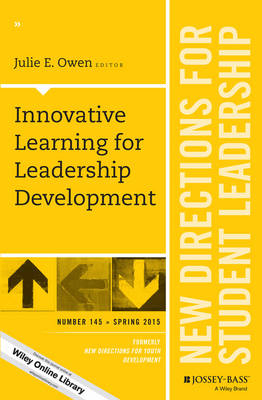
Innovative Learning for Leadership Development
Jossey-Bass Inc.,U.S. (Verlag)
978-1-119-06729-0 (ISBN)
- Titel ist leider vergriffen;
keine Neuauflage - Artikel merken
This volume examines:
the role of leadership educator,
the roles of authenticity (being true to one’s self) and criticality in education (interrogating beliefs and questioning power dynamics),
select learning theories and their implications for leadership learning, and
strategies for constructing leadership-related learning outcomes and assessing leadership learning.
The Jossey-Bass quarterly report series New Directions for Student Leadership explores leadership concepts and pedagogical topics of interest to high school and college leadership educators. Issues are grounded in scholarship and feature practical applications and best practices in youth and adult leadership education.
Volume Editor: Julie E. Owen is an associate professor of leadership and integrative studies and executive director of Social Action & Integrative Learning (SAIL) in New Century College at George Mason University. Series Editor: Susan R. Komives is Professor Emerita from the University of Maryland, co-founder of the National Clearinghouse for Leadership Programs and co-author or co-editor of a dozen books.
SERIES EDITORS’ NOTES 1
Susan R. Komives, Kathy L. Guthrie
EDITOR’S NOTES 5
Julie E. Owen
1. Transforming Leadership Development for Significant Learning 7
Julie E. Owen
Leadership education is undergoing a transformation where powerful pedagogies and emerging knowledge about the scholarship of teaching and learning supplant long held and often-outmoded practices of leadership education. This transformation requires new commitments to evidence-based practice, critical consciousness, and more complex understanding of the levers of leadership learning.
2. Building Critical Capacities for Leadership Learning 19
Mark Anthony Torrez, Melissa L. Rocco
Cognitive elements of transformational learning, particularly metacognition and critical self-reflection, are discussed as essential considerations for leadership development in the 21st century. The importance of
developmentally sequencing leadership-learning experiences and addressing evolving complexities of leadership identity are also explored.
3. Navigating Leadership Complexity Through Critical, Creative, and Practical Thinking 35
Jennifer M. Pigza
Leadership education that intentionally addresses critical, creative, and practical thinking enhances significant learning for students and deepens the leadership practices of educators. This chapter explores specific applications in the areas of graduate leadership education, action research, service immersion program, and advising conversations. Additionally, it presents a framework of pathways to social change and suggests how such a framework can be useful to students and leadership educators.
4. Integrative and Interdisciplinary Approaches to Leadership Development 49
Julie E. Owen
Integrating diverse conceptions of leadership across different disciplines, perspectives, and epistemologies is imperative if leaders are to operate in a global and networked world. Interdisciplinary and integrative leadership courses and digital learning communities are featured examples.
5. Valuing Human Significance: Connecting Leadership Development to Personal Competence, Social Competence, and Caring 59
Paige Haber-Curran, Scott J. Allen, Marcy Levy Shankman
This chapter examines humanistic ways of understanding learning; connects leadership learning to the concepts of personal competence, social competence, and caring; and introduces the model of emotionally intelligent leadership.
6. Connecting to Experience: High-Impact Practices for Leadership Development 71
Kerry L. Priest, Nicholas A. Clegorne
Leadership educators can leverage high-impact experiences to enhance student leadership development. This chapter describes three key practices—sociocultural conversations with peers, mentoring, and membership in off-campus organizations—as levers of leadership learning. Illustrations of the practice in context and reflections from practitioners and students are also included. The chapter concludes with considerations of context, developmental readiness, and best practices of experiential education.
7. Connecting to Communities: Powerful Pedagogies for Leading for Social Change 85
Wendy Wagner, Patricia Mathison
This chapter explores the use of powerful pedagogies such as servicelearning, cultural immersion, and community-based research to enhance leadership development. Four key principles are presented that
describe how leadership educators can facilitate community-based learning in a way that creates an optimal learning environment for students, while also engaging ethically with individuals and organizations in the community.
8. Formative Assessment as an Effective Leadership Learning Tool 97
J. Matthew Garrett, Jill M. Camper
Formative assessment can be a critical and creative practice in leadership education and significantly enhance student learning, leader development, and leadership development. This chapter seeks to frame the use of assessment as both a best practice in leadership education and as an integral component to effective leadership learning pedagogy.
INDEX 107
| Erscheint lt. Verlag | 2.3.2015 |
|---|---|
| Reihe/Serie | J-B SL Single Issue Student Leadership |
| Verlagsort | New York |
| Sprache | englisch |
| Maße | 150 x 229 mm |
| Gewicht | 136 g |
| Themenwelt | Sozialwissenschaften ► Pädagogik ► Bildungstheorie |
| Sozialwissenschaften ► Pädagogik ► Didaktik | |
| Wirtschaft ► Betriebswirtschaft / Management | |
| ISBN-10 | 1-119-06729-4 / 1119067294 |
| ISBN-13 | 978-1-119-06729-0 / 9781119067290 |
| Zustand | Neuware |
| Informationen gemäß Produktsicherheitsverordnung (GPSR) | |
| Haben Sie eine Frage zum Produkt? |
aus dem Bereich