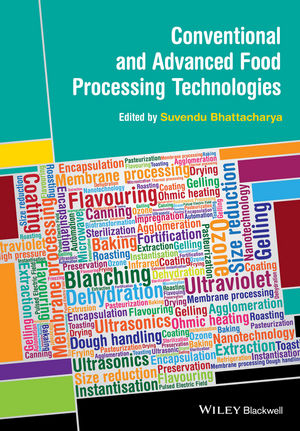
Food processing technologies are an essential link in the food chain. These technologies are many and varied, changing in popularity with changing consumption patterns and product popularity. Newer process technologies are also being evolved to provide the added advantages.
Conventional and Advanced Food Processing Technologies fuses the practical (application, machinery), theoretical (model, equation) and cutting-edge (recent trends), making it ideal for industrial, academic and reference use. It consists of two sections, one covering conventional or well-established existing processes and the other covering emerging or novel process technologies that are expected to be employed in the near future for the processing of foods in the commercial sector. All are examined in great detail, considering their current and future applications with added examples and the very latest data.
Conventional and Advanced Food Processing Technologies is a comprehensive treatment of the current state of knowledge on food processing technology. In its extensive coverage, and the selection of reputed research scientists who have contributed to each topic, this book will be a definitive text in this field for students, food professionals and researchers.
Dr Suvendu Bhattacharya is the Chief Scientist in the Food Engineering Department at the Central Food Technological Research Institute, Mysore, India.
Food processing technologies are an essential link in the food chain. These technologies are many and varied, changing in popularity with changing consumption patterns and product popularity. Newer process technologies are also being evolved to provide the added advantages. Conventional and Advanced Food Processing Technologies fuses the practical (application, machinery), theoretical (model, equation) and cutting-edge (recent trends), making it ideal for industrial, academic and reference use. It consists of two sections, one covering conventional or well-established existing processes and the other covering emerging or novel process technologies that are expected to be employed in the near future for the processing of foods in the commercial sector. All are examined in great detail, considering their current and future applications with added examples and the very latest data. Conventional and Advanced Food Processing Technologies is a comprehensive treatment of the current state of knowledge on food processing technology. In its extensive coverage, and the selection of reputed research scientists who have contributed to each topic, this book will be a definitive text in this field for students, food professionals and researchers.
Dr Suvendu Bhattacharya is the Chief Scientist in the Food Engineering Department at the Central Food Technological Research Institute, Mysore, India.
Chapter 1
Drying and Dehydration Processes in Food Preservation and Processing
Panagiotis A. Michailidis and Magdalini K. Krokida
Laboratory of Process, Analysis and Design, School of Chemical Engineering, National Technical University of Athens, Zografou, Greece
1.1 Introduction
Drying is the removal of a liquid from a material (usually consisting of a macromolecules matrix) and is one of the most important and oldest unit operations used for thousand years in a variety of materials, such as wood, coal, paper, biomass, wastes and foods. According to Ratti (2001), drying generally refers to the removal of moisture from a substance. In the case of food materials, the application of drying aims to reduce the mass and usually the volume of the product, which makes their transportation, storage and packaging easier and more economic, but most important is their preservation and to increase their shelf-life. This is particularly important for seasonal foods, as they become available for a much longer period after drying. As water content decreases due to drying, the rate of quality deteriorating reactions decreases as well or is even suspended, leading to a product that is microbiologically steady.
Drying provides the most diversity among food engineering unit operations as there are literally hundreds of variants actually used in drying particulate solids, pastes, continuous sheets, slurries or solutions. Each drying method and the specific process parameters selected can cause undesirable effects on the product, including shrinkage, case hardening, change of the porosity and porous size distribution, colour change, browning, loss of aromatic compounds, reduction of nutrient and functional molecules, and others.
The most important and widespread drying methods are discussed in the present chapter. Emphasis has been paid on the presentation of the effects of each technique on the properties (structural, nutritional, quality) of the food undergoing drying.
1.2 Drying kinetics
A convenient way to express the reduction of moisture content of a material during drying is to use a drying kinetic equation, which expresses the moisture content or moisture ratio as a function of time. Several drying equations have been presented in the literature (Estürk, 2012). The simplest of them is the exponential model or Lewis equation, which includes a constant, known as the drying constant. This is a phenomenological coefficient of heat and mass transfer. Drying kinetics replace the complex mathematical models for the description of the simultaneous heat and mass transport phenomena in the internal layers of the drying material and at the interface with the surrounding space. It is a function of the material characteristics (physical properties, dimensions) and the drying environment properties, including temperature, humidity and velocity of air, chamber pressure, microwave power, ultrasound intensity and other factors depending on the drying method(s) used. The drying constant is determined experimentally in a pilot plant dryer based on drying experiments of the examined material under different values of the drying parameters.
1.3 Different drying processes
1.3.1 Hot-air drying
Hot-air (or conventional) drying (HAD) is one of the oldest, most common and simplest drying methods for dewatering of food materials. Thus, it is frequently used to extend the shelf life of food products. It is one of the most energy-consuming food preservation processes, but its main disadvantage focuses on the drastically reduced quality of the hot-air treated foods compared to the original foodstuff. High temperatures during HAD have a great influence on colour degradation and the physical structure of the product, such as the reduction in volume, decrease in porosity (shrinkage) and increase in stickiness. This phenomenon takes place when the solid matrix of the material can no longer support its own mass. The phenomena underlying HAD outline a complex process involving simultaneous mass and energy (mainly heat) transport in a hygroscopic and shrinking system. The solid to be dried is exposed to a continuously flowing hot stream of air or inert fluid (, ) where moisture evaporates as heat is transferred to the food (Ratti, 2001).
During drying, evaporation of water desiccates the solid matrix of the food material and increases the concentration of solubles in the remaining solution. Changes in pH, redox potential and solubility may affect the structure and functionality of biopolymers, while in the final stages of drying phase transitions may occur. Increased concentration of solubles can promote chemical and enzymatic reactions due to higher concentrations of reagents and catalysts. The removed water is, at least partially, replaced by air and the contact with oxygen is substantially increased (Lewicki, 2006). The mechanisms related to the water movement include capillary forces, diffusion due to concentration gradients, flow due to pressure gradients or to vaporization and condensation of water, diffusion of water vapour in the pores filled with air and diffusion on the surface.
One of the most common dryers for many applications, including air drying of food materials, is the conveyor belt dryer, which is depicted schematically in Figure 1.1. Dryers of this type usually consist of sections placed in series, each of which includes a certain number of chambers. The conveyor belt is common for all the chambers of a section. The properties of drying air such as temperature and velocity in each chamber can be adjusted independently from the rest of the section's chambers by means of a heat exchanger and fan installed in each chamber. Additionally, the air circulation is also independent in each chamber and through the mixing of recirculated and fresh air to the proper ratio achieves the desired properties such as that of the air humidity. The dryer presented in Figure 1.1 is a one-section two-chamber dryer.
Figure 1.1 Representation of a one-section two-chamber conveyor belt dryer (, dry solids feed flow rate; , dry air flow rate exiting chamber after the splitter (this is equal to the fresh dry air flow rate entering chamber , where , 2 in the case of the presented dryer), , dry air flow rate passing through chamber ; , heat duty in chamber ; , initial solids temperature; , solids temperature exiting chamber ; , ambient air temperature; , air temperature exiting chamber ; , initial air temperature feeding in chamber ; , air temperature after the mixing of recirculated and fresh air in chamber ; , steam temperature in the exchanger of chamber ; , initial solids moisture content; , solids moisture content exiting chamber 1; , final solids moisture content; , ambient absolute humidity; , absolute humidity of air exiting chamber ; , absolute humidity of air feeding in chamber )
1.3.2 Vacuum drying
Vacuum drying (VD) is an efficient technique for reducing moisture content of heat-sensitive materials that may be changed or damaged if exposed to high temperature. Characteristics of VD are the high drying rate due to the low vapour pressure in the drying environment, the low drying temperature as the boiling point of water reduces with a pressure drop, the oxygen-deficient drying environment and the reduction of energy consumption. These characteristics contribute to conservation of qualities such as colour, shape, aroma, flavour and nutritive value of the dried product (Šumić et al., 2013) and induce degradation of nutritional compounds, oxidation of beneficial substances or formation of toxic compounds (Dueik, Marzullo and Bouchon, 2013). Due to molecular transport of evaporated water the process is long and can last up to 24 hours. Dry products are of very good quality but the shelf-life is dependent on the post-drying processes applied (Lewicki, 2006). VD is ideal in situations where a solvent must be recovered or when materials have to dry to very low levels of moisture.
Lee and Kim (2009) studied the drying kinetics of radish slices in a vacuum dryer at a pressure of 0.1 mPa. They observed the absence of a constant drying rate period. An increase in the drying temperature and a decrease in slice thickness caused a decrease in the drying time. The effective diffusivity varied from 6.92 to over the temperature range of 40–60 °C and followed an Arrhenius-type relationship.
Šumić et al. (2013) investigated VD of frozen sour cherries in order to optimize the preservation of health-beneficial phytochemicals, as well as the textural characteristics. The optimum conditions of 54 °C and 148 mbar were established for VD of the food material considering the maximum amount of total phenolics content, vitamin C, anthocyanin and maximum antioxidant activity and the minimum total colour change, value and firmness of the product. Under optimal conditions, the value of the following quality indicators of dried sour cherry was predicted: total phenolics was 744 mg CAE (chlorogenic acid equivalents)/100 g dry weight (d.w.), vitamin C 1.44 mg/100 g d.w., anthocyanin content 125 mg/100 g d.w., antioxidant activity IC50 3.23 mg/ml, total solids 70.72%, water activity value 0.65, total colour change 52.61 and firmness 3395.4 g.
1.3.3 Microwave drying
Microwave drying (MWD) results in the dewatering of a food material by heating it in a microwave oven using microwave energy, which is an electromagnetic radiation in the frequency range between 3 MHz and 30 000 GHz. The main factors affecting this method include sample mass, microwave power...
| Erscheint lt. Verlag | 26.9.2014 |
|---|---|
| Sprache | englisch |
| Themenwelt | Naturwissenschaften ► Biologie |
| Technik ► Lebensmitteltechnologie | |
| Wirtschaft ► Betriebswirtschaft / Management | |
| Weitere Fachgebiete ► Land- / Forstwirtschaft / Fischerei | |
| Schlagworte | advantages • application • Chain • consists • Conventional • essential link • Food • food engineering • Food Processing, Production & Manufacture • Food Science & Technology • Food Science & Technology Special Topics • Herstellung u. Verarbeitung von Lebensmitteln • Ideal • Industrial • Lebensmittelforschung u. -technologie • Lebensmitteltechnik • Lebensmittelverarbeitung • many • newer process • Novel • popularity • Practical • Process • processes • sections • Spezialthemen Lebensmittelforschung u. -technologie • Technologies • two • wellestablished |
| ISBN-10 | 1-118-40630-3 / 1118406303 |
| ISBN-13 | 978-1-118-40630-4 / 9781118406304 |
| Informationen gemäß Produktsicherheitsverordnung (GPSR) | |
| Haben Sie eine Frage zum Produkt? |
 EPUB (Adobe DRM)
Kopierschutz: Adobe-DRM
Adobe-DRM ist ein Kopierschutz, der das eBook vor Mißbrauch schützen soll. Dabei wird das eBook bereits beim Download auf Ihre persönliche Adobe-ID autorisiert. Lesen können Sie das eBook dann nur auf den Geräten, welche ebenfalls auf Ihre Adobe-ID registriert sind.
Details zum Adobe-DRM
Dateiformat: EPUB (Electronic Publication)
EPUB ist ein offener Standard für eBooks und eignet sich besonders zur Darstellung von Belletristik und Sachbüchern. Der Fließtext wird dynamisch an die Display- und Schriftgröße angepasst. Auch für mobile Lesegeräte ist EPUB daher gut geeignet.
Systemvoraussetzungen:
PC/Mac: Mit einem PC oder Mac können Sie dieses eBook lesen. Sie benötigen eine
eReader: Dieses eBook kann mit (fast) allen eBook-Readern gelesen werden. Mit dem amazon-Kindle ist es aber nicht kompatibel.
Smartphone/Tablet: Egal ob Apple oder Android, dieses eBook können Sie lesen. Sie benötigen eine
Geräteliste und zusätzliche Hinweise
Buying eBooks from abroad
For tax law reasons we can sell eBooks just within Germany and Switzerland. Regrettably we cannot fulfill eBook-orders from other countries.
aus dem Bereich