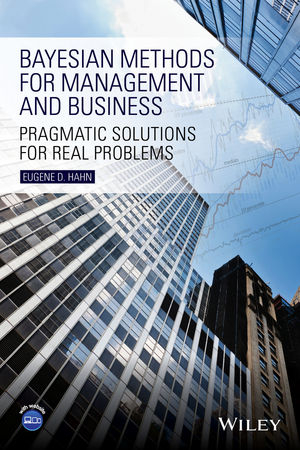
Bayesian Methods for Management and Business (eBook)
John Wiley & Sons (Verlag)
978-1-118-63756-2 (ISBN)
HIGHLIGHTS THE USE OF BAYESIAN STATISTICS TO GAIN INSIGHTS FROM EMPIRICAL DATA
Featuring an accessible approach, Bayesian Methods for Management and Business: Pragmatic Solutions for Real Problems demonstrates how Bayesian statistics can help to provide insights into important issues facing business and management. The book draws on multidisciplinary applications and examples and utilizes the freely available software WinBUGS and R to illustrate the integration of Bayesian statistics within data-rich environments.
Computational issues are discussed and integrated with coverage of linear models, sensitivity analysis, Markov Chain Monte Carlo (MCMC), and model comparison. In addition, more advanced models including hierarchal models, generalized linear models, and latent variable models are presented to further bridge the theory and application in real-world usage.
Bayesian Methods for Management and Business: Pragmatic Solutions for Real Problems also features:
- Numerous real-world examples drawn from multiple management disciplines such as strategy, international business, accounting, and information systems
- An incremental skill-building presentation based on analyzing data sets with widely applicable models of increasing complexity
- An accessible treatment of Bayesian statistics that is integrated with a broad range of business and management issues and problems
- A practical problem-solving approach to illustrate how Bayesian statistics can help to provide insight into important issues facing business and management
Bayesian Methods for Management and Business: Pragmatic Solutions for Real Problems is an important textbook for Bayesian statistics courses at the advanced MBA-level and also for business and management PhD candidates as a first course in methodology. In addition, the book is a useful resource for management scholars and practitioners as well as business academics and practitioners who seek to broaden their methodological skill sets.
Eugene D. Hahn, PhD, is Associate Professor in the Department of Information and Decision Systems in the Franklin P. Perdue School of Business at Salisbury University. He has published in leading business and management journals as well as in statistical journals that discuss Bayesian methods.
Eugene D. Hahn, PhD, is Associate Professor in the Department of Information and Decision Systems in the Franklin P. Perdue School of Business at Salisbury University. He has published in leading business and management journals as well as in journals that discuss Bayesian methods.
Chapter 1
Introduction to Bayesian Methods
1.1 Bayesian Methods: An Aerial Survey
The modern business environment is awash in data. As a result, managers seek ways to summarize and simplify data to emphasize a select number of key aspects. They may also wish to examine whether certain kinds of structure and patterns are present in the data. Or, they may wish to use data to draw conclusions about other kinds of unobserved or latent phenomena they believe exist with respect to their businesses, customers, materials, and so on. These kinds of activities managers undertake are not mutually exclusive, but rather emphasize different aspects of the data discovery process.
Statistical methods are some of the most widely-used methods for data discovery. Many managers who have gone through an undergraduate or graduate business education will have encountered some of these methods. The methods that are typically taught to managers are called classical statistical methods. Classical methods are also known as frequentist methods because they derive from a frequency-based view of probability. Classical methods can be summarized as statistical methods that can be arrived at based on consideration of the likelihood function alone (Fisher, 1922). These include the familiar -test, simple linear regression, and logit analysis by maximum likelihood. The likelihood function can be thought of as the “data function” since it quantifies the relative likelihood of parameter values in the data we have observed. The likelihood function allows the manager to summarize or estimate unknown parameters such as the lifetime value of a customer or the average failure rate of an important component.
In addition to the likelihood function, Bayesian methods also incorporate a prior distribution for parameters. If the manager has preexisting beliefs about parameters, such as an intuition about the average failure rate of a component, he/she can often express this in terms of a probability distribution. Having done so, Bayesian methods can proceed and the final results (summarized by the posterior distribution) will contain a blend of the information arising from the prior (i.e., from personal beliefs) and from the likelihood function (i.e., from the data). This blend will reflect the relative weight of information arising from the two sources. For example, if the prior is extremely concentrated, very large quantities of discrepant data will be required in order to produce a substantive change in the parameter estimate. No doubt you have met someone at some point in your life whose prior beliefs about something were rather difficult to change even with substantial evidence, and this is conceivably possible with the Bayesian approach as well. More commonly, however, a manager or researcher willadopt what is called a non-informative prior. Such priors are designed to have little effect on the conclusions that would be drawn from the data, and hence reflect an “open-mindedness” about the data in the sense that a broad range of values would be considered reasonably possible. Given the practical emphasis of business and management, these diffuse priors are almost always employed when one is interested in understanding the data because there is little point in analyzing data if we already wish to retain our preconceived notions. However, there are situations where one needs to be more careful about the impact of the prior, and the most common of these is the situation where the sample size is small. Since the posterior distribution reflects the relative weight of the data and the prior, we must exercise care when the data influence is light due to its scarcity (of course, we would also want to draw conclusions cautiously if classical methods were used with small samples).
The use of the prior distribution is an important differentiating aspect between Bayesian and classical methods. Historically it has also been a major point of contention (Gelman and Robert, 2013), with proponents of opposing viewpoints trading critiques (e.g., see) Edwards, 1972, ch. 4, for an example of a critique of the Bayesian approach). Another historical challenge for the Bayesian approach has been mathematical. As will be shown in Chapter 2, substantive Bayesian methods require the evaluation of integrals, and, for complex or nonstandard problems this can be difficult, tedious, or worse. Earlier Bayesian reference texts such as those by Zellner (1971) and Box and Tiao (1973) show that much can be accomplished in the Bayesian context when one had the requisite mathematical background. However, the twin barriers of skepticism regarding priors and mathematical difficulty made the application of Bayesian methods less common for many years. The popularization of Markov chain Monte Carlo (MCMC) methods (Gelfand et al., 1990, 1992) dramatically reduced the latter barrier. MCMC also provided researchers with a powerful tool that could be effectively wielded against complex and/or nonstandard problems. This raw power enabled individuals with a knowledge of Bayesian methods to examine important problems in new and revealing ways.
Businesses have been also able to take advantage of the benefits offered by Bayesian methods. For example, Medtronic was able to shorten the Federal Drug Administration (FDA) approval timeline for the development of a therapeutic strategy for a spinal-stabilizing device (Lipscomb et al., 2005). TransScan Medical was able to establish efficacy of its T-Scan 2000 device for mammography with a smaller sample size by incorporating prior information from previous studies (FDA, 1999). Enterprise software by Autonomy used Bayes’ rule to uncover patterns in large corporate databases and has been deployed to unravel the events that occurred prior to the collapse of Enron as well as to detect terrorists fildes10. The creators of the Web site homeprice.com.hk used Bayesian hierarchical models to provide consumers with pricing information on over 1 million residential real estate properties in Hong Kong and surrounding areas (Shamdasani, 2011). The energy industry has used Bayesian methods to understand petroleum reservoir parameters (Glinsky and Gunning, 2011) and update uncertainty regarding possible failures in underground pipelines (Francis, 2001). Finally, recent Bayesian work by Denrell et al. (2013) suggests that long-term superior corporate performance may depend considerably on early fortunate outcomes.
In a few management disciplines, particularly marketing (Rossi et al., 1996; Arora et al., 1998; Ansari et al., 2000; Rossi et al., 2005), Bayesian methods have been extensively and fruitfully applied. However, in many others, their full potential has yet to be realized. In part, this may be due to a lack of material showing the relevance of Bayesian statistics to a variety of business disciplines. This book aims to fill this gap.
1.1.1 Informal Example
We can begin with an informal example from a small business. Suppose you are a restaurant owner who wants to estimate how much a diner spends on average. Initially, based on a hunch, you estimate that the average is about $25. Following up on your hunch, you pick a random day and obtain the data on how much each diner has spent. You calculate the average for the data and find the sample average is $28.23. Based on this, you might intuitively update your initial estimate. You might revise your estimate to $28 as a compromise between your hunch and the data. Your hunch comes from your informal assessment over a long period, so you wouldn't want to completely discard it. However, the data seems to indicate that your hunch may have been a little on the low side.
We can try that process again in a slightly more sophisticated manner. Suppose your hunch was that the average amount spent was $25 and that you're fairly sure that the average will be within $5 of that. By “fairly sure” you mean that you think there is about a 95% chance that the average amount spent will be between $20 and $30. Suppose you think that the average amount spent approximately follows a normal distribution. You do a back-of-the-envelope calculation based on the normal distribution. You recall that the 95% central probability interval for the normal distribution uses the formula where is the standard deviation. A side calculation shows that, if , then the 95% probability interval for the normal distribution is . You decide that sounds reasonable here.
The Bayesian terminology for your hunch is the prior. More formally, this is called prior distribution since we were able to represent your beliefs with a statistical distribution. Your final estimate of $28 involves what is called the posterior in Bayesian terminology. You used empirical data to update your prior and came up with a revision, the posterior. Your intuitive update method is similar to what happens when we formally apply Bayes’ theorem. A formal application of Bayes’ theorem will give you a posterior distribution. The posterior distribution depends on both the prior and the data. The posterior distribution combines both sources of information in a sort of “weighted average” of the information available. If there is alot of data and little prior information, the posterior distribution will be heavily influenced by the data. Conversely, if there is little data but the prior belief is strong, the posterior distribution will tend to look like the prior distribution.
1.2 Bayes’ Theorem
Bayesian methods utilize a formula obtained by an...
| Erscheint lt. Verlag | 2.9.2014 |
|---|---|
| Sprache | englisch |
| Themenwelt | Mathematik / Informatik ► Mathematik ► Finanz- / Wirtschaftsmathematik |
| Mathematik / Informatik ► Mathematik ► Statistik | |
| Mathematik / Informatik ► Mathematik ► Wahrscheinlichkeit / Kombinatorik | |
| Technik | |
| Wirtschaft | |
| Schlagworte | Bayesian analysis • Bayes-Verfahren • business • Business & Management • decision science</p> • Decision Sciences • <p>Bayesian methods • Management • Mathematics • Mathematik • Operations Research & Management Science • R • Statistics • Statistik • Theorie der Entscheidungsfindung • Unternehmensforschung u. Betriebswirtschaft • WinBUGS • Wirtschaft u. Management |
| ISBN-10 | 1-118-63756-9 / 1118637569 |
| ISBN-13 | 978-1-118-63756-2 / 9781118637562 |
| Informationen gemäß Produktsicherheitsverordnung (GPSR) | |
| Haben Sie eine Frage zum Produkt? |
 EPUB (Adobe DRM)
Kopierschutz: Adobe-DRM
Adobe-DRM ist ein Kopierschutz, der das eBook vor Mißbrauch schützen soll. Dabei wird das eBook bereits beim Download auf Ihre persönliche Adobe-ID autorisiert. Lesen können Sie das eBook dann nur auf den Geräten, welche ebenfalls auf Ihre Adobe-ID registriert sind.
Details zum Adobe-DRM
Dateiformat: EPUB (Electronic Publication)
EPUB ist ein offener Standard für eBooks und eignet sich besonders zur Darstellung von Belletristik und Sachbüchern. Der Fließtext wird dynamisch an die Display- und Schriftgröße angepasst. Auch für mobile Lesegeräte ist EPUB daher gut geeignet.
Systemvoraussetzungen:
PC/Mac: Mit einem PC oder Mac können Sie dieses eBook lesen. Sie benötigen eine
eReader: Dieses eBook kann mit (fast) allen eBook-Readern gelesen werden. Mit dem amazon-Kindle ist es aber nicht kompatibel.
Smartphone/Tablet: Egal ob Apple oder Android, dieses eBook können Sie lesen. Sie benötigen eine
Geräteliste und zusätzliche Hinweise
Buying eBooks from abroad
For tax law reasons we can sell eBooks just within Germany and Switzerland. Regrettably we cannot fulfill eBook-orders from other countries.
aus dem Bereich