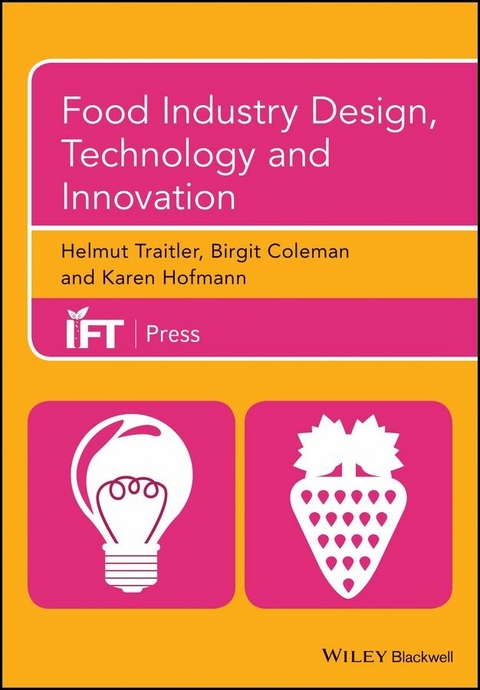
Food Industry Design, Technology and Innovation (eBook)
John Wiley & Sons (Verlag)
978-1-118-82334-7 (ISBN)
But now design is impacting more dramatically on the complex web that makes up our food supply, and beginning to make it better. Ways of thinking about design have broad applications and are becoming central to how companies compete. To succeed, food designers need to understand consumers and envision what they want, and to use technology and systems to show they can deliver what has been envisioned. They also need to understand organizations in order to make innovation happen in a corporation.
The authors of this book argue that design has been grossly underestimated in the food industry. The role of design in relation to technology of every kind (materials, mechanics, ingredients, conversion, transformation, etc.) is described, discussed, challenged and put into proper perspective. The authors deftly analyze and synthesize complex concepts, inspiring new ideas and practices through real-world examples. The second part of the book emphasizes the role of innovation and how the elements described and discussed in the first parts (design, technology, business) must join forces in order to drive valuable innovation in complex organizations such as large (and not so large) food companies.
Ultimately, this groundbreaking book champions the implementation of a design role in defining and executing business strategies and business processes. Not only are designers tremendously important to the present and future successes of food corporations, but they should play an active and decisive role at the executive board level of any food company that strives for greater success.
Helmut Traitler has a PhD in Organic Chemistry from the University of Vienna, Austria. In 2010, after decades' of experience with Nestlé in various roles around the world, Helmut co-founded Life2Years, Inc, a start-up company producing healthy beverages for the over-fifties. Birgit Coleman holds a Master of Arts in Business, MA from the University of Applied Sciences, Vienna. She is a strategic thinker and Connections Explorer in her current role at Swissnex San Francisco. Karen Hofmann Karen holds a Bachelor of Science in Product Design from Art Center College of Design and a Bachelor of Arts in Psychology from California State University, Northridge. Karen is Chair of the Product Design Department at the Art Center College of Design in Pasadena, California.
| Erscheint lt. Verlag | 25.8.2014 |
|---|---|
| Reihe/Serie | Institute of Food Technologists Series |
| Institute of Food Technologists Series | Institute of Food Technologists Series |
| Sprache | englisch |
| Themenwelt | Naturwissenschaften ► Biologie |
| Technik ► Lebensmitteltechnologie | |
| Wirtschaft ► Betriebswirtschaft / Management | |
| Weitere Fachgebiete ► Land- / Forstwirtschaft / Fischerei | |
| Schlagworte | Applications • Art & Applied Arts • broad • Business & Management • Central • companies • compete • Complex • Considerations • corporation • Creativity & Innovation Management • Design • Designers • Design-Geschichte u. -Theorie • Design History & Theory • dramatically • Envision • Food • Food Marketing & Product Development • Food Science & Technology • Innovation • Innovations- u. Kreativitätsmanagement • Innovations- u. Kreativitätsmanagement • Kunst u. Angewandte Kunst • Lebensmittelforschung u. -technologie • Lebensmittel-Vermarktung u. -Produktentwicklung • Part • Process • Products • restricted • Supply • Technology • Ways • Web • Wirtschaft u. Management |
| ISBN-10 | 1-118-82334-6 / 1118823346 |
| ISBN-13 | 978-1-118-82334-7 / 9781118823347 |
| Informationen gemäß Produktsicherheitsverordnung (GPSR) | |
| Haben Sie eine Frage zum Produkt? |
 PDF (Adobe DRM)
Kopierschutz: Adobe-DRM
Adobe-DRM ist ein Kopierschutz, der das eBook vor Mißbrauch schützen soll. Dabei wird das eBook bereits beim Download auf Ihre persönliche Adobe-ID autorisiert. Lesen können Sie das eBook dann nur auf den Geräten, welche ebenfalls auf Ihre Adobe-ID registriert sind.
Details zum Adobe-DRM
Dateiformat: PDF (Portable Document Format)
Mit einem festen Seitenlayout eignet sich die PDF besonders für Fachbücher mit Spalten, Tabellen und Abbildungen. Eine PDF kann auf fast allen Geräten angezeigt werden, ist aber für kleine Displays (Smartphone, eReader) nur eingeschränkt geeignet.
Systemvoraussetzungen:
PC/Mac: Mit einem PC oder Mac können Sie dieses eBook lesen. Sie benötigen eine
eReader: Dieses eBook kann mit (fast) allen eBook-Readern gelesen werden. Mit dem amazon-Kindle ist es aber nicht kompatibel.
Smartphone/Tablet: Egal ob Apple oder Android, dieses eBook können Sie lesen. Sie benötigen eine
Geräteliste und zusätzliche Hinweise
Buying eBooks from abroad
For tax law reasons we can sell eBooks just within Germany and Switzerland. Regrettably we cannot fulfill eBook-orders from other countries.
aus dem Bereich