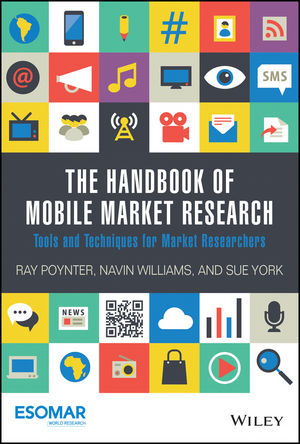
The Handbook of Mobile Market Research (eBook)
John Wiley & Sons (Verlag)
978-1-118-93577-4 (ISBN)
More people have mobile phones than have computers or land lines and for several years researchers have understood that data collection needs to become mobile. Up until now, there were no systems available to do so, fuelled by incompatibilities between systems, lack of suitable systems, lack of understanding in terms of how to use mobile and too many organizations trying to put old fashioned surveys into the mobile world without confronting the changes that need to be made, e.g. shorter surveys.
However, mobile research is finally beginning to take-off and it is doing so on multiple fronts. The Handbook of Mobile Market Research leads the way by offering a range of practical tools and techniques market researchers can use.
• New approaches to qualitative research, where participants use their smartphones to collect ethnographic-type data, of their own lives and of the lives around them
• Broadens the term ‘mobile’ to include tablet devices, creating a range of new possibilities for mobile research
• Practical tools and techniques to meet the needs of beginners, practitioners or advanced users.
The premier guide to mobile market research The Handbook of Mobile Market Research is the first guide to focus exclusively on the use of mobile technology in market research. From a global perspective, more people own mobile phones than landlines or computers, and most people have their mobile phones with them at all times along with their tablets, smartwatches, media players, and navigation devices. The continuous surge of mobile innovation provides unprecedented access to real-time consumer behaviour. Mobile market research allows users to reach more people, engage more people, and collect more valuable data as respondents are free to engage at their own pace, on their own time. Industry forerunners Ray Poynter, Navin Williams, and Sue York employ decades of study to examine the present and future state of mobile market research, as well as the advantages and disadvantages of various approaches. This book contains clear, comprehensive knowledge for those who implement, utilise, and study the field. Readers will learn: The characteristics, scope, and importance of mobile market research Purposes and effects of principal tools like brand tracking, ad testing, customer satisfaction research, and research technology How mobile devices are used for qualitative and quantitative research by way of online focus groups, online discussions, mobile diaries, mobile ethnographies, and mobile surveys Aspects and implications of mobile computer interviews, mobile phone interviews, mixed-mode research, international mobile research, and research using passive data, panels, lists, and communities The significance of the mobile ecosystem, market research ethics, and research on research Designed to be accessible and helpful for beginners and advanced users alike, The Handbook of Mobile Market Research is an extensive guide to one of the most promising, dynamic methods of data collection.
Ray Poynter has spent the last 35 years at the forefront of market research, technology and innovation. He is the creator of NewMR, author of The Handbook of Online and Social Media Research, Director of Vision Critical's knowledge sharing centre, and Managing Director of The Future Place. He is in frequent demand as a workshop leader, conference speaker, session facilitator, writer of articles, trainer, and consultant. Ray feels his mission is to help people, have fun, keep learning, and ideally make some money along the way. Navin Williams has lived and worked in diverse markets like China, Africa and India, where he has had the opportunity to be part of market research technological adoptions in developing environments. His quest to drive mobile adoption in market research led him to form MobileMeasure Consultancy Limited. A pioneer in mobile enabled market research, Navin has written a number of whitepapers and is a frequent speaker at industry conferences and educational campuses. An early voice on mobile market research, he is very excited by the current chorus of industry captains, industry bodies and researchers championing mobile. Sue York has a love of new research methods and is an advocate of methodological rigour and the need for research-on-research. Sue has a high profile within the global market research community, and has run workshops for bodies such as ESOMAR, AMSRS and the Singapore MRSS. She is joint editor and curator of the ESOMAR book Answers to Contemporary Market Research Questions. Sue is an active member of the market research online community and was a founder of NewMR.
Foreword ix
Introduction xi
PART 1 Mobile Market Research 1
1 Overview of Mobile Market Research 3
2 Mobile Research in Action 16
3 The Technology of Mobile Market Research 32
PART 2 Qualitative and Quantitative Research 53
4 Mobile Qualitative Research 55
5 Mobile Forums and Online Focus Groups 70
6 Mobile Diaries and Ethnography 83
7 Mobile Quantitative Research 103
8 Designing and Conducting Mobile Surveys 120
PART 3 The Methods and Applications of Mobile Market
Research 147
9 mCAPI -Mobile Computer Aided Personal Interviewing
149
10 mCATI - Mobile Telephone Interviewing 160
11 Mixed-Mode Research 171
12 Utilizing Passive Data 180
13 Panels, Lists, and Communities 192
14 International Mobile Research 206
PART 4 Researching the Mobile Ecosystem, Ethics, and the
Future 223
15 Researching the Mobile Ecosystem 225
16 Ethics, Laws, and Guidelines 237
17 Research-on-Research 246
18 The Evolving Picture 252
Glossary 271
References 279
About the Authors 283
A Note of Thanks 285
Index 000
1
Overview of Mobile Market Research
INTRODUCTION
Mobile market research (sometimes abbreviated to MMR) is a topic that had been forecast as the next big thing in market research for more than ten years. By 2014, there was widespread agreement that it was finally coming of age and was already having a major impact on many aspects of market research, from quantitative to qualitative, and from local to global. In the future, most market researchers are likely to come into contact with mobile market research in their everyday work and therefore a good understanding of the opportunities, characteristics, limitations, and challenges of this mode is essential. Similarly, buyers and users of market research need to be aware of the implications of some or all of their research being collected via mobile devices.
WHAT DOES MOBILE MARKET RESEARCH MEAN?
Mobile market research refers to participants taking part in market research via mobile devices and market research about the use of mobile devices.
Until recently the term ‘mobile market research’ was largely synonymous with research conducted by or about mobile phones. However, since the arrival of additional mobile devices, such as tablets and phablets, the term ‘mobile market research’ has become broader.
More specifically, mobile market research typically refers to the following:
- Quantitative research where the participants complete surveys on their mobile device.
- Mixed-mode quantitative studies, where some participants complete surveys via a PC while others use a mobile device.
- Quantitative research where participants allow applications on their mobile device to gather information about them or their environment, referred to as passive data collection.
- Qualitative research, where the mobile device either facilitates communication (e.g. taking part in an online focus group from a tablet), or facilitates data collection (e.g. collecting photos and recordings), or a combination of the two.
- Research communities where the mobile device is a key method of communication or participation.
- Face-to-face research where the interviewers are using mobile devices to collect data, sometimes referred to as mCAPI (CAPI utilizing a mobile device).
Using participants' mobile phones to take part in CATI interviews is not always classed as mobile market research, but that might change in the future and a chapter on mCATI (CATI with mobile phones) is included in this book.
STANDARDIZED SOLUTIONS FOR MOBILE MARKET RESEARCH
When mobile market research first appeared on the scene, market researchers planning to use it often had to be very tech savvy and prepared to help develop or test solutions. However, for most people those days are gone.
Most mobile research is conducted via the international survey platforms such as Confirmit, through the mobile services of access panels such as Research Now, or through a specialist provider such as Revelation, MobileMeasure, or Locately: note – there are large and growing numbers in each of these categories. For most researchers it is not necessary to develop their own software solutions. In the more developed research markets, researchers will tend to use a conventional sample source such as an access panel, customer list, or community.
WHY THE INTEREST IN MOBILE?
There are four key drivers of the widespread interest in mobile market research:
- The growing ubiquity of mobile devices.
- People having their phones with them all the time, facilitating ‘in the moment’ research.
- Growth in more powerful mobile devices, especially smartphones and tablets.
- Passive data collection, recording information about participants without their having to actively enter information.
1. THE UBIQUITY OF MOBILE PHONES
Data about the penetration of mobile phones, smartphones, and tablets changes all the time, but in order to emphasize the scale of the mobile phenomenon, consider the following data from the ITU's Measuring the Information Society (ITU 2013) report:
- 6.8 billion mobile phones estimated to be in use, compared with the global population of about 7.2 billion.
- By the end of 2012, over 50% of the world's population were living in areas with at least 3G coverage.
- By the end of 2013 there were almost 2 billion mobile broadband subscriptions – with Ericsson forecasting that by the end of 2018 this figure would be 6.5 billion.
The world is quickly moving to a point where every economically active adult who wants a mobile phone will have one. The trend is very much towards devices with internet access, further widening the potential for mobile research. However, it should be noted that 6.8 billion devices does not mean that 6.8 billion people have a mobile device, as many people have more than one mobile device.
2. ‘IN THE MOMENT’
There is a widespread belief in marketing and market research that interviews conducted ‘in the moment’, for example, when someone is making a purchase, finishing a meal, or staying at a hotel, will reveal more than a survey conducted at a later date. Traditional research has relied on participants recalling details of interactions with products, services, and advertising, days or even weeks after the event. ‘In the moment’ approaches capture the information while it is still fresh in people's minds.
Most users of mobile phones have them with them all the time, for example Pew estimated that in 2012, 44% of Americans slept next to their phones (Pew Research Center 2012). This ‘always available’ characteristic of mobile devices finally allows researchers to conduct studies much closer to the ‘moment of truth’, that is, closer to when a product or service is being experienced.
3. PUTTING THE ‘SMART’ IN MOBILE MARKET RESEARCH
Early forms of mobile market research relied on SMS, WAP, or downloaded software (such as apps written in languages such as Java) to conduct research. These options were technically limiting (especially in the case of SMS) and sometimes required a high degree of cooperation from the participant.
By contrast, the larger, touchscreens of smartphones and the growing popularity of tablets has greatly increased the range of research that can be conducted via mobile market research. Similarly, the growth of higher speed internet connections, including 3G, 4G, and Wi-Fi, has enabled mobile devices to be used in a growing number of ways.
Similarly, the standardization of the processes for writing apps, and downloading them from app stores, has opened up a wide range of alternatives for market research.
4. PASSIVE DATA COLLECTION
Mobile devices, especially smartphones and tablets, can collect a wide variety of information as the research participant goes about their normal, everyday life. In most cases, this is based on the research participant downloading an app onto their device. For example, a location tracking app could use a phone's GPS receiver to create a record of the participant's journeys to and from work.
Passive data is very attractive to marketers and market researchers because it can collect a large amount of detailed data about what people do, without burdening participants with research tasks, and without introducing the biases implicit in asking research participants to decide what to report or capture.
A BRIEF HISTORY OF MOBILE MARKET RESEARCH
Table 1.1 provides a timeline giving a brief history of mobile market research.
Table 1.1 A brief history of mobile market research
| Date | Description |
| 1990s | The first serious attempts to use mobile phones for market research appeared in the 1990s, most of which used SMS. Questions were sent to participants via text messaging and the participants answered via text, typically by entering a single digit, such as 1 for Agree strongly, 2 for Agree, etc. These surveys needed to be very short. Only a small percentage of market research projects were conducted using this method because of the requirement for surveys to be very short and because the interface was considered so limited. This method is still in use today, in cases where it meets specific research needs, for example reaching a broad range of mobile phones in developing economies. One early innovation with the SMS method was to utilize its ‘in the moment’ potential. For example, some businesses put up signs inviting users/visitors to text their satisfaction score to a central location. |
| 2000 | As phones became ‘smarter’, acquiring larger screens and some form of internet access (e.g. WAP) researchers began to use these phones for longer and/or more complex surveys. By 2001, researchers were reporting success in Japan by capitalizing on DoCoMo's early lead in advanced services for mobile phones, sending longer surveys and incentivizing participants via telephone credits (Cattell 2001). However, mobile market research remained a small percentage of all market research. Studies such as the Confirmit Annual Market Research Survey regularly reported mobile as being less than 1% of all data collected. With the growth in the ownership of... |
| Erscheint lt. Verlag | 12.8.2014 |
|---|---|
| Sprache | englisch |
| Themenwelt | Wirtschaft ► Betriebswirtschaft / Management ► Marketing / Vertrieb |
| Schlagworte | Business & Management • Data collection Techniques • designing mobile surveys • Digital Marketing • expanding consumer reach • increasing consumer engagement • Market Research • market research methods • market research techniques • Marktforschung • mobile intelligence • mobile longitudinal studies • Mobile Marketing • mobile optimized study • mobile research strategy • mobile research types • Navin Williams • Qualitative Research Methods • Quantitative Research Methods • Ray R. Poynter • Sue York • The Handbook of Mobile Market Research: Tools and Techniques for Market Researchers • Wirtschaft u. Management |
| ISBN-10 | 1-118-93577-2 / 1118935772 |
| ISBN-13 | 978-1-118-93577-4 / 9781118935774 |
| Informationen gemäß Produktsicherheitsverordnung (GPSR) | |
| Haben Sie eine Frage zum Produkt? |
 EPUB (Adobe DRM)
Kopierschutz: Adobe-DRM
Adobe-DRM ist ein Kopierschutz, der das eBook vor Mißbrauch schützen soll. Dabei wird das eBook bereits beim Download auf Ihre persönliche Adobe-ID autorisiert. Lesen können Sie das eBook dann nur auf den Geräten, welche ebenfalls auf Ihre Adobe-ID registriert sind.
Details zum Adobe-DRM
Dateiformat: EPUB (Electronic Publication)
EPUB ist ein offener Standard für eBooks und eignet sich besonders zur Darstellung von Belletristik und Sachbüchern. Der Fließtext wird dynamisch an die Display- und Schriftgröße angepasst. Auch für mobile Lesegeräte ist EPUB daher gut geeignet.
Systemvoraussetzungen:
PC/Mac: Mit einem PC oder Mac können Sie dieses eBook lesen. Sie benötigen eine
eReader: Dieses eBook kann mit (fast) allen eBook-Readern gelesen werden. Mit dem amazon-Kindle ist es aber nicht kompatibel.
Smartphone/Tablet: Egal ob Apple oder Android, dieses eBook können Sie lesen. Sie benötigen eine
Geräteliste und zusätzliche Hinweise
Buying eBooks from abroad
For tax law reasons we can sell eBooks just within Germany and Switzerland. Regrettably we cannot fulfill eBook-orders from other countries.
aus dem Bereich