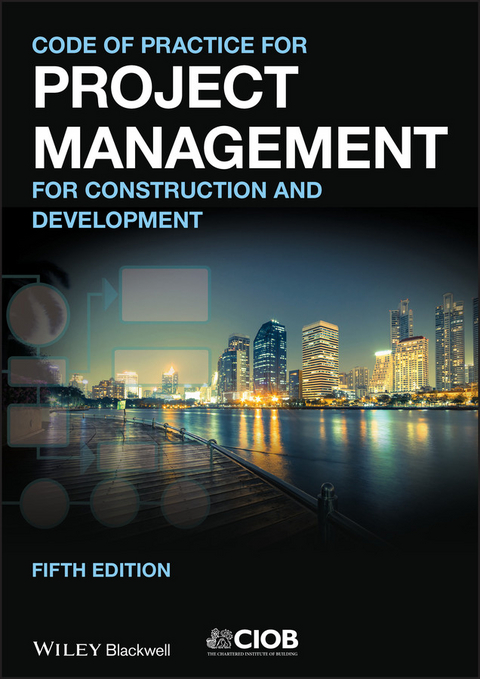
Code of Practice for Project Management for Construction and Development (eBook)
John Wiley & Sons (Verlag)
978-1-118-37818-2 (ISBN)
The first edition of the Code of Practice for Project Management for Construction and Development, published in 1992, was groundbreaking in many ways. Now in its fifth edition, prepared by a multi-institute task force coordinated by the CIOB and including representatives from RICS, RIBA, ICE, APM and CIC, it continues to be the authoritative guide and reference to the principles and practice of project management in construction and development.
Good project management in construction relies on balancing the key constraints of time, quality and cost in the context of building functionality and the requirements for sustainability within the built environment. Thoroughly updated and restructured to reflect the challenges that the industry faces today, this edition continues to drive forward the practice of construction project management. The principles of strategic planning, detailed programming and monitoring, resource allocation and effective risk management, widely used on projects of all sizes and complexity, are all fully covered. The integration of Building Information Modelling at each stage of the project life is a feature of this edition. In addition, the impact of trends and developments such as the internationalisation of construction projects and the drive for sustainability are discussed in context.
Code of Practice will be of particular value to clients, project management professionals and students of construction, as well as to the wider construction and development industries. Much of the information will also be relevant to project management professionals operating in other commercial spheres.
About the CIOB
The Chartered Institute of Building is at the heart of a management career in construction. It is the world's largest and most influential professional body for construction management and leadership, with a Royal Charter to promote the science and practice of building and construction for the benefit of society. With over 48,000 members worldwide, the CIOB is the international voice of the building professional.
The first edition of the Code of Practice for Project Management for Construction and Development, published in 1992, was groundbreaking in many ways. Now in its fifth edition, prepared by a multi-institute task force coordinated by the CIOB and including representatives from RICS, RIBA, ICE, APM and CIC, it continues to be the authoritative guide and reference to the principles and practice of project management in construction and development. Good project management in construction relies on balancing the key constraints of time, quality and cost in the context of building functionality and the requirements for sustainability within the built environment. Thoroughly updated and restructured to reflect the challenges that the industry faces today, this edition continues to drive forward the practice of construction project management. The principles of strategic planning, detailed programming and monitoring, resource allocation and effective risk management, widely used on projects of all sizes and complexity, are all fully covered. The integration of Building Information Modelling at each stage of the project life is a feature of this edition. In addition, the impact of trends and developments such as the internationalisation of construction projects and the drive for sustainability are discussed in context. Code of Practice will be of particular value to clients, project management professionals and students of construction, as well as to the wider construction and development industries. Much of the information will also be relevant to project management professionals operating in other commercial spheres.
About the CIOB The Chartered Institute of Building is at the heart of a management career in construction. It is the world's largest and most influential professional body for construction management and leadership, with a Royal Charter to promote the science and practice of building and construction for the benefit of society. With over 48,000 members worldwide, the CIOB is the international voice of the building professional.
0
Introduction
Project management
Project management has come a long way since its modern introduction to construction projects in the late 1950s. Now, it is an established discipline which executively manages the full development process, from the client’s idea to funding coordination and acquirement of planning and statutory controls approval, sustainability, design delivery, through to the selection and procurement of the project team, construction, commissioning, handover, review, to facilities management coordination.
This Code of Practice positions the project manager as the client’s representative, although the responsibilities may vary from project to project; consequently, project management may be defined as ‘the overall planning, co-ordination and control of a project from inception to completion aimed at meeting a client’s requirements in order to produce a functionally and financially viable project that will be completed safely, on time, within authorised cost and to the required quality standards’.
The fifth edition of this Code of Practice is the authoritative guide and reference to the principles and practice of project management in construction and development. It will be of value to clients, project management practices and educational establishments and students, and to the construction and development industries. Much of the information contained in the Code of Practice will also be relevant to project management practitioners operating in other commercial spheres.
Definitions
There are many definitions in existence for the term ‘Project Management’. The CIOB, in this Code of Practice, and in all other publications, uses the following definition:
Project management
The overall planning, coordination and control of a project from inception to completion aimed at meeting a client’s requirements in order to produce a functionally viable and sustainable project that will be completed safely, on time, within authorised cost and to the required quality standards.
Table 0.1 summarises a number of definitions of project management, as practiced by a selection of leading organisations involved in project management within the construction and building industry in UK.
Table 0.1 Definitions of project management
| Organisation | Definition of project management |
| Chartered Institute of Building | The overall planning, coordination and control of a project from inception to completion aimed at meeting a client’s requirements in order to produce a functionally viable project that will be completed safely, on time, within authorised cost and to the required quality standards. |
| Association for Project Management | The application of processes, methods, knowledge, skills and experience to achieve the project objectives.1 |
| British Standards 6079:2010 | A unique set of coordinated activities, with definite starting and finishing points, undertaken by an individual or organisation to meet specific objectives within defined schedule, cost and performance parameters. |
| Office of Government Commerce (Department of Business, Innovation, and skills) | The planning, monitoring and control of all aspects of the project and the motivation of all those involved in it to achieve the project objectives on time and to the specified cost, quality and performance.2 |
| International Organization for Standardization 21500:2012 | Project management is the application of methods, tools, techniques and competencies to a project. Project management includes the integration of the various phases of the project lifecycle. |
| International Project Management Association3 IPMA | Project management (PM) is the planning, organising, monitoring and controlling of all aspects of a project and the management and leadership of all involved to achieve the project objectives safely and within agreed criteria for time, cost, scope and performance/quality. It is the totality of coordination and leadership tasks, organisation, techniques and measures for a project. It is crucial to optimise the parameters of time, cost and risk with other requirements and to organise the project accordingly |
| Project Management Institute4 PMI | Project management is the application of knowledge, skills and techniques to execute projects effectively and efficiently. It is a strategic competency for organisations, enabling them to tie project results to business goals – and thus, better compete in their markets. |
1 Definition as available at http://www.apm.org.uk/content/project-management (accessed November 2012).
2 Definition obtained from OGC Glossary of Terms & Definitions v06 March 2008 – at the time of publication the document is available at www.gov.uk through publications of the Department of Business, Innovation & Skills.
3 Definition obtained from ICB 3.0 – page 127.
4 Definition as available at http://www.pmi.org/About-Us/About-Us-What-is-Project-Management.aspx (accessed February 2013).
Characteristics of construction projects
Construction projects have inherent features that make them highly complicated enterprises. These features are characterised by high levels of complexity, uncertainty and uniqueness and include
- Complexity created by the fragmentation of the organisational mechanism by which most projects are delivered. Usually the project delivery team is external to the client organisation, there is a separation between the designers and the constructors and the requirement for a wide range of specialist knowledge and skills demands the involvement of a large number of consultants, contractors, suppliers and statutory bodies.
- Complexity of the technology involved in the construction of modern buildings.
- Logistical complexity created by the locational aspects of projects – the site being a fixed location means that everything else must be taken to it. It is likely logistical complexity will be increased in a highly urbanised country where the pressure on land means the building footprint is likely to be the same as the site area, leaving minimal working space.
- Uncertainty created by exposure to the extremes of the weather.
- Uniqueness of each project; the project organisation and the participants vary, site conditions are different, technology adopted for the building varies, external influences on the project will be different and client constraints will be different.
- Uncertainty caused by the time necessary for the project life cycle. The longer the period of time, the greater the opportunity for the project to be impacted by changing external circumstances, such as economic conditions, or by changing client requirements.
Further pressures are created by a client needing to commit to key criteria such as the project duration and cost budget at an early stage, often before the full implications of what the project actually is about and how it is to be implemented have been developed in detail.
Most participants to the project are involved because they are offering a service or product as part of their business activity. It is usual practice for this involvement to be a formal contractual agreement with an agreed fixed, lump sum price based on a definition of the service or product required. Throughout their contribution to the project, participants are therefore balancing protecting their commercial position with working towards helping to achieve the overall project objectives. This relationship is not without difficulties and does not always work to the best advantage of the client or the project.
Characteristics of construction project management
Construction projects are intricate, resource consuming and often complex activities. The development and delivery of a project typically consists of several phases, sometimes over lapped but always linked, requiring a wide variety of skills and specialised services to balance the key project constraints (Figure 0.1). In progressing from initial feasibility to completion and occupation, a typical construction project passes through successive somewhat distinct stages that necessitate input from such asynchronous areas such as financial institutions, regulatory and statutory organisations, members of the public, engineers, planners, architects, specialist designers, cost engineers, building surveyors, lawyers, insurance companies, constructors, suppliers, tradesmen and cost managers.
During the construction stage itself, a project of relatively simple design and methodology involves a wide range of skills, materials and a plethora of different but often sequential activities and tasks that must follow a predetermined order that constitutes a complicated and sensitive pattern of individual criteria and restrictive sequential relationships.
The Construction Industry Council (CIC) suggests that the primary purpose of project management is to add significant and specific value to the process of delivering construction projects.1 This is achieved by the systematic application of a set of generic...
| Erscheint lt. Verlag | 23.7.2014 |
|---|---|
| Sprache | englisch |
| Themenwelt | Technik ► Bauwesen |
| Wirtschaft ► Betriebswirtschaft / Management ► Projektmanagement | |
| Schlagworte | authoritative • Baubetrieb • Bauingenieur- u. Bauwesen • built • Business & Management • ciob • Civil Engineering & Construction • Code • constraints • Construction • Construction Management • ConText • Edition • Environment • Fifth • First • Good • Guide • Key • many • multiinstitute • Practice • Principles • Project Management • Projektmanagement • Representatives • Rics • task force coordinated • Time • Ways • Wirtschaft u. Management |
| ISBN-10 | 1-118-37818-0 / 1118378180 |
| ISBN-13 | 978-1-118-37818-2 / 9781118378182 |
| Informationen gemäß Produktsicherheitsverordnung (GPSR) | |
| Haben Sie eine Frage zum Produkt? |
 EPUB (Adobe DRM)
Kopierschutz: Adobe-DRM
Adobe-DRM ist ein Kopierschutz, der das eBook vor Mißbrauch schützen soll. Dabei wird das eBook bereits beim Download auf Ihre persönliche Adobe-ID autorisiert. Lesen können Sie das eBook dann nur auf den Geräten, welche ebenfalls auf Ihre Adobe-ID registriert sind.
Details zum Adobe-DRM
Dateiformat: EPUB (Electronic Publication)
EPUB ist ein offener Standard für eBooks und eignet sich besonders zur Darstellung von Belletristik und Sachbüchern. Der Fließtext wird dynamisch an die Display- und Schriftgröße angepasst. Auch für mobile Lesegeräte ist EPUB daher gut geeignet.
Systemvoraussetzungen:
PC/Mac: Mit einem PC oder Mac können Sie dieses eBook lesen. Sie benötigen eine
eReader: Dieses eBook kann mit (fast) allen eBook-Readern gelesen werden. Mit dem amazon-Kindle ist es aber nicht kompatibel.
Smartphone/Tablet: Egal ob Apple oder Android, dieses eBook können Sie lesen. Sie benötigen eine
Geräteliste und zusätzliche Hinweise
Buying eBooks from abroad
For tax law reasons we can sell eBooks just within Germany and Switzerland. Regrettably we cannot fulfill eBook-orders from other countries.
aus dem Bereich