Innovation Governance (eBook)
John Wiley & Sons (Verlag)
978-1-118-58858-1 (ISBN)
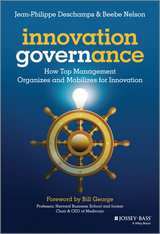
Innovation governance is a hot topic in the business world. In a fast-paced business environment, the ability of corporate leaders to build purpose, direction, and focus for innovation is more important than ever. In this book, the authors provide a framework for encouraging and focusing innovation by explaining what innovation governance is, the various models for governance and their advantages and disadvantages, how to assess and improve governance practices, and behavioral tactics for maximizing the effectiveness of governance. It offers guidance for everyone from the boardroom through senior management, illustrating effective governance models with real case studies from a range of companies in the United States and Europe.
- Addresses an important yet underappreciated skill for CEOs, board members, and top management
- Features real-world examples and case studies from a variety of business from around the world
- Written by an author team with hands-on experience in the subjects of innovation management, organizational learning, innovation leadership, organizational behavior, and individual leadership and teamwork
Innovation governance is a sadly neglected topic in many organizations. This book offers vital guidance and real-world experience for building innovation into any business from the top down.
Jean-Philippe Deschamps is an innovation management practitioner with 40 years of international consulting experience. At IMD, which he joined in 1996 as professor of technology and innovation management, he focuses his research, teaching and consulting activities on the management and governance of innovation and on the profile and focus of innovation leaders. Before IMD, he was a vice president and practice leader with consulting firm Arthur D. Little.
He is the author of numerous cases, articles and book chapters, and Product Juggernauts: How Companies Mobilize to Generate Streams of Market Winners co-authoredwith P. Ranganath Nayak (Harvard Business School Press, 1995) and Innovation Leaders: How Senior Executives Stimulate, Steer and Sustain Innovation (Wiley/Jossey-Bass, 2008).
He has given conferences and lectures throughout the world, including the prestigious 2010 Millenium Prize in Helsinki, the equivalent of the “Nobel prize” for technology and twice as a speaker at the World Economic Forum in Davos.
He lives near Lausanne and is married to a practicing psychoanalyst and author
Beebe Nelson has worked as an innovation and product development consultant and facilitator for the past 25 years. As co-director and then director of the IAPD (International Association for Product Development) she helped leading innovation companies refine and improve their innovation practices. Her articles on innovation and product development have appeared in publications of the PDMA (Product Development and Management Association) as well as other professional publications, and she has given lectures and seminars on innovation topics. She holds a doctorate in philosophy from Harvard University and has taught philosophy and management at the University of Massachusetts at Boston and at Lowell.
The publication of New Product Development for Dummies (co-authored with Robin Karol, Wiley, 2007) marked the maturity of the product development field and pointed clearly to the need for excellence in innovation governance.
The business leader's guide to encouraging continuous innovation in any organization Innovation governance is a hot topic in the business world. In a fast-paced business environment, the ability of corporate leaders to build purpose, direction, and focus for innovation is more important than ever. In this book, the authors provide a framework for encouraging and focusing innovation by explaining what innovation governance is, the various models for governance and their advantages and disadvantages, how to assess and improve governance practices, and behavioral tactics for maximizing the effectiveness of governance. It offers guidance for everyone from the boardroom through senior management, illustrating effective governance models with real case studies from a range of companies in the United States and Europe. Addresses an important yet underappreciated skill for CEOs, board members, and top management Features real-world examples and case studies from a variety of business from around the world Written by an author team with hands-on experience in the subjects of innovation management, organizational learning, innovation leadership, organizational behavior, and individual leadership and teamwork Innovation governance is a sadly neglected topic in many organizations. This book offers vital guidance and real-world experience for building innovation into any business from the top down.
Jean-Philippe Deschamps is an innovation management practitioner with 40 years of international consulting experience. At IMD, which he joined in 1996 as professor of technology and innovation management, he focuses his research, teaching and consulting activities on the management and governance of innovation and on the profile and focus of innovation leaders. Before IMD, he was a vice president and practice leader with consulting firm Arthur D. Little. He is the author of numerous cases, articles and book chapters, and Product Juggernauts: How Companies Mobilize to Generate Streams of Market Winners co-authoredwith P. Ranganath Nayak (Harvard Business School Press, 1995) and Innovation Leaders: How Senior Executives Stimulate, Steer and Sustain Innovation (Wiley/Jossey-Bass, 2008). He has given conferences and lectures throughout the world, including the prestigious 2010 Millenium Prize in Helsinki, the equivalent of the "Nobel prize" for technology and twice as a speaker at the World Economic Forum in Davos. He lives near Lausanne and is married to a practicing psychoanalyst and author Beebe Nelson has worked as an innovation and product development consultant and facilitator for the past 25 years. As co-director and then director of the IAPD (International Association for Product Development) she helped leading innovation companies refine and improve their innovation practices. Her articles on innovation and product development have appeared in publications of the PDMA (Product Development and Management Association) as well as other professional publications, and she has given lectures and seminars on innovation topics. She holds a doctorate in philosophy from Harvard University and has taught philosophy and management at the University of Massachusetts at Boston and at Lowell. The publication of New Product Development for Dummies (co-authored with Robin Karol, Wiley, 2007) marked the maturity of the product development field and pointed clearly to the need for excellence in innovation governance.
FOREWORD ix
PREFACE: WHY SHOULD WE PAY ATTENTION TO INNOVATION
GOVERNANCE? xvii
ACKNOWLEDGMENTS xxv
PART I: ADDRESSING THE INNOVATION GOVERNANCE CHALLENGE
1
1 WHAT IS INNOVATION GOVERNANCE? 3
2 GOVERNING INNOVATION IN PRACTICE: THE ROLE OF THE BOARD OF
DIRECTORS 31
3 GOVERNING INNOVATION IN PRACTICE: THE ROLE OF THE TOP
MANAGEMENT TEAM 49
PART II: CHOOSING BETWEEN ALTERNATIVE GOVERNANCE MODELS
85
4 WHY FOCUS ON INNOVATION GOVERNANCE MODELS? 87
5 INNOVATION GOVERNANCE MODELS 107
6 WHICH MODELS SEEM TO WORK AND WHY? 135
PART III: LEARNING FROM THE FIELD 151
7 LEADING FROM THE TOP 153
Example 1 - IBM's Innovation Governance Model: A
Succession of CEOs Oversees "Continuous
Transformation"
8 LEADING FROM THE TOP 173
Example 2 - Corning's Innovation Governance Model:
Two Executive Councils Execute Hands-on Governance
9 APPOINTING INDIVIDUAL INNOVATION CHAMPIONS 193
Example 1 - Nestlé's Innovation Governance
Model: CTO in Partnership with Business Heads
10 APPOINTING INDIVIDUAL INNOVATION CHAMPIONS 223
Example 2 - DSM's Innovation Governance Model: The
Entrepreneurial CIO
11 SETTING UP A COLLECTIVE GOVERNANCE SYSTEM 247
Example - Tetra Pak's Innovation Governance Model:
High-level Cross-functional Steering Groups
PART IV: DESIGNING YOUR OWN GOVERNANCE SYSTEM AND MAKING IT
WORK 269
12 GETTING STARTED 271
How Michelin has Rethought its Governance Model
13 RECOGNIZING THE IMPERATIVES FOR AN EFFECTIVE GOVERNANCE
SYSTEM 299
14 ALIGNING INDIVIDUAL AND COLLECTIVE INNOVATION LEADERSHIP
321
APPENDIX: EXAMPLES OF TASKS AND INITIATIVES TO SUPPORT
INNOVATION 345
INDEX 351
Foreword
Innovation
Many volumes of books and articles have been written on this subject, yet most organizations acknowledge they are not truly innovative in spite of concentrated efforts to become so. Back in 1997 HBS Professor Clayton Christensen wrote his seminal book, The Innovator's Dilemma, that described in lucid terms why organizations fail to innovate. Businesses, including my own, Medtronic, took his admonitions to heart, yet most established companies have been unable to move the needle on their efforts to become more innovative. I continue to be amazed at the number of outstanding companies whose leaders talk the innovation talk but fail to create innovative organizations or to come up with innovative business ideas.
In my experience, most companies fail to innovate for five fundamental reasons:
World-class innovation expert Jean-Philippe Deschamps and his co-author, Beebe Nelson, have examined the larger scope of innovation and have discovered why companies fail to innovate. In their view two things are sorely lacking in organizations: leadership and governance. In his 2008 book, Innovation Leaders, Deschamps addressed the vital question of why innovation leaders are sorely lacking in most established organizations. He also addressed the question of what can be done to develop more innovation leaders who rise to the top of large organizations.
In Innovation Governance, Deschamps and Nelson scale new heights in taking the question of innovation leadership to a higher plane by focusing on the core reason for failure: lack of a well-established system for governing innovation. They challenge the reader to ask, why don't all companies who are striving to be innovative have a well-established system of governing their efforts and clear ground rules for carrying them out?
While scholars and practitioners like myself have argued for decades about whether the key is the innovation process or its leaders, Deschamps and Nelson neatly combine the two in their concept of innovation governance. However, their solution is not prescriptive. Rather than advocating a single governance model, they instead explore the full range of innovation governance approaches. Their 3 × 3 matrix model produces nine ways of thinking about the type of governance system you wish to establish for your company.
To provide depth and context to each of the nine models, Deschamps and Nelson examine the innovation structures of the world's leading companies and how they govern their innovation. By avoiding the one-size-fits-all approach so common in most treatises on innovation, they challenge innovation leaders to create their own approaches that will work best in their cultures and align with their business models and strategies.
My Experiences in Leading Innovation
Throughout my career I have seen innovation as the key to creating value for your customers, motivating your employees, and building growing businesses – all the necessary elements for creating lasting value for your owners and investors. In my early years in business my role models of innovation leaders were Hewlett-Packard founders David Packard and Bill Hewlett, Merck's Roy Vagelos, Louis Lehr of 3M and Medtronic founder Earl Bakken. In recent years, newer innovation role models have emerged, such as Dan Vasella of Novartis, Arthur Levinson of Genentech, eBay's Meg Whitman (now CEO of Hewlett-Packard), Apple's Steve Jobs and Google's Eric Schmidt.
I have never considered myself an innovator who invents products. Rather, I have tried to be a leader who leads and stimulates the innovation process to ensure the real innovators get the encouragement, support, mentoring, and focus they need to produce great innovations. Surprisingly, many CEOs and senior leaders of established companies who are eager for their companies to innovate nevertheless take actions repeatedly that prevent an innovative culture from emerging. For example, during budget season they are prone to trim back budgets for innovation projects rather than protect them, or they stand passively by as their business heads do so in order to meet pre-established targets or protect short-term product upgrades. Or they may be quite critical of innovations that do not materialize, often punishing the innovators who took the risks on their behalf. Other leaders fully fund their research and development budgets, but never engage the innovators themselves. Nor do they understand their own cultures well enough to know why they are not producing any genuine breakthrough products.
My first general management role dates back to 1969. My goal was to create the consumer microwave oven business for Litton Industries, a challenge I found highly stimulating. At the time consumers didn't even know what microwaves were. If they did, most were afraid of potential radiation, as we weren't that far removed from stories of Hiroshima and Nagasaki. At Litton we used innovation in our products and marketing to turn the microwave oven from a popcorn popper to a widely used device that has become standard in most homes. Since neither consumers nor appliance sales people, most of whom were men, understood how to use the product, we hired 2,000 part-time home economists to work at retail, conducting cooking classes and demonstrations.
Sadly, when I moved to Honeywell in 1978, my successor at Litton focused almost entirely on getting product costs down and innovation dried up. In my Honeywell years, innovation became more difficult. This company of superb engineers focused primarily on generating better products and processes, not breakthrough innovations. The ring laser gyroscope that guides all aircraft today was a notable exception.
Joining Medtronic in 1989, I saw the opportunity to harness and expand innovation in a highly creative company that was using medical technology to restore millions of people to full life and health. Medtronic was filled with remarkable innovators and exceptional innovation leaders, yet the company's recent history had been characterized more by missed opportunities and notable failures in innovation. Win Wallin, my predecessor as CEO of Medtronic, revived the process by focusing on the implantable defibrillator, whose inventor had been rejected by Medtronic. However, a system for governing innovation had not yet been established within this predominantly functional organization.
To create the innovation governance system at Medtronic, we started with our board of directors. Between 1990 and 1996 Wallin and I took significant steps to add pioneering medical doctors and technologists to the Medtronic board, who ensured that the company's emphasis stayed laser-focused on innovation. The board established a technology and quality committee, which provided oversight, ideas and guidance to management. The T&Q Committee, as it was known, was very helpful in pointing out emerging technologies that management may have overlooked and examining the viability of technologies we were pursuing. The board wanted to ensure that the company never again overlooked an important medical technology as it had with the implantable defibrillator.
From a management standpoint, it was clear that Medtronic's innovation was not well organized, leading to haphazard results. To bring some clarity to the governance process, I decided to bifurcate the organization between established businesses organized around strategic business units (SBUs) and an innovation function that included new ventures, research projects, and external alliances. The existing businesses were run by chief operating officer Art Collins, who later became my successor. The innovative work was championed by vice chairman Glen Nelson, MD. Nelson was a brilliant physician with a keen interest in medical technology who was recruited from a pioneering health maintenance organization. The company's largest business, cardiac rhythm management (pacemakers and defibrillators), was led by an exceptionally strong innovation leader, Bob Griffin. Griffin had a long history within the company of championing breakthrough innovations, often reprogramming funds to keep them alive. For the next decade Nelson and Griffin drove Medtronic's innovation while Collins skillfully managed the SBUs. Both Nelson and Griffin were masters at scouring the world for new medical technologies being created by courageous physicians and entrepreneurs that we could bring into Medtronic.
During this period Medtronic innovators were successful in using medical technology to create breakthrough innovations that addressed a wide range of complex diseases like sudden cardiac arrest, Parkinson's, atherosclerosis, heart failure, spinal disease, diabetes, and incontinence. All they needed from our top executive team was funding, focus, and a high level of engagement with their innovations. Not infrequently, Nelson, Griffin and I had to make organizational interventions to prevent the SBU leaders from shooting down their ideas before they had been developed or refusing to transfer the talent to them that were needed to make their innovation projects successful.
I recall one especially tense meeting involving a novel idea for minimally invasive cardiac surgery, also...
| Erscheint lt. Verlag | 3.6.2014 |
|---|---|
| Sprache | englisch |
| Themenwelt | Wirtschaft ► Betriebswirtschaft / Management ► Unternehmensführung / Management |
| Schlagworte | Business & Management • Corporate Governance • Creativity & Innovation Management • encouraging innovation in business • encouraging organisational innovation • encouraging organizational innovation • guide to innovation governance • how to encourage innovation • innovation best practices • Innovation governance • innovation governance best practices • innovation governance framework • innovation governance guide • Innovation guide • Innovation Management • Innovationsmanagement • Innovations- u. Kreativitätsmanagement • Innovations- u. Kreativitätsmanagement • managing innovation • organisational innovation • Organizational innovation • Unternehmensführung • Unternehmensführung • Wirtschaft u. Management |
| ISBN-10 | 1-118-58858-4 / 1118588584 |
| ISBN-13 | 978-1-118-58858-1 / 9781118588581 |
| Informationen gemäß Produktsicherheitsverordnung (GPSR) | |
| Haben Sie eine Frage zum Produkt? |
 EPUB (Adobe DRM)
Kopierschutz: Adobe-DRM
Adobe-DRM ist ein Kopierschutz, der das eBook vor Mißbrauch schützen soll. Dabei wird das eBook bereits beim Download auf Ihre persönliche Adobe-ID autorisiert. Lesen können Sie das eBook dann nur auf den Geräten, welche ebenfalls auf Ihre Adobe-ID registriert sind.
Details zum Adobe-DRM
Dateiformat: EPUB (Electronic Publication)
EPUB ist ein offener Standard für eBooks und eignet sich besonders zur Darstellung von Belletristik und Sachbüchern. Der Fließtext wird dynamisch an die Display- und Schriftgröße angepasst. Auch für mobile Lesegeräte ist EPUB daher gut geeignet.
Systemvoraussetzungen:
PC/Mac: Mit einem PC oder Mac können Sie dieses eBook lesen. Sie benötigen eine
eReader: Dieses eBook kann mit (fast) allen eBook-Readern gelesen werden. Mit dem amazon-Kindle ist es aber nicht kompatibel.
Smartphone/Tablet: Egal ob Apple oder Android, dieses eBook können Sie lesen. Sie benötigen eine
Geräteliste und zusätzliche Hinweise
Buying eBooks from abroad
For tax law reasons we can sell eBooks just within Germany and Switzerland. Regrettably we cannot fulfill eBook-orders from other countries.
aus dem Bereich