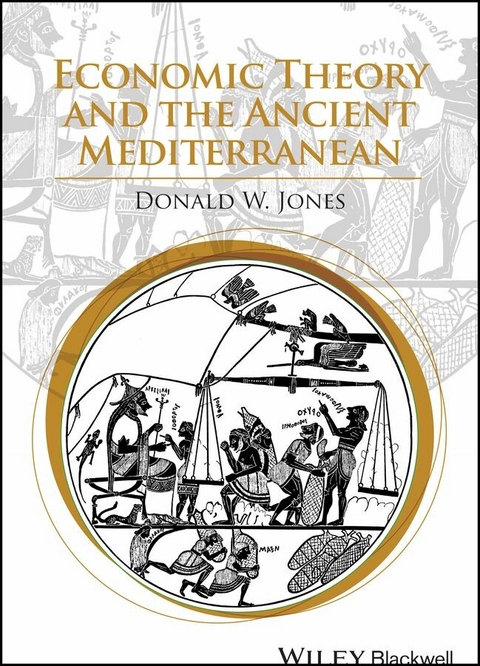
Economic Theory and the Ancient Mediterranean (eBook)
John Wiley & Sons (Verlag)
978-1-118-62791-4 (ISBN)
Economic Theory and the Ancient Mediterranean presents a comprehensive introduction to the application of contemporary economic theory to the ancient societies of the Mediterranean Sea from the period of 5000 BCE to 400 CE.
- Offers an accessible presentation of modern economic theory and its relationships to ancient societies
- Presents innovative expositions and applications of economic theory to issues in antiquity not often found in the literature
- Features insightful discussions of the relevance of contemporary economic models to various situations in antiquity
- Written for a broad range of scholars of ancient Mediterranean regions, including archaeologists, ancient historians, and philologists
Donald W. Jones is Adjunct Professor of Classics, University of Tennessee, and is also an economic consultant involved with demand forecasting and energy economics. He is the author of External Relations of Early Iron Age Crete, 1100-600 B.C. (2000) and co-editor of Measuring the Full Costs and Benefits of Transpiration (1997).
Economic Theory and the Ancient Mediterranean presents a comprehensive introduction to the application of contemporary economic theory to the ancient societies of the Mediterranean Sea from the period of 5000 BCE to 400 CE. Offers an accessible presentation of modern economic theory and its relationships to ancient societies Presents innovative expositions and applications of economic theory to issues in antiquity not often found in the literature Features insightful discussions of the relevance of contemporary economic models to various situations in antiquity Written for a broad range of scholars of ancient Mediterranean regions, including archaeologists, ancient historians, and philologists
Donald W. Jones is Adjunct Professor of Classics, University of Tennessee, and is also an economic consultant involved with demand forecasting and energy economics. He is the author of External Relations of Early Iron Age Crete, 1100-600 B.C. (2000) and co-editor of Measuring the Full Costs and Benefits of Transpiration (1997).
"It is a majestic manual on economics...covering basically the full spectrum of standard economic theory. ...[T]he book is a powerful, even if advanced tool, to develop an understanding of economic theories." (Nordicum-Mediterraneum, 1 January 2015)
Introduction
This volume's primary goal is to offer a compact, if intense, introduction to contemporary economic theory for scholars of the ancient Mediterranean-Aegean-Near Eastern region: archaeologists, ancient historians, and philologists.1 Why might people from these fields find this material of interest? Economic topics of antiquity have been of abiding interest in these related disciplines, and while much has been learned over the past four decades or so, that scholarship has, frankly, been hampered by misconceptions about and awkward applications of the body of theory that offers direct insights into those topics. It takes long and difficult effort to turn oneself into a classicist or a scholar of the ancient Near Eastern or Egyptian languages, plus acquire the modern languages necessary to read the present literature in the field, plus learn the history, archaeology, methodologies, including some physical science applications, and the list could go on. There's a lot to learn, and limited time and energy. Triage principles certainly have to be applied. That, and, we might as well be direct about it, a lot of twentieth-century political and ideological baggage has attached itself to economic theory in a number of social science and humanities disciplines.
Rationale
It is not difficult to find comments in the literature on ancient societies and economies that, when stripped of their costumery, amount to “economic theory isn't applicable.” Reading some of these works, it is not clear that the knowledge base is always sufficient to reach such a conclusion. Contemporary economic theory can model the maximization of prestige as comfortably as it can profit, and there is no reason to view the theory as a reductionist tool.2 Other scholars of antiquity find economics and economic models useful but sometimes their use of them is hampered by limited understanding of how the models work. Nobody has enough time to study everything that really needs to be studied, and learning enough economics to be functional with its concepts takes time and energy but, at some point, excuses involving time and energy become threadbare. This volume offers humble assistance in surmounting these twin problems of time limitations and unfamiliarity. At the very least, the volume offers some archaeologists, ancient historians, and philologists the opportunity to make more authoritative statements of “economics isn't applicable,” and explain why they reach such a conclusion, from a base of sound knowledge; some may find a modest conversion with closer understanding; and others who found the models appealing all along may find them more useful.
In trying to make the essentials of economic theory and a broad swath of its principal applications more accessible to busy scholars in other fields, I have not been able to make the subject easier than it is. I regret that, but then no one has been able to make Attic Greek or Middle Egyptian easy either. Plenty of late-night tears have been shed during the youth of all these disciplines' current elders. However, I hope I have succeeded in some measure in making the operation a quicker affair than it otherwise would be: a few weeks or months of pain versus several years of classes. The introductory and intermediate textbooks dealing with the topics of this volume's chapters easily would stand five or six feet high. In making this distillation, I have omitted the numerical examples, case studies, and problem sets that inflate the page counts of these textbooks but undoubtedly assist the novice's learning. I have, however, offered examples of cases from antiquity to demonstrate how the theories might be applied to subjects of interest to the target audience. This approach assumes that the audience consists of scholars of a certain degree of personal and intellectual maturity and intellectual discipline, who understand from experience the effort required to surmount entry barriers to new fields of study, be they another ancient or modern language or even a new, relatively unexplored topic of inquiry. These scholars have acquired the patience to read a sentence several times, if necessary, to understand it. They are accustomed to flipping back a few pages in a text now and then to re-establish a continuity of thought if necessary.
Organization
The organization of the volume is as follows. The first five chapters form the core of economic theory—called price theory or microeconomics. The following nine chapters treat major applied branches of economics. They are applications of the basic price theory addressed in the first five chapters. However, many of these chapters introduce additional models of issues that involve basic price theory. Two examples: the theory of externality is treated in Chapter 6 on public economics, and risk is the subject of Chapter 7. The externality concept3 requires the concepts of private and public goods, which need not burden the reader just struggling with the concepts of supply and demand, who doesn't really need to know at that point that goods that are supplied and demanded may have sharply differing—or blurred on occasion—economic properties: better to stick with simple, privately consumed goods such as food and clothing before moving on to bridges and city walls, which are consumed by many people at the same time. In the case of risk, we all know that it's ubiquitous but, again, the consequences of risk are better appreciated when they can be compared with situations without risk. Again, it's a needless complication on the first date. There is reason to the order of appearance of the applications chapters. Each introduces some new concepts beyond those treated in the core chapters—but using the principles of the core chapters. Later applied chapters often make recourse to principles developed in earlier applied chapters.
To attempt to illustrate how the models and reasoning introduced in these chapters can be applied to problems of interest to scholars of antiquity, the core chapters offer some sample application sections, and each of the nine applied chapters ends with a section containing suggestions for how the material of the chapter might be used by archaeologists or ancient historians and philologists (I group the latter two together on the grounds that both rely much more on textual evidence while the archaeologists rely more heavily on material evidence). These suggestions should not be considered definitive but rather as offering a few ideas, which may suggest applications to topics I have not thought of. Also, following the references to each chapter is a short list of suggested readings in economics pertinent to that chapter. Some of these works may strike readers as dated, with publication dates in the 1980s and even the 1970s, and earlier. The reasoning for my choices is several. First, some are simply classics and remain the best and most accessible statements on their subjects. Second, I have used these editions myself and understand them but have not actively pursued subsequent editions. While advances have been made in all these fields, the basic ideas to which readers are directed in these works remain foundational, while some of the advances are simply less accessible. Third, in some cases of works that have gone through many editions, some still continuing, I frankly think an earlier edition is superior to later or even current ones for the purposes and needs of this volume's readers. And fourth, if a reader wants to buy some of these works, the older ones are generally considerably cheaper than newer ones.
Method
A note on what might be called method: when necessary, I have used symbolic expressions in the text. There's no way around the fact that these are mathematical expressions, or sentences, and presented to an audience many of whose members chose other routes in college. However, I have kept the mathematical operations they present to the four basic arithmetic operations—addition, subtraction, multiplication, and division4—and these expressions can be read just like sentences: “This times that, plus the other thing times something else, equals what we're interested in.” These expressions can be read for precise meaning just as an ordinary sentence can be read—hence my inclusion of them in sentences rather than set apart from the text. It's important for readers to see exactly what is and is not included in an economic calculation. The application of economic theory can live with the imprecision frequently found in ancient textual and material evidence, but the logic of the theory requires fairly sharp dividing lines between what is and what isn't included in a concept, and the mathematical expression facilitates this precision. That said, I grant that some pretty fuzzy concepts can be wrapped up in a symbol to make them look crisper than they are, and readers must beware of such ornamentation. And finally, if a reader wants to get something out of articles in professional economics journals, the experience of settling down to read a mathematical expression in this text should open up more than the abstract and the conclusion (if those) in the typical technical paper.
A reader may be tempted to peek ahead at some chapters on particularly interesting subjects. For example, growth in antiquity (Chapter 14) recently has become a topic of considerable interest to scholars of antiquity. A look-ahead is likely to be disappointing to readers who haven't absorbed at least a fair amount of the core five chapters'...
| Erscheint lt. Verlag | 3.6.2014 |
|---|---|
| Sprache | englisch |
| Themenwelt | Geschichte ► Allgemeine Geschichte ► Vor- und Frühgeschichte |
| Geschichte ► Allgemeine Geschichte ► Altertum / Antike | |
| Geschichte ► Teilgebiete der Geschichte ► Wirtschaftsgeschichte | |
| Wirtschaft ► Allgemeines / Lexika | |
| Wirtschaft ► Volkswirtschaftslehre | |
| Schlagworte | Altertum • Ancient & Classical History • Antike • Antike u. klassische Geschichte • Antiquity, economics, economic theory, ancient Mediterranean, ancient societies, archaeology, ancient history, philology, ethics, politics, accounting, labor, commodity, commodities, price, law, Hesiod, Xenophon, market, wealth, • Classical Studies • Economics • Economic Theory • Geschichte • Geschichte des Altertums u. der klassischen Antike • History • Humanistische Studien • Volkswirtschaftslehre • Wirtschaftstheorie |
| ISBN-10 | 1-118-62791-1 / 1118627911 |
| ISBN-13 | 978-1-118-62791-4 / 9781118627914 |
| Informationen gemäß Produktsicherheitsverordnung (GPSR) | |
| Haben Sie eine Frage zum Produkt? |
 EPUB (Adobe DRM)
Kopierschutz: Adobe-DRM
Adobe-DRM ist ein Kopierschutz, der das eBook vor Mißbrauch schützen soll. Dabei wird das eBook bereits beim Download auf Ihre persönliche Adobe-ID autorisiert. Lesen können Sie das eBook dann nur auf den Geräten, welche ebenfalls auf Ihre Adobe-ID registriert sind.
Details zum Adobe-DRM
Dateiformat: EPUB (Electronic Publication)
EPUB ist ein offener Standard für eBooks und eignet sich besonders zur Darstellung von Belletristik und Sachbüchern. Der Fließtext wird dynamisch an die Display- und Schriftgröße angepasst. Auch für mobile Lesegeräte ist EPUB daher gut geeignet.
Systemvoraussetzungen:
PC/Mac: Mit einem PC oder Mac können Sie dieses eBook lesen. Sie benötigen eine
eReader: Dieses eBook kann mit (fast) allen eBook-Readern gelesen werden. Mit dem amazon-Kindle ist es aber nicht kompatibel.
Smartphone/Tablet: Egal ob Apple oder Android, dieses eBook können Sie lesen. Sie benötigen eine
Geräteliste und zusätzliche Hinweise
Buying eBooks from abroad
For tax law reasons we can sell eBooks just within Germany and Switzerland. Regrettably we cannot fulfill eBook-orders from other countries.
aus dem Bereich